

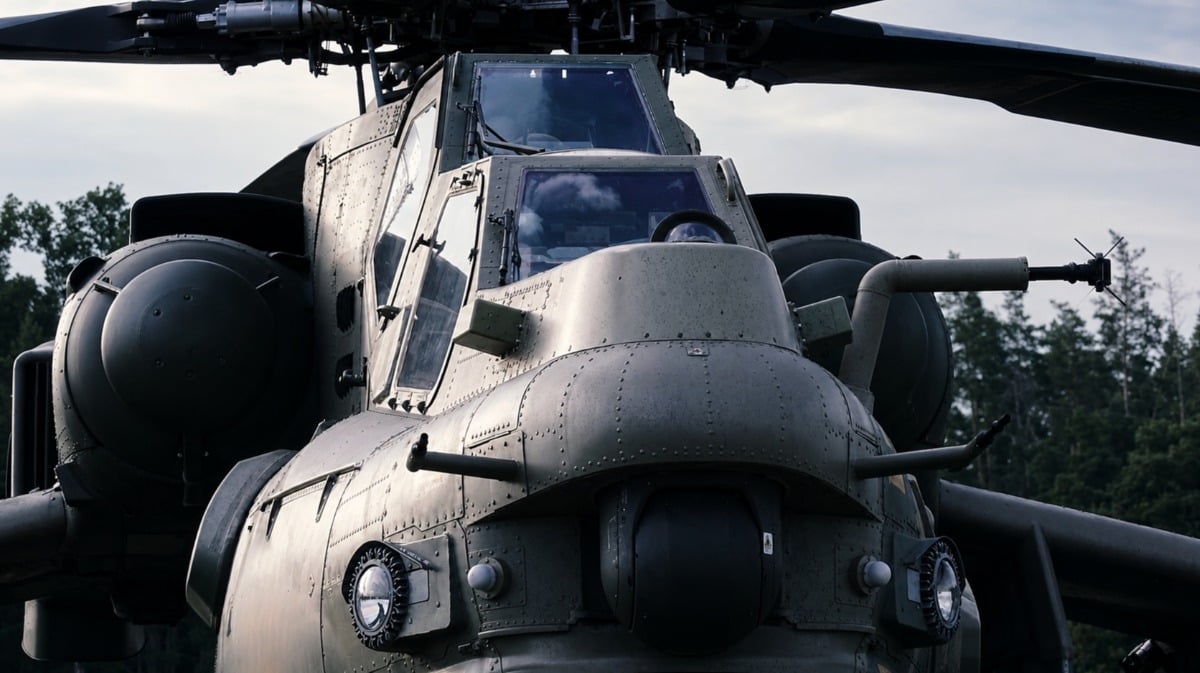
- Israeli defense analyst Guy Plopsky identified new antenna housings on the nose, stub-wing pods, and tail boom of Mi-28NM helicopters in Russian MoD video footage.
- Plopsky assessed the housings as presumably elements of an ECM system, likely jamming equipment for counter-drone use, while noting detection equipment cannot be ruled out.
Russia appears to have modified its most advanced attack helicopter with new electronic warfare equipment, and the changes visible in recently released Russian military footage suggest the Mi-28NM is being adapted to counter the drone threat that has fundamentally reshaped the battlefield over Ukraine.
Israeli defense analyst Guy Plopsky, who closely tracks Russian military aviation developments, identified the modifications after examining stills extracted from a new Russian Ministry of Defense video documenting Mi-28NM operations against Ukraine. The images show what appear to be new antenna housings installed in multiple locations across the airframe, a configuration that had not been previously documented on production Mi-28NM aircraft and that points toward a significant electronic warfare upgrade added to the platform during or after its operational deployment cycle.
The Mi-28NM, known in NATO reporting as the Havoc, is Russia’s most capable operational attack helicopter, a dedicated tank-killing and close air support platform that entered service as an upgraded variant of the baseline Mi-28N with improved avionics, a new radar system mounted above the rotor hub for over-the-tree-line targeting, and enhanced night-fighting capability. The helicopter carries a 30mm automatic cannon in an undernose turret, along with hardpoints for anti-tank guided missiles, unguided rockets, and air-to-air missiles on its stub wings, making it one of the most heavily armed rotary-wing platforms in the Russian inventory. Russia has deployed Mi-28NMs extensively in Ukraine, where they have been used for both direct fire support against Ukrainian ground positions and stand-off attacks using guided munitions launched from beyond the range of Ukrainian air defenses.
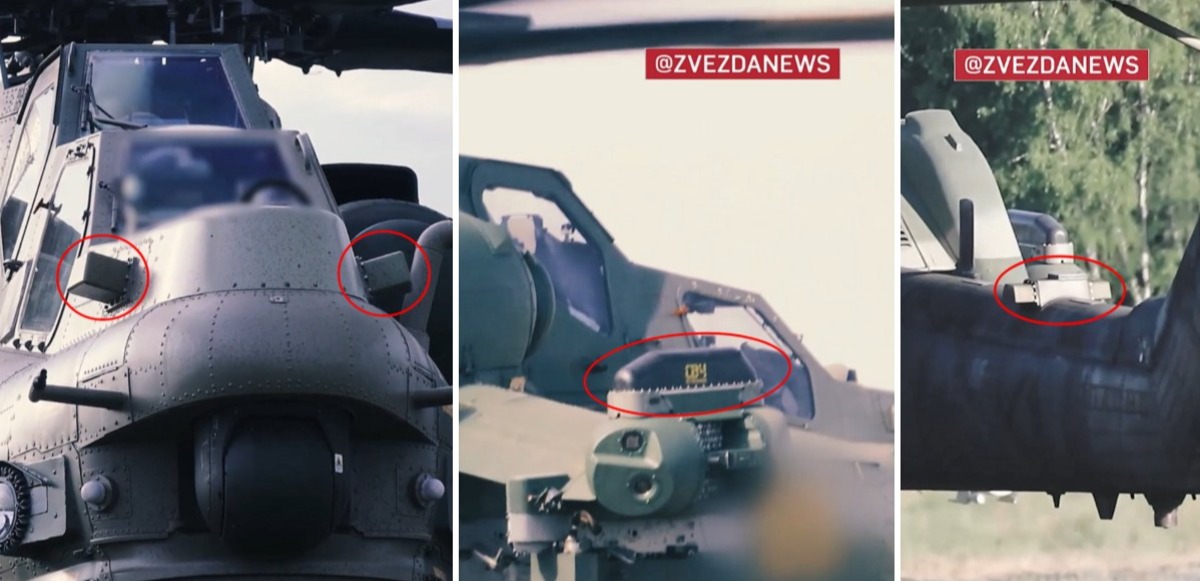
Plopsky described the specific locations of the new antenna housings in precise terms drawn from his analysis of the video stills.
“Several stills from a new Russian MoD video on Mi-28NM operations against Ukraine. Note what appear to be new antenna housings on the sides of the nose, atop the stub-wing pods and on the tail boom. Presumably elements of an ECM system (likely jamming equipment for C-UAS use).”
The distribution of the housings across three distinct locations on the airframe, the nose flanks, the tops of the stub-wing weapon pods, and the tail boom, is consistent with the installation of an electronic countermeasures system designed to provide wide-angle coverage around the helicopter rather than focused directional jamming in a single sector. An antenna array distributed across nose, wing, and tail positions would allow the system to detect and jam signals arriving from multiple directions simultaneously, which matters considerably for a helicopter operating in an environment where small drones can approach from any angle and at altitudes ranging from ground level to well above the aircraft’s flight path.
Plopsky added a careful qualification about the precise function of the new installations that is worth carrying through any reporting on the modification.
“Worth adding that it is not immediately clear whether any of these also/instead house drone detection equipment.”
A jamming system and a detection system serve related but different functions in the counter-drone mission. Jamming equipment disrupts the radio frequency or GPS signals that control a drone or guide it to its target, potentially causing it to crash, return to its operator, or fly erratically depending on how its control architecture responds to signal loss. Detection equipment, by contrast, uses radar, radio frequency scanning, acoustic sensors, or optical systems to identify and track incoming drones before they reach engagement range, providing the crew with warning time and targeting data. A system that combines both functions represents a more capable counter-drone suite than one that only jams or only detects, and the antenna housings Plopsky identified could plausibly serve either or both purposes depending on the electronic hardware installed behind them, which is not visible in the exterior imagery.
Ukrainian forces have deployed first-person view drones, loitering munitions, and adapted commercial quadcopters extensively against Russian armored vehicles, artillery positions, and helicopters throughout the conflict, and Russian military aviation has suffered documented losses to drone attacks over the course of the war. Attack helicopters are particularly vulnerable to drone threats because their operational profile, flying at low altitudes and relatively slow speeds in close proximity to front-line positions, puts them within range of the cheap, widely available drone systems that Ukrainian units operate in large numbers. A helicopter that can jam or detect incoming drones before they close to lethal range survives engagements that an unmodified aircraft might not, which gives the Russian military a strong operational incentive to accelerate the fielding of counter-drone electronic warfare equipment on its most valuable rotary-wing assets.
Russia has previously documented the installation of electronic warfare equipment on other platforms operating in Ukraine, including the addition of jamming systems to tanks and armored vehicles to defeat Ukrainian drone-delivered munitions, and the broader pattern of rapid field modification in response to battlefield experience is well established across the conflict. Whether the Mi-28NM modifications Plopsky identified represent a factory-installed upgrade being rolled out across the fleet or a field modification applied to specific aircraft remains unclear from the available imagery, and the precise capabilities of whatever electronic system the new housings contain will not be publicly known until either Russian technical documentation becomes available or the system’s effects are observed in operational footage from the front.
What the video stills confirm is that Russia is actively modifying its most capable attack helicopter in response to the drone-saturated environment over Ukraine, and that the modifications are visible enough to appear in official Russian Ministry of Defense promotional footage without apparent concern about revealing their existence.