

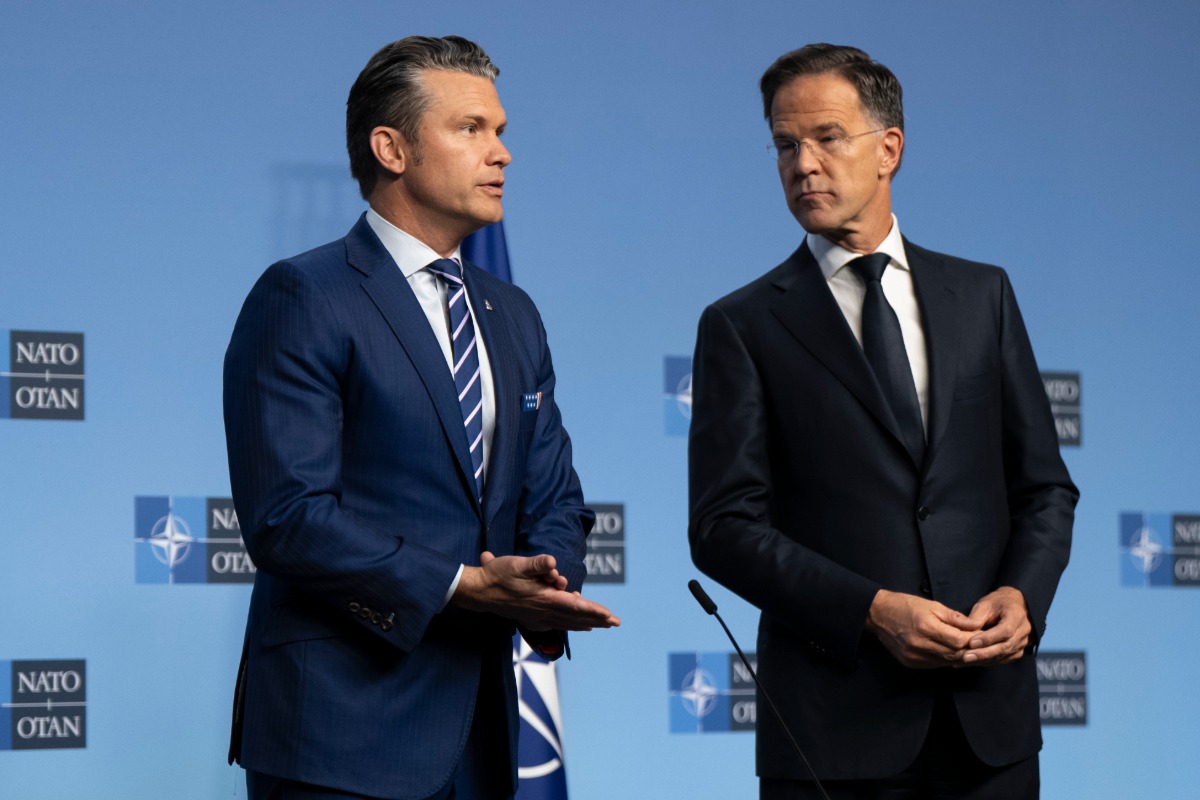
- Secretary of War Pete Hegseth spoke at NATO headquarters in Brussels on June 17, 2026, ahead of a Ukraine Defence Contact Group meeting.
- Hegseth said allied funding through the PURL initiative has let European nations lead financing for Ukraine's defense while Ukrainian forces hold their lines against Russian assaults.
Ukrainian troops are holding their ground against Russian assaults right now, and the top U.S. defense official just credited an unusual financial arrangement with keeping it that way. Speaking at NATO headquarters in Brussels on June 17, 2026, Secretary of War Pete Hegseth told allied defense ministers that Ukraine’s defenses are holding because European nations have started footing the bill for American weapons, a shift he framed as proof that President Trump’s approach to burden sharing is working.
Hegseth made the remarks ahead of a closed-door Ukraine Defence Contact Group meeting later that same day, where allies were expected to discuss further support for Kyiv.
The financial mechanism Hegseth credited goes by the clunky name Prioritized Ukraine Requirements List, known throughout NATO circles simply as PURL, and it works differently than most people assume American military aid to Ukraine works. Rather than the United States buying weapons and shipping them to Ukraine at American taxpayer expense, PURL lets European allies and Canada pay for American-made weapons and equipment that then get transferred to Ukraine’s military, with NATO coordinating delivery through its Security Assistance and Training for Ukraine command based in Wiesbaden, Germany. The arrangement emerged from an agreement Trump struck with NATO Secretary General Mark Rutte in July 2025, and it has scaled up significantly since, with allies and partners committing more than $4 billion in equipment through the program by December 2025, much of it going toward air defense systems and ammunition that Ukraine has identified as urgent operational priorities.
Hegseth singled out air defense specifically during his remarks, telling ministers that allies must do their fair share given the system’s effectiveness at providing protection “which only the United States can deliver.” That’s not an empty boast. American-made Patriot missile batteries remain the backbone of Ukraine’s defense against Russian ballistic missile attacks, and the technology to produce the interceptor missiles those systems fire exists almost exclusively within the U.S. defense industrial base, which is precisely why PURL routes funding through American suppliers even when the money itself comes from European treasuries. Hegseth framed the PURL initiative as having allowed allies to take the lead in funding Ukraine’s defense, and pointed to Ukraine’s continued battlefield resilience as validation that the approach works.
“Ukrainians are holding their lines even in the face of sustained Russian assaults,” Hegseth said. “We said it could be done that our allies could lead and that it would be consistent with Ukraine’s defense. It is happening. And it’s a validation of President Trump’s approach. An approach that will set the table for peace.”
That framing arrived alongside a sharper message aimed at the broader alliance, one that complicates any simple reading of Hegseth’s Ukraine comments as purely celebratory. The Secretary of War used much of his remarks to announce a six month Department of War review of American force posture and basing across Europe, a review he said would push NATO toward what he called a more balanced structure with European nations leading their own conventional defense rather than depending on Washington. Hegseth tied that broader restructuring directly to the Ukraine funding model, suggesting PURL represents the kind of allied burden sharing he wants to see replicated across NATO’s entire defense posture, not just its support for Kyiv. Whether European governments view PURL as a template they’re comfortable extending elsewhere, or as a Ukraine-specific arrangement born of wartime urgency, remains an open question that Hegseth’s remarks didn’t resolve.
There’s also a complication hovering over the PURL program that Hegseth’s Brussels remarks didn’t address directly. Reporting earlier this year indicated that the Department of War had considered redirecting some air defense interceptor missiles originally procured for Ukraine under PURL toward replenishing American stockpiles drawn down during the conflict with Iran, a prospect that alarmed Ukrainian officials worried about potential shortfalls. Ukraine’s Permanent Representative to NATO has said Kyiv received no direct confirmation that weapons earmarked for it would actually be diverted, but the episode underscored a structural vulnerability in a funding model that depends on American production capacity remaining available for Ukraine even as the United States juggles its own competing global commitments.
What Hegseth didn’t say in Brussels matters almost as much as what he did. He offered no new dollar commitment, no specific weapons package, and no details on what allies would actually agree to fund at the Ukraine Defence Contact Group meeting scheduled for later that day. The PURL mechanism he praised remains, by design, a month-to-month arrangement dependent on European governments continuing to write checks for American hardware, a system that has proven durable for nearly a year now but carries no guarantee of permanence. For Ukrainian soldiers holding positions against Russian assaults, that distinction between a funding mechanism that has worked so far and one that’s guaranteed to keep working is not an abstraction. It’s the difference between an air defense battery that has interceptors left to fire and one that doesn’t, and nothing said in a conference room in Brussels changes the fact that the answer to that question gets decided one monthly commitment at a time.