

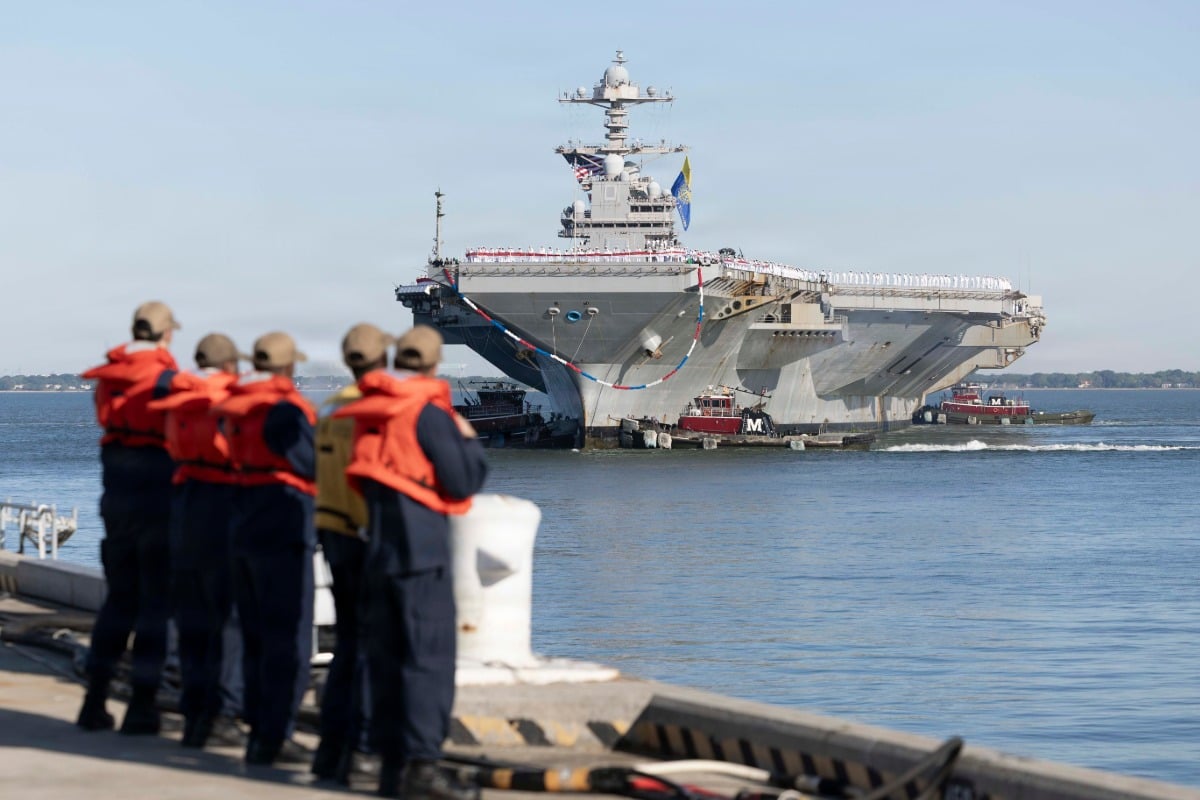
- General Dynamics NASSCO-Norfolk received a $17.6 million contract modification to perform emergent maintenance on the USS Gerald R. Ford in Norfolk, Virginia.
- Work on the carrier, which recently returned from a 326-day combat deployment against Iran, is expected to be completed by March 2027.
A ship that spent nearly a year in harm’s way, operating under persistent threat from Iranian missiles and one-way attack drones while the Ford Carrier Strike Group carried out or coordinated hundreds of strikes against Iranian targets, now needs fixing.
The U.S. Navy has awarded General Dynamics NASSCO-Norfolk a $17.6 million contract modification to perform emergent maintenance on the USS Gerald R. Ford, America’s most advanced aircraft carrier, with work expected to wrap up by March 2027.
The contract, a modification to an existing agreement awarded to Metro Machine Corp. doing business as General Dynamics NASSCO-Norfolk, covers what the Pentagon calls an “Emergent Maintenance Availability,” a term for unplanned or newly identified repair work that couldn’t be scheduled in advance. The Mid-Atlantic Regional Maintenance Center in Norfolk, Virginia, the Navy’s primary oversight body for East Coast warship upkeep, is managing the contract. All $17.6 million in fiscal 2026 operations and maintenance funds will be obligated immediately.
Displacing more than 100,000 tons and costing roughly $13 billion to build, the carrier recently returned home after 326 days at sea, one of the longest deployments for a U.S. aircraft carrier in decades. That deployment took the ship from the Atlantic to Northern Europe, then to the Caribbean, and finally into the caldron of the Iran conflict. On February 28, Israeli and American forces launched attacks on Iran, with the Ford participating in Operation Epic Fury alongside the USS Abraham Lincoln and, later, the USS George H.W. Bush.
What made the deployment extraordinary wasn’t just what the Ford’s crews did to Iran. It was what Iran tried to do to them. The Ford Carrier Strike Group received the Presidential Unit Citation, described by the Associated Press as the highest award a unit can receive, in part because the group operated under “persistent threat from enemy missiles and one-way attack drones” throughout the campaign. One-way attack drones are unmanned aircraft loaded with explosives and flown directly into targets with no pilot and no intention of returning, essentially a guided missile built cheaply and deployed in large numbers. One sailor who spoke to CNN described the experience of standing watch in the Red Sea and seeing an orange streak arc across the sky as Iranian munitions appeared on the horizon. When those missiles or drones closed within lethal range, the ship would sound an alert warning the crew to brace for impact and prepare for damage control.
Defense Secretary Pete Hegseth, speaking to the crew after the ship returned to Norfolk, noted that the destroyers in the strike group fired Tomahawk cruise missiles, land-attack weapons with a range of roughly 1,600 km (994 miles), deep into Iran while simultaneously providing air defense, shooting down the incoming drones and missiles the crew had trained to survive. Presenting the Presidential Unit Citation, Hegseth told the assembled sailors: “We do not hand this award out simply for performing your duties.”
Rear Adm. Gavin Duff, commander of Carrier Strike Group 12, told the crowd gathered at the pier that 80 sailors held newborn children for the first time that morning. By the numbers, the crew conducted 23 replenishments-at-sea and covered over 57,713 nautical miles (67,213 miles or 108,185 km). Carrier Air Wing 8, the aviation element embarked on the Ford, logged more than 5,760 flight hours and 12,200 flight launches.
The maintenance contract awarded to General Dynamics NASSCO-Norfolk fits naturally into a long-standing relationship between the shipyard and the Navy’s carrier fleet. NASSCO-Norfolk is the consolidation of two Port of Hampton Roads shipyards, the former Earl Industries and the former Metro Machine Corp., which was founded in 1963 and won its first Master Ship Repair Agreement with the Navy in 1966. The firm has worked on more than 450 ships and holds a dedicated contract for non-nuclear maintenance on East Coast carriers, covering both planned and emergent repair work of exactly this kind. Aircraft carriers are nuclear-powered, but the vast majority of their systems, from weapons elevators and catapults to damage-control equipment and hull plating, are conventional and require the same repair work as any large warship.
The specifics of what work will actually be performed under this contract modification have not been publicly disclosed, which is standard for emergent availability contracts where the scope is determined by the ship’s actual condition after deployment. Given the Ford’s operational history, the range of possibilities is wide. Ships that operate under sustained combat conditions, including the stress of repeated high-tempo flight operations, prolonged high-speed maneuvering, and the shock and vibration effects of nearby weapons fire and detonations, accumulate wear that goes beyond what routine maintenance schedules anticipate.
At 326 days, Ford’s deployment was the longest U.S. carrier deployment in the past 50 years; the Associated Press cited USS Midway’s 332-day 1973 deployment and USS Coral Sea’s 329-day 1965 deployment as the only longer historical examples on record. That context makes the emergent maintenance award less a bureaucratic footnote and more a direct consequence of wartime service. The Ford fought its way through an 11-month deployment, held the line against a barrage of enemy fire, and is now sitting in Norfolk waiting for the hands that will prepare it to do it all again.