

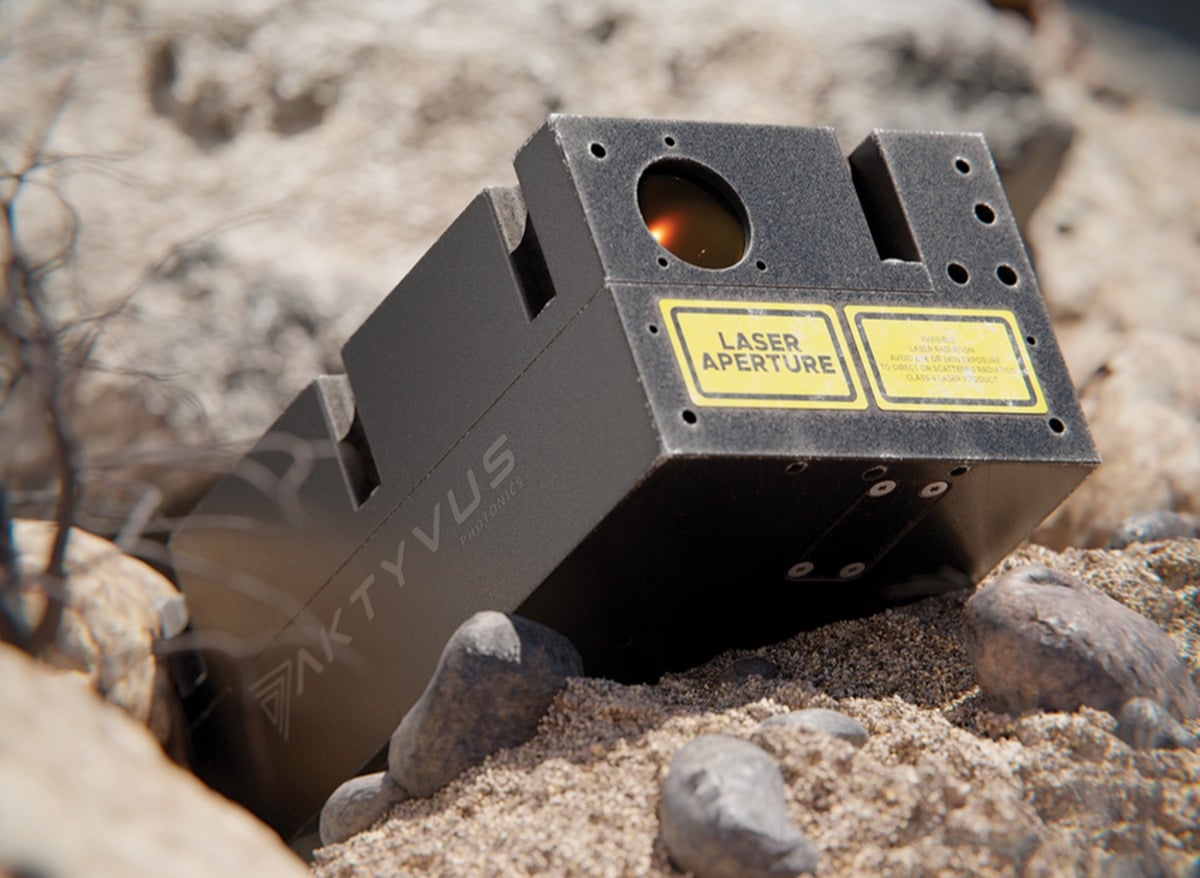
- Aktyvus Photonics is tripling production of its BAUDĖJAS and STRIKER MINI laser designation modules in 2026, targeting over 600 units annually by 2027, funded by reinvested 2025 profits.
- The Lithuanian company's 200-gram, ITAR-free laser modules measure 85x50x35mm and are designed for micro-UAV integration and handheld soldier designator applications.
A Lithuanian startup has built a laser targeting system small enough to fit in a palm and light enough to mount on the kind of small drones that have become the defining weapons platform of the war in Ukraine, and it is tripling production this year funded entirely from last year’s profits.
Aktyvus Photonics, based in Lithuania, announced it is on track to deliver more than 600 laser target designation systems annually by 2027, up from a base that only turned profitable in the defense segment in 2025. The company’s two OEM laser modules, the BAUDĖJAS, compliant with STANAG 3733 Class D1, and the smaller STRIKER MINI, a Class D2 system, measure just 85 by 50 by 35 millimeters (3.3 by 2 by 1.4 inches) and weigh approximately 200 grams (7 oz). Both are ITAR-free, meaning they can be exported and integrated by European and allied defense companies without the licensing restrictions that apply to American-origin technology under the U.S. International Traffic in Arms Regulations. All revenue is currently driven by export markets, with domestic Lithuanian state contracts also dedicated to supporting Ukraine.
To understand why 200 grams matters, it helps to understand the problem these systems solve and why existing solutions have not solved it. A laser target designator is the device that paints a target with an invisible infrared laser spot, allowing a laser-guided bomb or missile to home onto the reflected energy and strike with precision. Without a designator, a precision-guided munition is just an expensive unguided one. The standard military-grade designation payloads used by major Western defense programs have historically weighed between 20 and 50 kilograms (44 to 110 lb), sized for integration onto large combat aircraft or specialized ground vehicles that can carry that mass and power the systems. Those legacy constraints made precision targeting a capability of large, expensive, specialized platforms rather than something a frontline infantry unit could deploy from a small drone.
Ukraine’s war has made the small drone the central tool of tactical combat, used by both sides for reconnaissance, artillery spotting, and direct attack. The platforms carrying these missions are typically commercial quadcopters or small fixed-wing drones weighing between 1 and 5 kilograms total, with payload capacities measured in hundreds of grams rather than kilograms. The same air defenses and electronic warfare systems that make large, multi-million-euro aircraft extremely vulnerable in contested Ukrainian airspace are far less effective against small, fast, low-observable drones that attack in large numbers from unpredictable vectors. That tactical shift has made compact, lightweight laser designation capability a front-line requirement rather than a niche specialization.
The BAUDĖJAS module serves double duty as both the airborne designation system for micro-UAVs and the core of the company’s handheld soldier designator, meaning the same laser technology powers both the drone-mounted version and a dismounted unit that a soldier carries. That single-module approach reduces manufacturing complexity and supply chain requirements while giving customers a common spare parts ecosystem for two platform types. STRIKER MINI addresses applications where even the BAUDĖJAS’s footprint is too large, pushing the physical envelope further toward the smallest viable designation system.
Lithuania’s emergence as a supplier for this capability is not accidental. The country sits on NATO’s eastern flank, shares a land border with the Kaliningrad exclave of Russia, and has one of the highest defense spending levels relative to GDP in the alliance, committing a record budget of approximately $5.9 billion, equivalent to 5.36 percent of GDP, to national defense. That security environment creates both the motivation and the political conditions to develop domestic defense industrial capability at speed. Lithuania has a commercial laser and photonics sector that predates the current defense investment surge, giving companies like Aktyvus Photonics an engineering talent base and supply chain that would be difficult to build from scratch in a country without that legacy.
The ITAR-free status of the Aktyvus Photonics modules deserves attention for what it means to European defense integrators. When a European drone manufacturer or systems integrator wants to incorporate an American-origin laser targeting component, it must navigate U.S. export control licensing, which adds administrative overhead, restricts which end customers can receive the system, and creates dependency on U.S. government approval for export decisions. A European-origin component with equivalent performance and no ITAR encumbrance gives integrators supply chain freedom that reduces both regulatory complexity and geopolitical risk. The EU’s European Defence Industrial Strategy has set formal targets requiring member states to source 50 percent of defense expenditure from the European Defence Technological and Industrial Base by 2030, rising to 60 percent by 2035. Aktyvus Photonics is building directly toward that procurement shift.
“Europe is reaching a point where defence readiness can no longer depend solely on budgets or political commitments,” said Laurynas Šatas, CEO of Aktyvus Photonics. “It also depends on whether we can build critical technologies here, in Europe, and scale them quickly enough. Our goal is not short-term profit-taking; we are reinvesting because precision targeting reduces the number of weapons required to achieve a mission, limits collateral damage, and directly saves lives. That is why production scale matters.”