

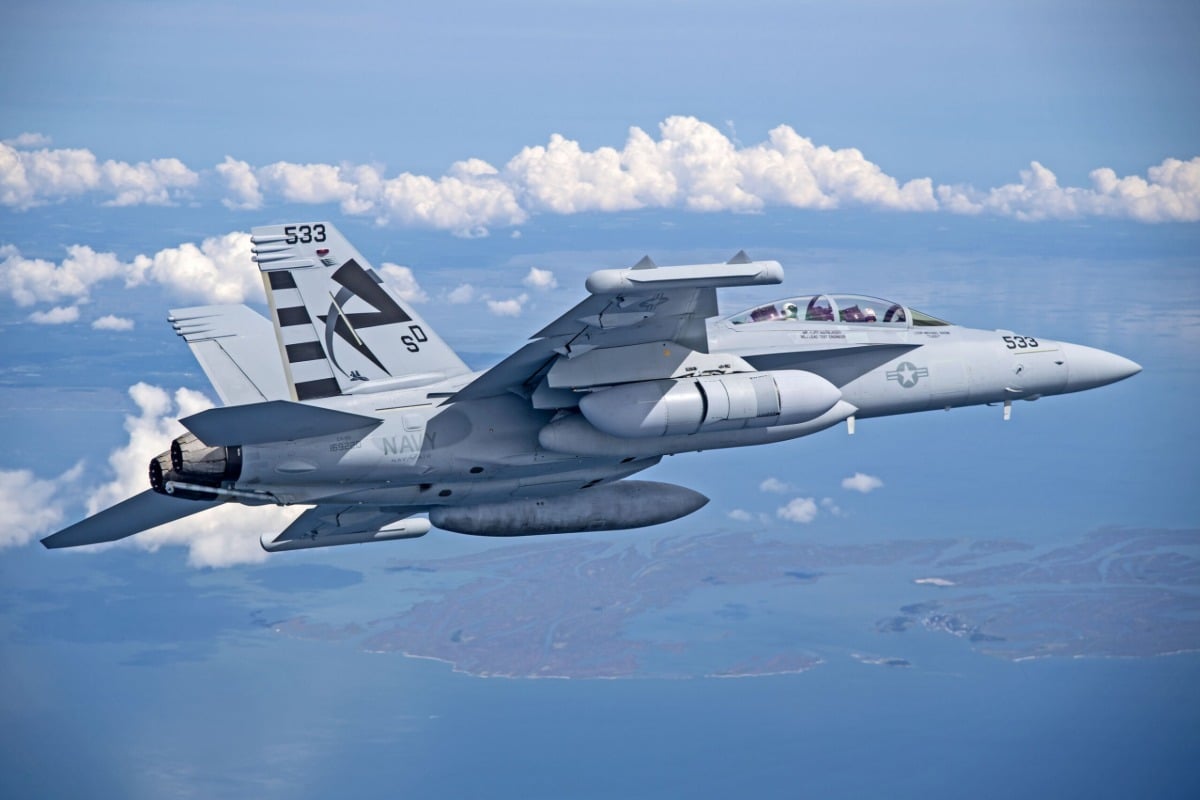
- The Naval Air Warfare Center Weapons Division published a sole-source notice on June 9, 2026, to extend Raytheon's ALQ-249 Next Generation Jammer engineering contract for the EA-18G Growler.
- The contract covers full lifecycle engineering, software development, jammer tactics, fleet support and training; responses are due June 24, 2026, with a Top Secret clearance required.
The U.S. Navy is moving to extend and expand its contract with Raytheon for engineering support on the ALQ-249 Next Generation Jammer, the electronic attack system being developed for the EA-18G Growler, the carrier-based aircraft the Navy relies on to blind and disrupt enemy radar and communications before and during strike operations.
The Naval Air Warfare Center Weapons Division, the Navy’s primary weapons development laboratory located at Point Mugu, California, published a sources sought notice on June 9, announcing its intent to award a contract modification to Raytheon, extending the ordering period and increasing the hours and funding available under an existing engineering services contract for the full life cycle of the ALQ-249 Next Generation Jammer Mid-Band and advanced electronic warfare subsystems.
The notice, which invites competing firms to submit capability statements by June 24 if they believe they can perform the work, makes clear that the Navy expects Raytheon to remain the sole provider, citing the company’s status as the system’s original equipment manufacturer and the complexity of the hardware and software interoperability that the contract demands.
To understand why the Navy is so invested in this particular program, it helps to understand what the EA-18G Growler actually does and why no strike package flies without it. The Growler is a two-seat variant of the F/A-18F Super Hornet, modified to carry electronic warfare systems instead of strike weapons, and its mission is to suppress and destroy enemy air defenses by jamming the radar and communications systems that guide surface-to-air missiles and fighter aircraft. Every major U.S. Navy carrier strike operation since the Growler entered service in 2009 has included these aircraft, because without effective jamming, the aircraft dropping bombs and firing missiles are exposed to the full lethality of modern integrated air defense systems. The Growler does not go in alone: it flies alongside strikers and saturates the electromagnetic spectrum with jamming energy, blinding enemy sensors and buying the strike package the time and freedom it needs to hit its targets and get out.
The AN/ALQ-249 Next Generation Jammer Mid-Band is the system that will replace the aging ALQ-99 jammer that Growlers have carried for decades. The ALQ-99 entered service in the 1970s and has been upgraded repeatedly, but it was designed for a different electromagnetic environment than the one U.S. forces operate in today. Modern adversary air defense systems, particularly those developed by China and Russia, operate across frequency ranges and with signal processing techniques that the ALQ-99 was never designed to counter. The NGJ-MB focuses specifically on the middle frequency bands of the electromagnetic spectrum, the range where many of the most capable modern radar and communications systems operate, using modern digital signal processing and high-power amplifier technology to generate jamming that can defeat adversary systems the ALQ-99 cannot touch. The program is one of three planned NGJ variants covering different frequency bands, with Mid-Band being the first to reach advanced development.
The Navy’s decision to pursue a sole-source extension rather than opening the contract to competition rests on a straightforward technical argument. The ALQ-249 is a deeply complex system with hardware and software that interact in ways only Raytheon, as the designer and builder, fully understands. The notice states that failure to secure these services from the original manufacturer would result in unacceptable delay, directly impacting mission readiness for fleet squadrons and jeopardizing cooperative U.S. and Australian defense projects. That last phrase is significant: Australia operates EA-18G Growlers as part of its own electronic attack capability, making the NGJ-MB program a bilateral effort with implications beyond the U.S. Navy’s own fleet. Any delay that disrupts the development timeline affects Australian capability development as well, adding an alliance dimension to the urgency the Navy is expressing.
The scope of the work Raytheon will continue to perform covers the full engineering lifecycle of the system: program management, systems engineering, software development, testing and evaluation, on-call field engineering, jammer techniques and tactics development, training, fleet support, and laboratory maintenance. The techniques and tactics development element is particularly specialized. Electronic warfare effectiveness depends not just on the hardware’s technical capability but on how operators program and employ that capability against specific threats. Developing the jamming techniques that make the ALQ-249 effective against a particular radar system requires deep knowledge of both the jammer’s capabilities and the target’s vulnerabilities, knowledge that only the system’s developer and the Navy’s own specialists possess in combination. That specialized knowledge base is part of what the Navy is describing when it says competition is not feasible.
Electronic warfare superiority has historically been one area where the United States maintained a significant advantage over potential adversaries, and the NGJ-MB program is the Navy’s primary investment in preserving that advantage into the next generation of carrier aviation. If the Growler is the most important aircraft in a carrier air wing that no one talks about, the Next Generation Jammer is the system inside it that makes everything else possible.