

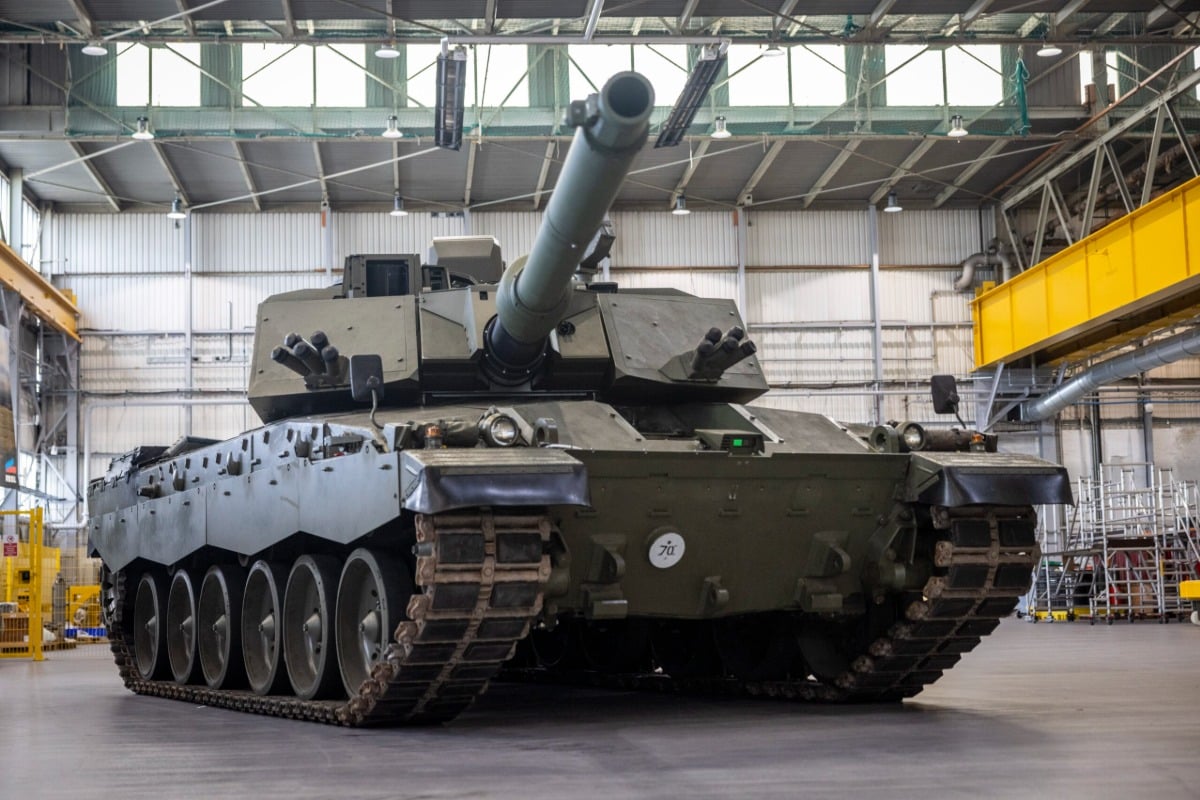
- RBSL confirmed Challenger 3 trial tanks have completed Battlefield Mission serials covering cross-country driving, road work, gunnery, and full crew drills.
- The 148-tank program targets initial operating capability in 2027, with series production to begin only after demonstration phase trials validate performance, per UK MOD.
Britain’s next-generation main battle tank has completed another round of Battlefield Mission serials, putting Challenger 3 trial vehicles through cross-country driving, road work, gunnery drills, and full crew exercises in conditions designed to mirror real operational use, UK Defence Journal reported.
The results are feeding directly into the engineering baseline as the program builds toward its formal trial phases, which are expected to lead to a System Qualification Review that will set the final manufacturing standard for the remaining tanks.
Challenger 3 is not a new design built from scratch; it is an extensive modernisation of the Challenger 2, the main battle tank that has served the British Army since 1998 and built its reputation for exceptional crew protection during combat operations in Iraq in 2003, where it became the only tank in the conflict never to lose a crewmember to enemy fire.
The upgrade, contracted at approximately £800 million, or roughly $1 billion, is being delivered by RBSL, a joint venture between Germany’s Rheinmetall and Britain’s BAE Systems, established in 2019 specifically to handle the United Kingdom’s land vehicle programs. As The Defence Blog reported in December 2025, the UK Ministry of Defence confirmed that series production will not begin on a fixed timetable but will proceed only after demonstration phase trials successfully validate the platform’s performance, a cautious and deliberate approach that reflects the program’s complexity and the Army’s intent to get the design right before committing to full conversion.
The most significant physical change the Challenger 3 brings is its new turret and main armament. The Challenger 2 was the last NATO tank to fire a rifled gun, the L30, a weapon that used a unique propellant charge system incompatible with the standardized ammunition the rest of the alliance uses. Challenger 3 replaces the L30 with a NATO-standard 120 mm (4.7 in) L55A1 smoothbore gun, bringing the British fleet onto the same ammunition standard as most NATO allies and clearing the way for the latest generation of tank rounds. That shift matters operationally because it means British tanks operating alongside allied armor can share ammunition in the field, eliminating a logistical vulnerability that had existed for decades and opening access to the newest anti-armor rounds entering NATO stockpiles.
Beyond the gun, the upgrade brings new thermal imaging optics, a modern digital fire-control system capable of tracking and engaging moving targets far more effectively than the Challenger 2’s older equipment, modular appliqué armor that can be reconfigured depending on the threat environment, and the Trophy active protection system developed by Israel’s Rafael Advanced Defense Systems. Trophy is a hard-kill system, meaning it physically destroys incoming anti-tank missiles and rocket-propelled grenades before they reach the vehicle, using a radar that detects incoming threats and a shotgun-like countermeasure launcher that fires a spread of projectiles to intercept them. The system has been operationally proven on Israeli Merkava tanks in combat, where it has recorded successful intercepts of anti-tank guided missiles in actual engagements, and its inclusion on Challenger 3 gives British Army crews a layer of active protection that the Challenger 2 entirely lacked.
The Battlefield Mission serials described in the UK Defence Journal report cover the full spectrum of what a tank crew must do: drive across open country and roads, operate the gunnery equipment, and work through the procedural drills the Army will require of finished vehicles. RBSL’s verification lead, identified in the report only as Nick, said the activity is “generating exactly the kind of learning” the team wants at this stage, with every serial helping sharpen processes and build confidence as the program heads toward its formal trials phase. That framing reflects how experienced defense engineers approach complex vehicle development: using pre-formal-trial activity to surface problems and refine procedures while the cost of fixing them is still relatively low, rather than discovering issues during the high-stakes formal evaluation phase that gates production entry.
Initial operating capability is targeted for 2027, with full operating capability planned later in the decade. The MOD has explicitly decoupled the production start from a fixed date and tied it instead to trial outcomes. Eight Challenger 2 hulls are currently allocated for design and testing, with series conversion not yet started. The path from current trial activity to production runs through the System Qualification Review, which will establish the final manufacturing standard before the bulk of the conversions begin.
The Challenger 3 program sits within a broader context of British Army armored vehicle modernization that also includes the Ajax reconnaissance vehicle and the Boxer protected mobility platform. The UK’s 2025 Strategic Defence Review reaffirmed the Army’s commitment to keeping armored firepower at the core of its land force structure, a statement that carried additional weight given ongoing debates about how much the British Army should invest in heavy armor versus lighter, more deployable formations. The Challenger 3’s development timeline means it will reach operational units well after the lessons of Ukraine’s armored warfare have been absorbed by NATO planners, and the program’s inclusion of Trophy active protection directly addresses one of the most consistent lessons from that conflict: that modern anti-tank guided missiles pose an existential threat to tanks that lack hard-kill countermeasures.