

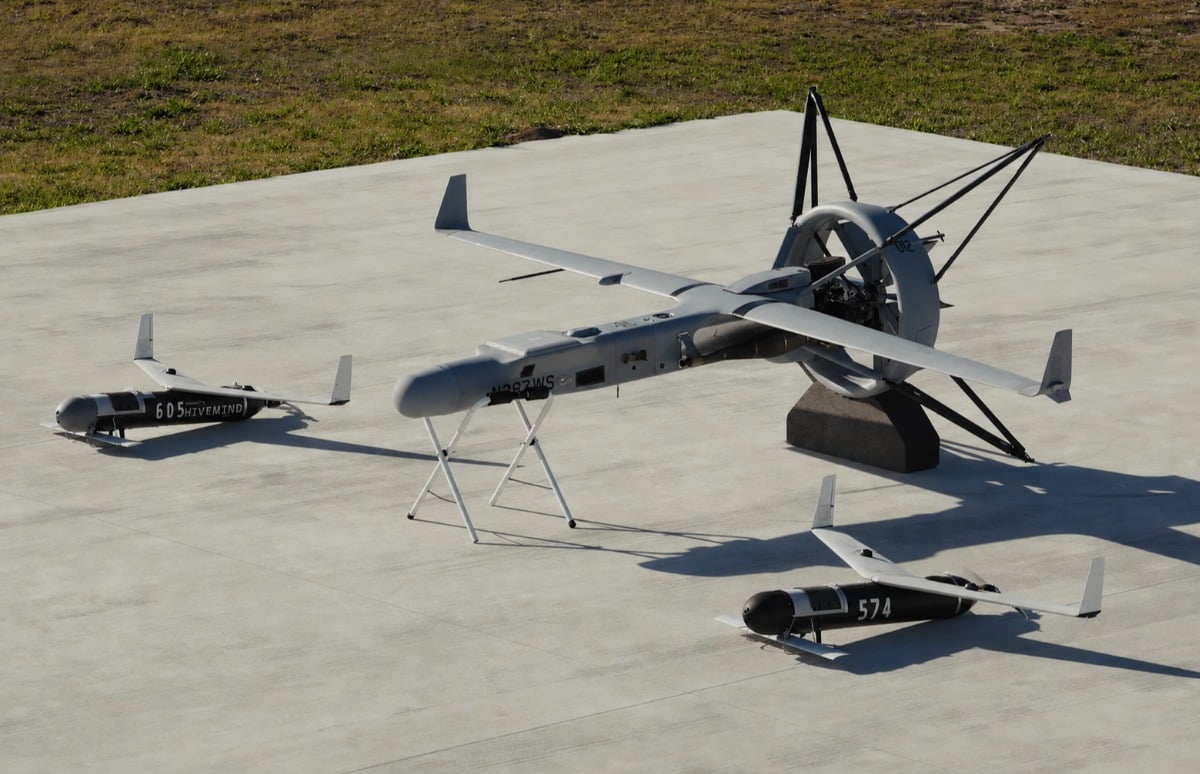
- Shield AI's Hivemind AI completed its first autonomous multi-platform teaming flight in Oklahoma, coordinating V-BAT and multiple Destinus Hornet drones without direct human control of each aircraft.
- V-BAT operated as an airborne mesh relay while Hivemind managed formation flight and adapted to dynamic in-flight mission updates across all platforms in real time.
Shield AI, the San Diego-based defense technology company that has been building autonomous flight systems for military applications since 2015, announced that its Hivemind AI completed its first autonomous multi-platform teaming flight in Oklahoma, combining its V-BAT unmanned aircraft with multiple Hornet drones from Destinus Defence in a demonstration that points directly at how military drone operations are likely to evolve as autonomy technology matures.
Shield AI’s Hivemind is the central technology at the heart of everything the company builds, a pilot AI designed to fly aircraft in GPS-denied, communications-jammed, and otherwise contested environments where a human operator cannot maintain reliable contact with the vehicle. Rather than relying on a remote pilot to command each movement, Hivemind makes onboard decisions in real time, responding to sensor data, mission parameters, and the behavior of other aircraft in the same operation. The multi-platform teaming flight extends that core capability beyond a single aircraft for the first time in this configuration, with Hivemind simultaneously coordinating multiple platforms of different types rather than managing one aircraft in isolation.
The two platforms involved in the test represent meaningfully different design philosophies. The V-BAT, originally developed by Martin UAV and now part of Shield AI’s portfolio, is a vertical takeoff and landing tube-launched drone that fits inside a cylinder roughly the size of a large military container and launches and recovers vertically without a runway or catapult. It has been used by the U.S. Navy and Marine Corps for shipboard and expeditionary reconnaissance, valued for its ability to operate from confined spaces and maintain persistent surveillance over a target area for extended periods. In this test, the V-BAT played a specific and operationally significant role: rather than acting as a reconnaissance asset, it served as an airborne relay node within a resilient mesh communications network connecting the ground control station and the Hornet aircraft, a distributed architecture that maintains connectivity even when individual communication links degrade under jamming or range constraints.
The Hornet systems provided by Destinus Defence, the defense-focused division of the Swiss-Spanish aerospace company Destinus, represent a different form factor optimized for speed and strike capability rather than the persistent loiter profile of the V-BAT. Destinus has been developing high-speed unmanned systems intended for contested environments where slower platforms face elevated survivability risk, and the Hornet’s participation in the teaming demonstration adds a strike-capable element to what would otherwise be a pure reconnaissance and relay architecture. The combination of a mesh-networked communications relay, multiple maneuvering autonomous aircraft, and a single AI coordinating all of them across a shared operational picture is precisely the configuration that military planners have been describing as the future of unmanned systems operations, and the Oklahoma test represents a confirmed step in that direction rather than a theoretical capability.
Mission plans were uploaded to the autonomous team before launch, establishing the baseline objectives for each platform, and Hivemind then received dynamic in-flight updates that required adapting flight paths and recoordinating the entire formation as conditions changed during the test. That two-layer approach, pre-programmed mission intent combined with real-time adaptability, represents the operational model that makes autonomous swarms genuinely useful in unpredictable environments. A drone that can only execute a fixed pre-launch plan is a scheduling tool. A drone that can receive updated objectives mid-flight and redistribute tasks across a multi-aircraft team without human intervention is a tactical asset of a different category entirely.
The communications relay role that V-BAT performed within the mesh network addresses a constraint that becomes increasingly severe as autonomous drone swarms operate at greater range or in environments where enemy electronic warfare degrades direct communication links. When a Hornet drone at extended range cannot reliably receive commands from the ground, it either falls back on pre-programmed mission profiles, returns home, or loses the ability to respond to updated mission information. Positioning V-BAT at altitude as a mesh relay node maintains that link even when the direct path is blocked or jammed, allowing Hivemind to push real-time mission updates to the Hornets throughout the flight and expanding the operational reach of the entire system beyond what any single platform could achieve independently.
The specific emphasis on heterogeneous platforms, aircraft with different communication architectures operating as a single autonomous unit as Shield AI described them, is significant beyond the technical detail it implies. Military unmanned systems procurement has produced a fragmented landscape where different services operate different platforms from different manufacturers with different data links and different software stacks. Building a coordination layer that can manage aircraft despite those differences, rather than requiring all platforms in a swarm to use identical communication systems, dramatically expands the practical utility of autonomous teaming beyond controlled laboratory conditions and into the mixed-inventory reality of actual military operations.
What Shield AI and Destinus demonstrated in Oklahoma is a single AI commanding drones it did not originally fly, maintaining coordination across a formation through a resilient mesh network, adapting that formation to new information in real time, and doing all of it without a human hand on any individual aircraft. When that capability becomes a standard operational reality, the ratio of human operators to autonomous aircraft changes permanently, and so does the nature of every contested airspace those aircraft enter.