

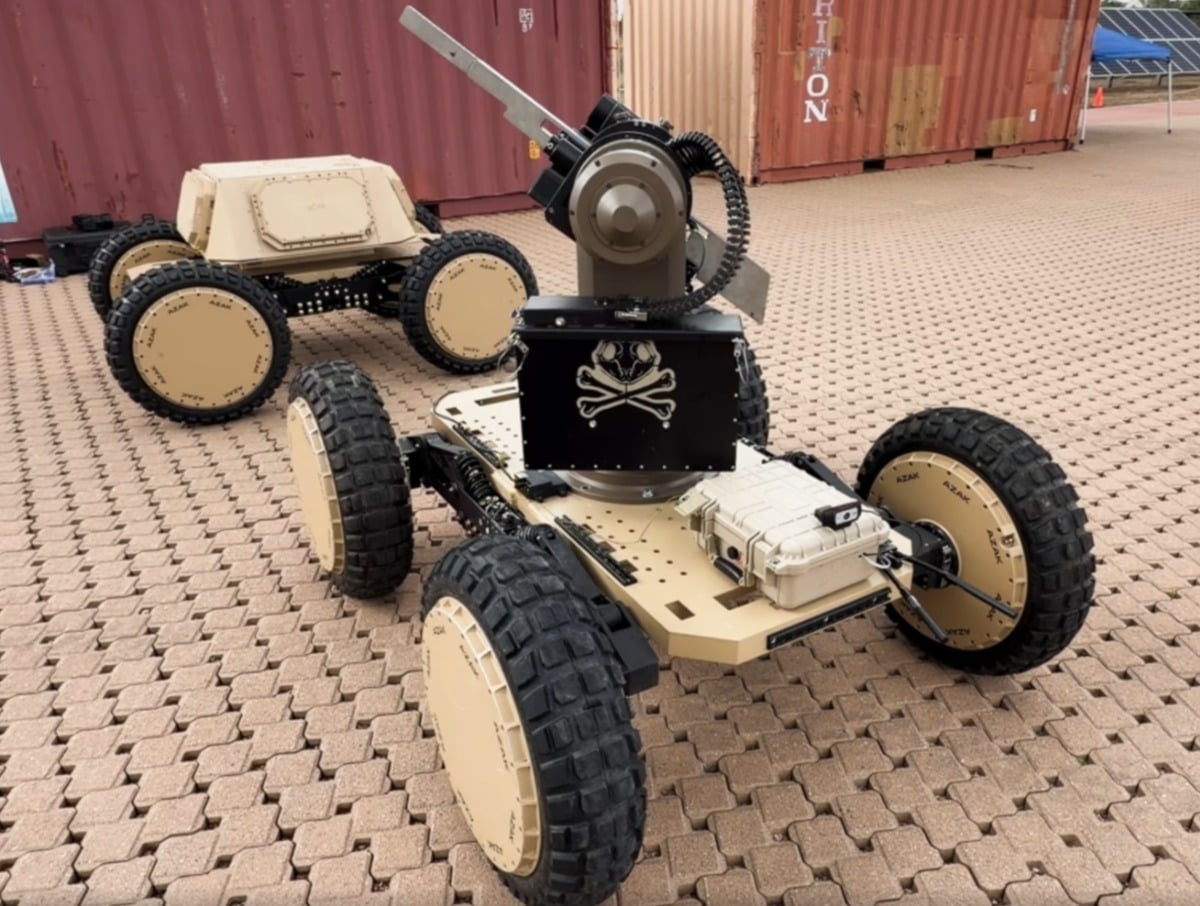
- Six companies integrated a two-vehicle autonomous counter-drone Hunter-Killer UGV system at Operation Jailbreak and demonstrated it to the Secretary of the Army in under a week.
- AZAK provided both UGV platforms, with HavocAI autonomy software, Leonardo DRS ACHR radar, Allen Control Systems Bullfrog weapon, Picogrid integration, and Anduril Lattice command and control.
Six defense technology companies walked into a demonstration event with separate products and walked out days later with a fully integrated autonomous hunter-killer ground vehicle system, presenting it directly to the Secretary of the Army in what participants described as proof that the American defense industry can move at a speed the Pentagon’s traditional procurement culture rarely achieves.
The demonstration, conducted under the name Operation Jailbreak, compressed what would normally be months of integration work into a matter of days and produced a functioning two-vehicle unmanned system capable of detecting aerial threats and engaging them without a human operator in the targeting loop.
The event was hosted by Dr. Alex Miller, the Chief Technology Officer of the Army, and Colonel Daiyaan, with AZAK Inc., a robotics company focused on unmanned ground vehicle platforms, anchoring the hardware side of the collaboration. The six-company team assembled for Operation Jailbreak divided the problem into distinct capability layers and then integrated them into a single coherent system architecture, with each company contributing the component it knew best rather than attempting to build the entire capability stack from scratch.
AZAK provided both unmanned ground vehicle platforms that served as the physical foundation of the system. The two vehicles, designated “The Hunter” and “The Killer” by the team, represent AZAK’s wheel-centric unmanned ground vehicle design, a platform architecture built around large-diameter wheels that provide mobility across difficult terrain while maintaining a compact overall footprint and a modular payload interface that allows operators to reconfigure the vehicle for different mission requirements without extensive mechanical modification. HavocAI, a company specializing in autonomous driving software for defense applications, provided the autonomy stack that allowed both vehicles to navigate and operate without a human driver in direct control. Leonardo DRS, the American subsidiary of the Italian-British defense electronics group Leonardo and one of the most established names in military sensor integration, fitted the first vehicle with its ACHR radar system, turning it into the detection and tracking node of the pair, hence “The Hunter.”
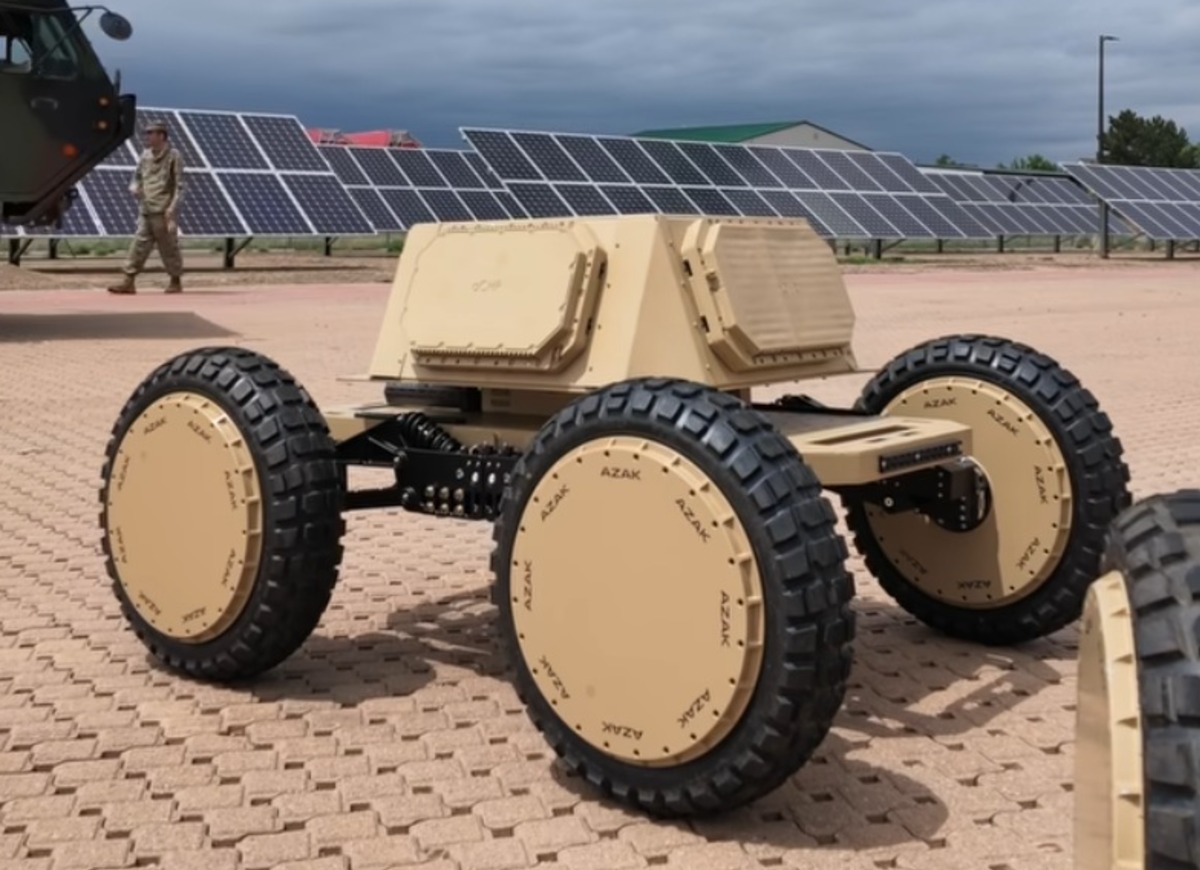
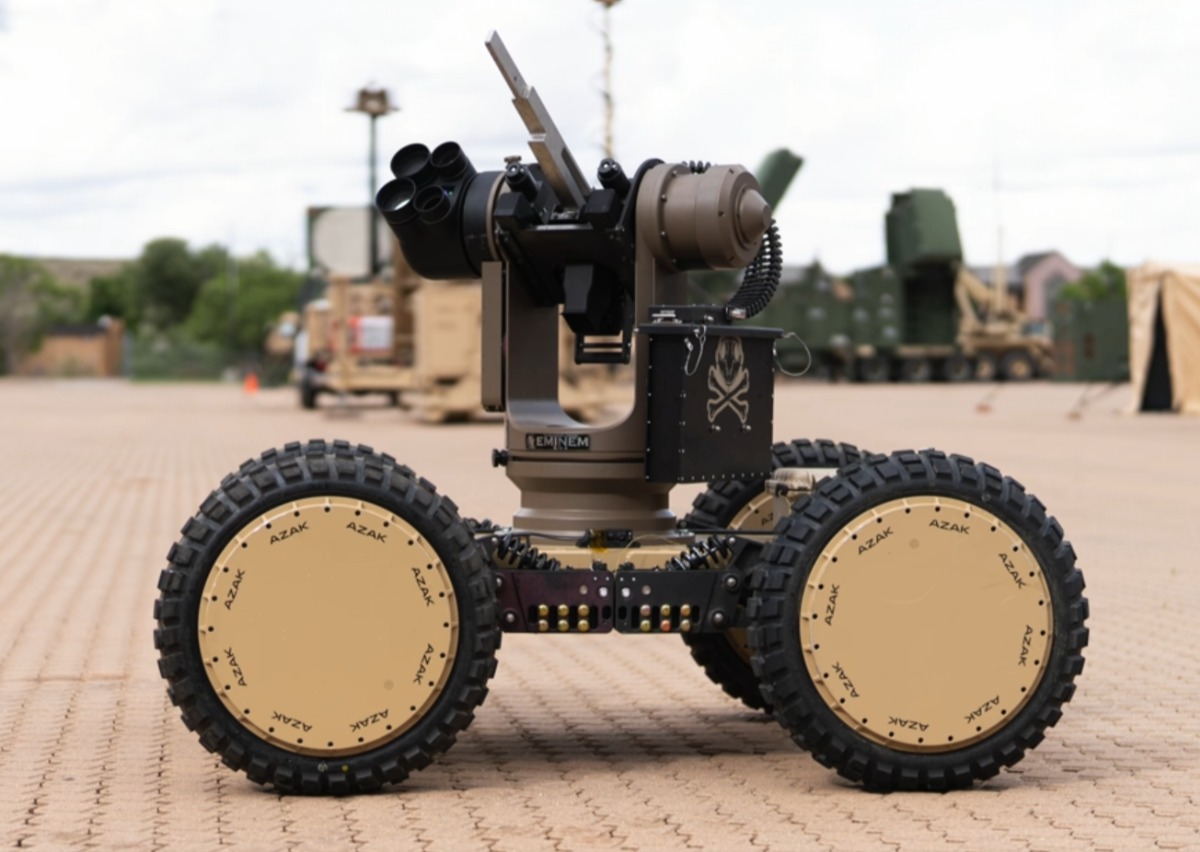
Allen Control Systems, known for its Bullfrog counter-drone weapon system, deployed the Bullfrog onto the second vehicle, giving it the ability to physically engage and destroy aerial threats, making it “The Killer.” Picogrid provided the integration architecture that unified the data flows between the two vehicles and their onboard systems into a single coherent operational picture, and Anduril Industries, the defense technology company founded by Palmer Luckey and known for its Lattice AI-powered command and control software, tasked the entire ecosystem through Lattice, the platform Anduril has positioned as a universal command layer for multi-domain autonomous systems.
The resulting Hunter-Killer system is what defense planners call a kill chain compressed into a ground-mobile package: one vehicle finds the threat, tracks it, and passes targeting data; the other receives that data and engages. The Bullfrog system that Allen Control Systems contributed to The Killer is a gun-based counter-drone platform that uses a high-rate-of-fire weapon to intercept unmanned aerial vehicles at close range, a class of capability the Army has been urgently seeking as small commercial drones have proliferated across virtually every combat environment where American forces might operate. Placing Bullfrog on an autonomous ground vehicle that can be repositioned rapidly, directed to a threat location without requiring a human driver, and cued automatically by a partnered radar vehicle eliminates several of the response-time constraints that limit the effectiveness of static or manually operated counter-drone systems.
The Lattice integration layer that Anduril provided is worth understanding in the context of what Operation Jailbreak demonstrated. Lattice is designed to receive data from diverse sensor systems, regardless of manufacturer or original design intent, and translate it into actionable targeting information that can be sent to diverse effector systems with equal manufacturer diversity. Using Lattice to tie together radar from Leonardo DRS, autonomy software from HavocAI, a counter-drone weapon from Allen Control Systems, vehicles from AZAK, and integration architecture from Picogrid means none of those components needed to be designed for each other in advance. The integration happened at the software layer, not the hardware layer, which is precisely what allowed six companies to build a functioning system in less than a week rather than the years that hardware-level integration programs typically require.
Dr. Miller’s decision to name the system “The Hunter-Killer” on the spot reflects both the operational clarity of what the team demonstrated and the CTO’s evident enthusiasm for what the rapid integration exercise proved about the pace at which defense technology can move when institutional friction is removed. The Secretary of the Army, who received the final demonstration, represents the highest-level validation that an event of this kind can achieve within the Army’s leadership structure, and the visibility of that presentation signals institutional interest in the approach rather than treating Operation Jailbreak as a peripheral experiment.
The speed benchmark set at Operation Jailbreak, a multi-company, multi-system autonomous kill chain integrated in days rather than months or years, speaks directly to a debate that has been running through American defense acquisition for more than a decade. Traditional military procurement programs for systems of comparable complexity typically involve years of requirements development, source selection, contract negotiation, system design, integration testing, and fielding before a capability reaches soldiers. The argument that Operation Jailbreak makes, by demonstrating rather than asserting, is that modular open architectures, software-defined integration layers, and collaborative industry engagements can compress that timeline dramatically when the institutional structures that slow traditional programs are bypassed.
Whether systems assembled at demonstration speed can survive the full weight of military qualification testing, reliability validation, cybersecurity certification, and supply chain sustainment that fielded systems must endure is a separate question that Operation Jailbreak did not address and was not designed to address. What it addressed was the integration timeline, and on that question it produced an answer that Army leadership chose to witness personally.