

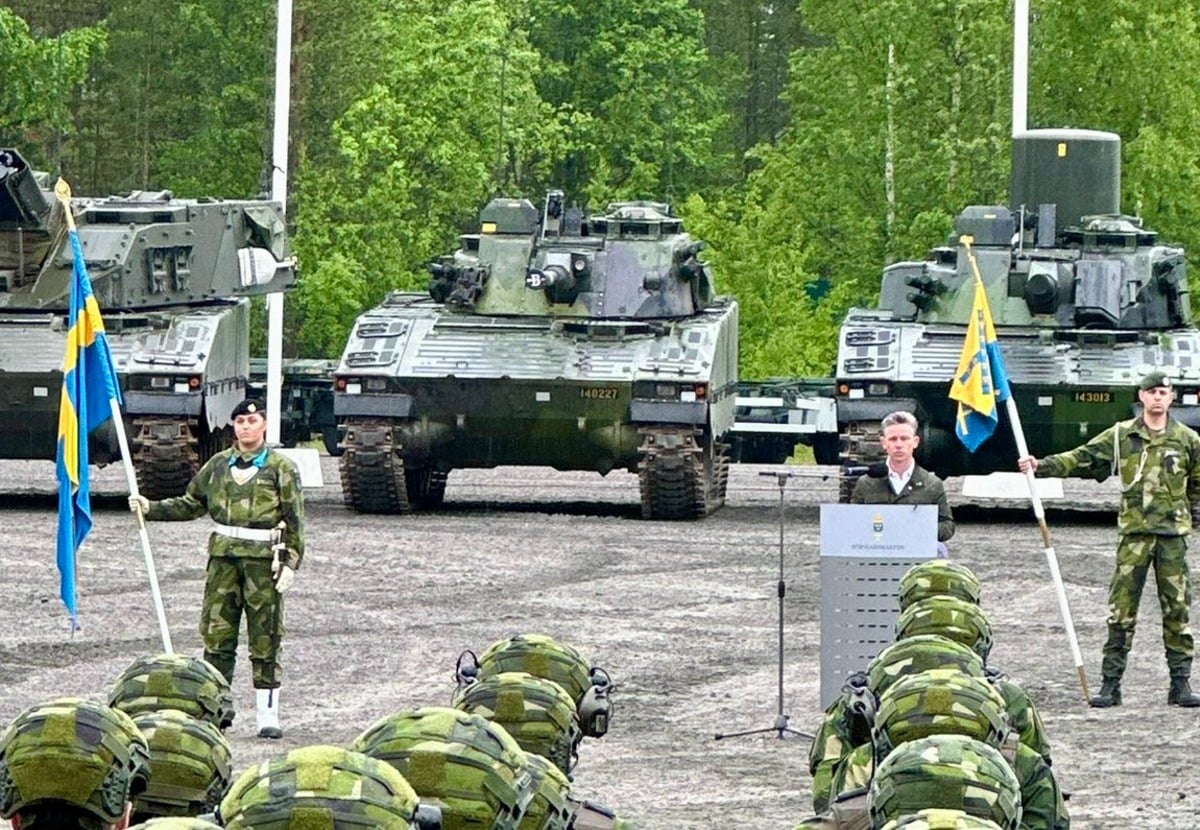
- Sweden formally established NATO's Forward Land Forces Finland on June 6, 2026, placing a battalion battlegroup from the Norrbotten Regiment under SACEUR's command.
- Sweden contributes approximately 600 personnel to FLF Finland in 2026 as framework nation, with capacity to expand to 1,200 personnel if required.
On Sweden’s National Day, a country that spent more than two centuries avoiding military alliances took formal command of a NATO battlegroup positioned at the edge of the Arctic, placing its soldiers under the alliance’s direct authority for the first time and completing a strategic transformation that would have been unimaginable before Russia’s invasion of Ukraine.
Swedish Defense Minister Pål Jonson attended a ceremony on June 6, at the Norrbotten Regiment base in Boden, a garrison city in northern Sweden approximately 90 km (56 miles) south of the Arctic Circle, to mark the establishment of NATO’s Forward Land Forces Finland, known as FLF Finland. At the ceremony, Sweden formally transferred authority over its battalion battlegroup to NATO’s Supreme Allied Commander Europe, placing those troops under SACEUR’s command and making Sweden the framework nation responsible for leading the alliance’s newest multinational ground force.
The battlegroup, drawing its core from the Norrbotten Regiment, one of Sweden’s most storied northern defense units with a history stretching back more than three centuries, will form the nucleus of FLF Finland alongside a Multinational Staff Element based in Rovaniemi, the capital of Finnish Lapland located approximately 830 km (516 miles) north of Helsinki.
“Sweden takes the work to reinforce NATO’s northeastern flank seriously, as clearly demonstrated by Swedish troops now being placed under NATO command in FLF Finland,” Jonson said at the ceremony. “Things have progressed quickly, and I welcome the positive and close cooperation with Finland, NATO and our Allies in this work.”
FLF Finland is NATO’s ninth Forward Land Forces multinational battlegroup, joining eight similar formations already established across the alliance’s eastern flank from Estonia in the north to Romania in the south. The Forward Land Forces concept, which NATO expanded significantly following Russia’s full-scale invasion of Ukraine in February 2022, places multinational combat-ready ground forces in frontline member states under a designated framework nation that leads, organizes, and commands the formation. The presence of these forces is intended to signal unambiguously that an attack on any NATO member will immediately engage alliance forces from multiple nations, eliminating any calculation by Russia that it could conduct a limited incursion against a Baltic or Nordic state before the alliance could respond.
Sweden’s role as framework nation for FLF Finland carries particular significance given the country’s recent history. Sweden joined NATO in March 2024, ending 210 years of military non-alignment that had been a cornerstone of Swedish foreign policy since the Napoleonic Wars. The decision to apply for membership, announced in May 2022 alongside Finland, represented a fundamental reassessment of Swedish security policy driven directly by Russia’s behavior in Ukraine, and the speed with which Sweden has moved from membership applicant to framework nation for a NATO battlegroup reflects both the urgency with which Stockholm views the current security environment and the substantial military capability Sweden brings to the alliance.
Sweden’s initial contribution to FLF Finland totals approximately 600 personnel in 2026, with the option to expand to 1,200 personnel if the security situation requires. The battlegroup is prepositioned in Boden rather than on Finnish soil, giving it the ability to operate across the North Calotte, the northernmost region of Scandinavia where Sweden, Norway, Finland, and Russia converge, and to rapidly reinforce northern Finland if circumstances demand forward deployment. That geographic positioning reflects both the practical reality of basing Swedish forces at an established Swedish garrison and the alliance’s calculation that a rapid-reinforcement posture in the Norwegian-Swedish-Finnish corridor serves deterrence as effectively as permanent forward deployment in Finland itself.
The location of the Norrbotten Regiment in Boden is not incidental to the story. Boden and its surrounding fortifications have been central to Swedish northern defense planning for over a century, originally built to protect Sweden’s iron ore mines and rail networks from potential Russian or German invasion in the early twentieth century and subsequently maintained as a key node in Sweden’s cold War-era defense infrastructure. The regiment’s deep familiarity with Arctic terrain, cold weather operations, and the specific geographic challenges of the North Calotte makes it a natural choice for a mission that may require rapid movement through some of Europe’s most demanding operational environments.
Finland, which shares an 1,340 km (832 mile) land border with Russia, joined NATO in April 2023, one year before Sweden completed its own accession. The bilateral defense relationship between Sweden and Finland, already extensive before either country joined NATO, now provides the foundation for FLF Finland, with Finnish territory representing the operational area the battlegroup is designed to reinforce and Swedish forces providing the framework nation leadership. That combination, two Nordic countries with deep military-to-military familiarity, shared understanding of Arctic operations, and compatible equipment and doctrine, represents a more cohesive foundation for a multinational battlegroup than most alliance formations can claim.
Russia’s military presence along the Norwegian-Finnish-Swedish axis has been a growing concern for Nordic planners since well before the full-scale invasion of Ukraine. The Kola Peninsula, located just across the Finnish border from Norway and within striking distance of northern Finland, hosts Russia’s Northern Fleet and a concentration of nuclear forces that makes the High North one of the most militarily sensitive regions in Europe. The establishment of FLF Finland adds a visible NATO ground presence to a region where alliance air and maritime forces have long operated, completing a layered deterrence picture that NATO has been building since 2022.
Two centuries of neutrality ended in March 2024. On June 6, 2026, Sweden’s National Day, the country that chose non-alignment to survive the Napoleonic Wars placed its soldiers under alliance command in the Arctic. History, as Minister Jonson noted, moved quickly.