

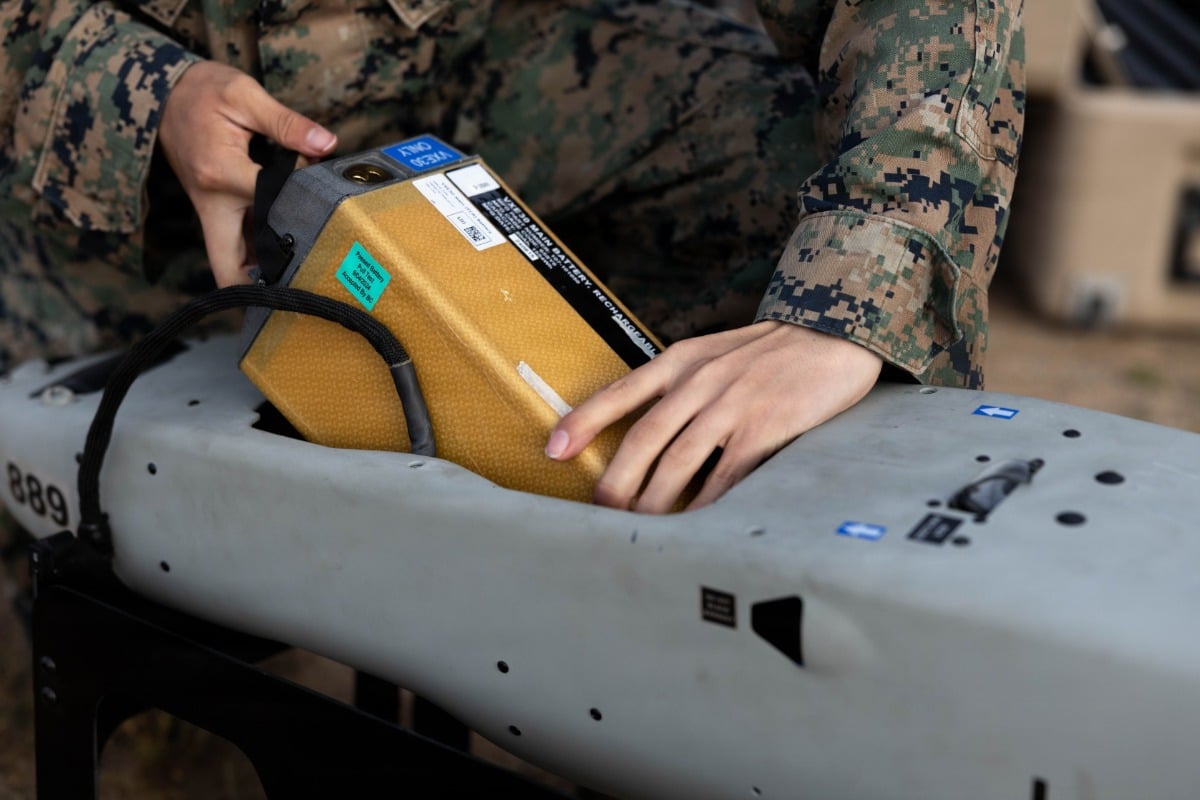
- DARPA published solicitation DARPA-PS-26-118 on June 5 seeking battery developers for the 36-month ExPEDitions program targeting rechargeable batteries above 2 kWh/kg specific energy.
- Abstracts are due June 26, 2026, with full proposals due August 19, 2026, and a target program start date of January 2027 under Other Transaction Agreements for Prototype.
The Defense Advanced Research Projects Agency, known as DARPA, published a solicitation on June 5, launching a new program called ExPEDitions, short for Expeditionary Power- and Energy-Dense Implementations, to develop rechargeable batteries capable of delivering five to ten times the energy density of current technology for use in drones, ground vehicles, and other military equipment.
DARPA, the Pentagon’s research arm historically responsible for some of the most consequential technological breakthroughs of the past seven decades, is seeking battery developers to advance foundational cell chemistry, materials, and architectures under the program solicitation designated DARPA-PS-26-118. Abstracts are due June 26, 2026, with full proposals due August 19, 2026. The program is structured as a 36-month effort divided into two 18-month phases, with a target start date of January 2027 and multiple awards anticipated through Other Transaction Agreements for Prototype, a contracting mechanism that allows DARPA to move faster and work with non-traditional defense companies that would struggle to compete in standard procurement processes.
The problem ExPEDitions is designed to solve is not abstract. Current rechargeable batteries, whether lithium-ion cells in a soldier’s radio or the battery packs powering small unmanned aircraft, carry a fundamental tradeoff between energy density, meaning how much energy a given weight of battery can store, and power density, meaning how quickly that energy can be delivered. Military missions demand both simultaneously: a drone loitering over a target for hours needs high energy density, while a drone executing a rapid strike maneuver needs high power density, and current battery chemistry struggles to provide both at once without compromising the other. The result is that electric military systems are constrained to relatively short range and endurance profiles compared to what their fuel-powered counterparts can achieve.
The energy density targets DARPA has set for ExPEDitions are ambitious by any current standard. By the end of Phase 1, at 18 months, performers must demonstrate batteries achieving a specific energy greater than 1 kilowatt-hour per kilogram and peak specific power greater than 1 kilowatt per kilogram, with rechargeability of more than 500 cycles before capacity degrades below 80 percent of original. By the end of Phase 2, at 36 months, those targets climb to more than 2 kilowatt-hours per kilogram for specific energy and more than 3 kilowatts per kilogram for peak power, with rechargeability extending beyond 5,000 cycles. The program also sets a cost constraint of $100 per kilowatt-hour at projected manufacturing scale after Phase 1, with a materials cost floor of $50 per kilowatt-hour for Phase 2, reflecting the reality that a militarily useful battery technology must be manufacturable at scale and affordable enough for field deployment.
The theoretical pathway toward those targets builds on prior DARPA work. The ExCURSion program, DARPA’s previous effort focused on Expeditionary Carbon Utilization for Energy Resilience and Stabilization, demonstrated rechargeable carbon-air battery systems with a theoretical specific energy exceeding 3 kilowatt-hours per kilogram, a figure that would represent a transformative improvement over lithium-ion technology if it can be translated from laboratory demonstration to practical hardware. The ExPEDitions program picks up where ExCURSion left off, focusing specifically on improving power density and recharging speed, the two performance characteristics that have prevented carbon-air and similar high-energy-density chemistries from moving from scientific promise to operational reality.
The recharging constraint is particularly significant. A battery that stores enormous energy but requires hours to recharge is operationally limiting in ways that are immediately apparent: a drone that needs eight hours to recharge cannot support continuous operations, and a ground vehicle that must remain stationary for extended periods to recharge its power systems becomes a target. The ExPEDitions program requires a minimum recharge rate of 625 watts per liter, combined with a round-trip efficiency greater than 90 percent, requirements designed to ensure that any technology emerging from the program can be refueled from electrical sources as rapidly as the mission demands.
The supply chain dimension of the program deserves attention. DARPA explicitly identifies current battery supply chain risk as a concern, noting that many components in state-of-the-art secondary batteries rely on critical materials not produced domestically. That observation connects ExPEDitions to a broader set of American defense industrial concerns about dependence on foreign sources, particularly China, for battery materials including lithium, cobalt, and rare earth elements that are essential to current battery chemistry but are concentrated in supply chains outside American control. DARPA’s preference for solutions constructed largely from easily sourced materials that can reach cost parity with current technology reflects a deliberate attempt to build a battery program that does not trade one supply chain vulnerability for another.
The program’s structure separates the battery development challenge from the integration challenge in a deliberate and operationally informed way. Battery developers selected through this solicitation will be responsible solely for advancing cell chemistry and manufacturing to prototype stage. A separate solicitation, to be issued at a later date, will identify end users who will be responsible for integrating the resulting batteries into actual operational devices for demonstration. That parallel structure is designed to allow battery chemistry researchers to remain focused on performance optimization without being pulled into the complexities of vehicle integration, while simultaneously ensuring that by the time a working prototype exists, there is already an end user ready to put it into a real system.
The capstone events built into the program schedule reflect DARPA’s characteristic approach to technology transition. At month 18, a Showcase Pitch Day will bring battery developers together with end users in a structured marketplace where developers pitch their technology and end users select integration partners, with a formal Associate Performer Agreement required to complete the milestone. At month 36, a public-facing Expo, branded “Powered by DARPA,” will demonstrate integrated systems to government and commercial stakeholders, creating visibility and transition opportunities that extend beyond the military applications that drove the program’s creation.
Every drone that crashes because its battery ran out before the target was reached, every vehicle that stalls waiting for a fuel resupply in a contested environment, and every sensor that goes dark at a critical moment represents a gap in capability that adversaries can exploit. ExPEDitions is DARPA’s attempt to close that gap with chemistry rather than logistics, and the performance targets it has set suggest it is not interested in incremental improvement.