

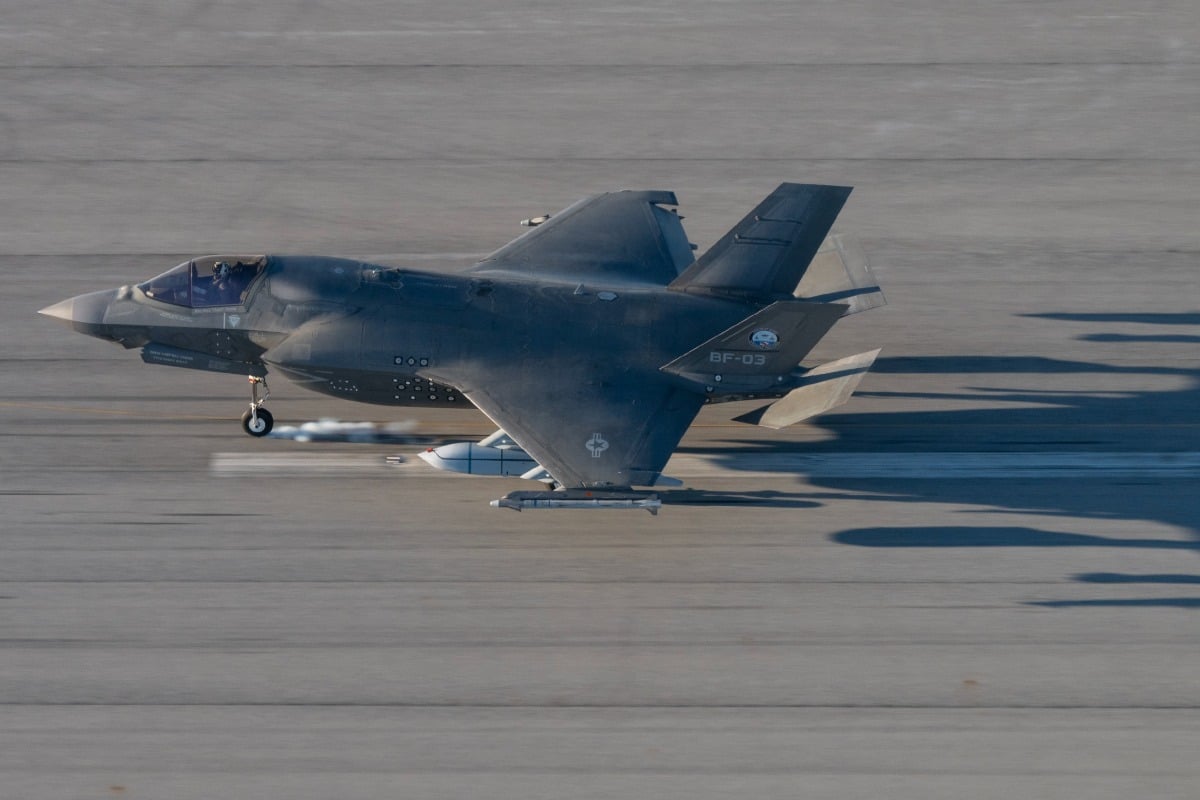
- The U.S. Air Force published a sources sought notice on June 5, 2026, seeking companies capable of producing JASSM for Lots 27-31 and LRASM for Lots 13-17, with delivery from 2031 to 2036.
- No foreign participation is permitted and white papers are due by June 12, 2026, to the Air Force Life Cycle Management Center's Long Range Systems Division.
The U.S. Air Force has published a sources-sought notice asking whether any company other than the current sole producer can build and deliver the Joint Air-to-Surface Standoff Missile and the Long-Range Anti-Ship Missile for production lots from 2031 to 2036.
The Air Force Life Cycle Management Center’s Long Range Systems Division, operating out of Wright-Patterson Air Force Base in Ohio, published the notice on June 5, seeking information from any company that believes it could produce and deliver JASSM for Lots 27 through 31 and LRASM for Lots 13 through 17, with a delivery period running from 2031 to 2036.
White papers are due by June 12, 2026. The announcement is explicit that no foreign participation is allowed, limiting responses to American companies with the necessary organizational and technical experience or the demonstrated ability to acquire it within the required timeframe.
The Joint Air-to-Surface Standoff Missile, known universally as JASSM, is a long-range stealthy cruise missile designed to destroy heavily defended, high-value targets from distances well beyond the reach of enemy air defenses. Carried internally and externally by a range of Air Force and allied aircraft including the B-1B, B-2, B-52, F-16, F-15E, and F-35, the JASSM uses a combination of GPS navigation, infrared terminal guidance, and an autonomous target recognition system to find and hit specific aim points on a target with precision. Its baseline variant carries a 450 kg (1,000 lb) penetrating warhead and has a range of approximately 370 km (230 miles). The extended-range variant, the JASSM-ER, stretches that reach to roughly 925 km (575 miles), giving strike aircraft the ability to hit targets deep inside defended airspace while the launching aircraft remains far outside the threat envelope.
The Long-Range Anti-Ship Missile, known as LRASM, is a derivative of the JASSM-ER adapted specifically for maritime strike, designed to find, identify, and destroy enemy warships at long range in highly contested environments where adversary air defenses and electronic warfare make earlier-generation anti-ship missiles increasingly vulnerable. LRASM uses an advanced seeker that combines radar, infrared, and electro-optical sensors to discriminate between individual ships in a group and home on a specific target vessel, a capability that addresses the fundamental limitation of older anti-ship missiles that could be defeated by decoys or confused by multiple targets. It has a range comparable to the JASSM-ER and carries a 450 kg (1,000 lb) warhead designed specifically for defeating the layered armor and compartmentalization of modern warships.
Both weapons are currently produced exclusively by Lockheed Martin Missiles and Fire Control, the defense and aerospace giant’s weapons division headquartered in Grand Prairie, Texas. Lockheed has been the sole source for JASSM since the program’s inception in the 1990s and for LRASM since that weapon entered development as a derivative of the JASSM-ER airframe. The sources sought document acknowledges Lockheed’s existing position directly, noting that as Lockheed Martin Missiles and Fire Control’s obligations under existing contracts continue, any government-owned peculiar equipment will not be available to any second source, a statement that flags the practical barrier facing any competitor: the specialized tooling, test equipment, and production infrastructure built around the existing program are Lockheed’s, not the government’s, and a new entrant would need to develop its own from scratch.
That barrier is substantial. JASSM and LRASM are not simple manufactured goods. Each missile requires precision machining of airframe components, integration of complex guidance electronics, loading of software that incorporates classified target recognition algorithms, testing against qualification standards that verify guidance accuracy and warhead performance, and packaging in specialized containers that maintain the weapon’s readiness across years of storage. The scope of what the Air Force is asking a potential competitor to take on is spelled out clearly in the sources sought document, which covers missile hardware, software, telemetry instrumentation kits, precision targeting image software, weapon system simulators, technical data, obsolescence management, upgrades, production implementation, sustainment, aircraft integration, non-warranty repair, containers, and all associated support items.
The urgency behind exploring competition, even at this early market research stage, is not difficult to understand for anyone following how JASSM and LRASM have been consumed in recent years. Ukraine’s war with Russia has driven an enormous surge in demand for precision long-range strike weapons across NATO, with multiple allied nations accelerating procurement and the United States drawing down its own stockpiles to support Ukrainian operations while simultaneously trying to maintain readiness for potential conflicts in the Pacific. China’s naval buildup has made LRASM in particular a priority weapon for the Pentagon’s Pacific strategy, and the Air Force has been pushing Congress and industry to increase production rates. A single-source production line, however efficient, carries inherent risk when demand can surge unpredictably and when a disruption at one facility can halt the entire supply.
The production lots being explored in this sources sought, Lots 27 through 31 for JASSM and Lots 13 through 17 for LRASM, represent a production horizon stretching nearly a decade into the future. The fact that the Air Force is asking this question now, with a June 12 response deadline, reflects the long lead times involved in standing up a new missile production capability and the need to make decisions well in advance of when the production capacity is actually required. If a qualified second source were identified and awarded a contract, it would take years of investment, facility development, workforce training, and qualification testing before that source produced its first deliverable missile.
Whether any American company has the technical depth, manufacturing infrastructure, and financial appetite to challenge Lockheed’s position on two of the most complex and classified missile programs in the inventory is an open question that this sources sought is specifically designed to answer. The Air Force is not signaling that it has found such a company. It is asking whether one exists.