

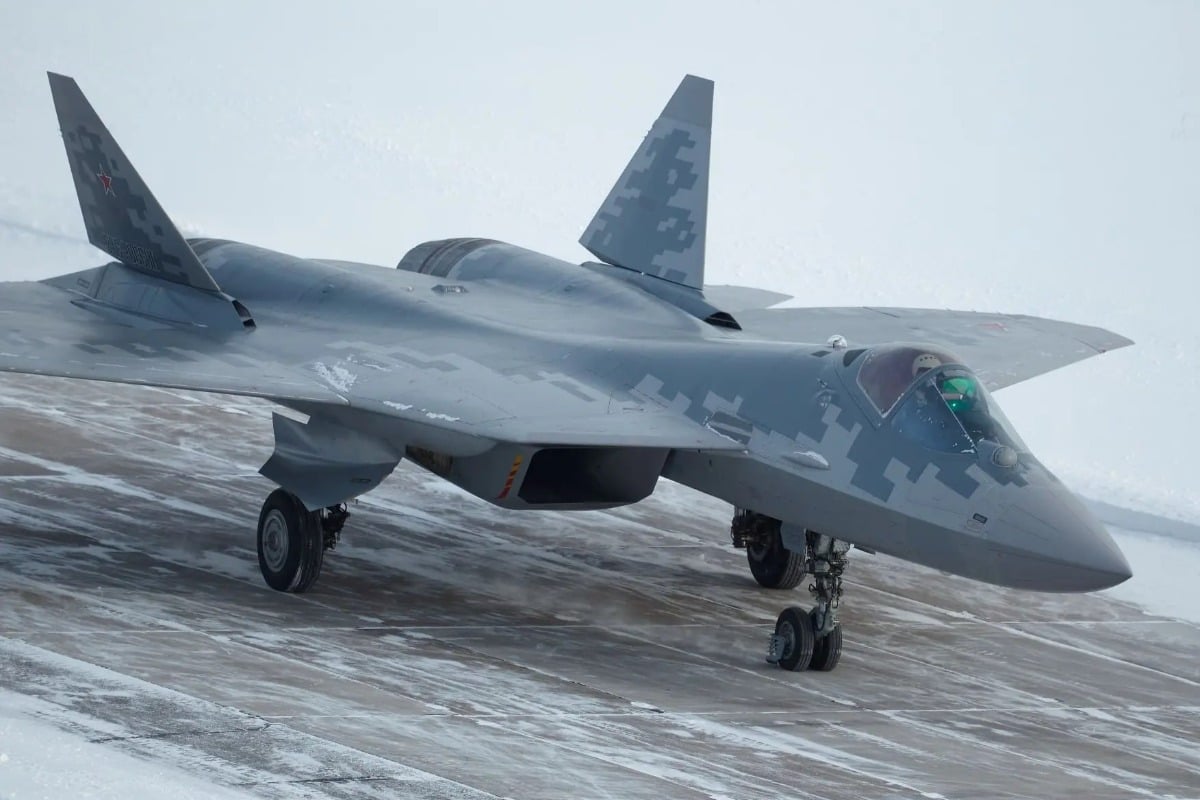
- Putin told international news agency leaders the Su-57 is the world's best fifth-generation fighter and offered India supply and joint development with no restrictions.
- Russia's United Aircraft Corporation claims the Su-57 has confirmed combat effectiveness in all mission types, but the jet flies with an interim engine and has been produced in very limited numbers.
Vladimir Putin told the world’s press agency chiefs this week that Russia’s Su-57 fighter is the best combat aircraft on the planet. Independent analysts and the jet’s own production record tell a more complicated story.
Putin made the claim at a meeting with leaders of major international news agencies organized by TASS, Russia’s state news service, where the topic of defense cooperation with India arose. The Russian president recalled that Moscow had once offered New Delhi a joint development program for the Su-57, an offer India declined.
“What concerns the Su-57, we once offered our friends from India to develop this aircraft together,” Putin said. “An aircraft of the fifth generation, I think the best in the world today. Our Indian friends said at the time: ‘You go ahead, and we’ll see.’ In principle, this aircraft could have been our joint production. We made it independently, and we are ready to work with India and supply it and develop it. There are no restrictions here.”
Russia’s United Aircraft Corporation, which manufactures the Su-57, describes the jet as the only fifth-generation fighter in the world to have confirmed its effectiveness across all variants of combat use, claiming both air-to-air and air-to-ground kills and crediting the aircraft’s stealth characteristics with allowing it to operate undetected by enemy air defense systems. The corporation also frames the Su-57 as an intelligent platform capable of acting as an airborne command center, including for the coordination of unmanned aerial vehicles, and notes a broad arsenal of current and prospective weapons integrated into the design.
On paper, the Su-57’s specifications are credible fifth-generation credentials. The aircraft is designed with an internal weapons bay to reduce radar cross-section, uses thrust-vectoring engines for extreme maneuverability, incorporates an active electronically scanned array radar, and features a sensor-fused avionics architecture intended to give the pilot a unified operational picture. Those are genuine fifth-generation characteristics, the same ones that define the American F-22 Raptor and F-35 Lightning II. Where the Su-57 diverges from those benchmarks is not in concept but in execution, production volume, and the gap between stated capabilities and what independent observers have been able to verify.
The engine program is the most persistent and well-documented problem. The Su-57 currently flies with the AL-41F1 engine, a derivative of the powerplant used in the Su-35, which is a fourth-generation engine in a fifth-generation airframe. Russia has been developing the intended definitive powerplant, known as the Product 30 or Izdeliye 30, for years, but series production of that engine has not been confirmed, and the timeline has slipped repeatedly. Without the Product 30, the Su-57 operates without the full-thrust supercruise capability, meaning the ability to sustain supersonic flight without afterburner, that is among the defining performance advantages of true fifth-generation designs. The F-22, by comparison, entered service in 2005 with its intended Pratt and Whitney F119 engines already integrated and qualified.
Production numbers underscore the gap between ambition and output. Russia has produced the Su-57 in extremely limited quantities compared to Western fifth-generation programs. The Russian Aerospace Forces had received only a small number of production-standard aircraft as of recent reporting, with deliveries progressing slowly against a backdrop of stated plans for dozens of aircraft that have repeatedly failed to materialize on schedule. Quality control issues at the Komsomolsk-on-Amur Aircraft Plant, which manufactures the Su-57, have been reported in Russian defense media, including accounts of manufacturing defects requiring rework before delivery. One Su-57 was lost in a crash in 2019, attributed to a flight control system malfunction, during a routine test flight before it could be delivered to the air force — an early signal of avionics integration challenges that developers were still working through years into the program.
The aircraft’s combat employment in Ukraine has been carefully managed in a way that raises its own questions. Russia has used Su-57s to fire long-range missiles into Ukrainian territory from positions well behind the front line, outside the reach of Ukrainian air defenses, rather than employing the aircraft in the contested airspace environments where stealth characteristics would actually be tested and proven. That mode of employment is tactically sensible given the risk to a small and irreplaceable fleet, but it makes Russian claims of confirmed combat effectiveness across all mission types difficult to assess independently. Firing a standoff missile from several hundred kilometers away is a task that a fourth-generation aircraft with the same missile could accomplish equally well.
Putin’s sales pitch to India is not irrational on its own terms. India operates a large fleet of Russian-origin aircraft and has the maintenance infrastructure and pilot training pipelines to integrate Russian platforms. The political relationship has historical depth and Russia needs the foreign currency and diplomatic alignment that arms exports provide. But Indian Air Force planners will weigh Putin’s claims against the documented production struggles, the engine gap, the quality control history, and the limited operational exposure the aircraft has received in conditions that would actually validate stealth and sensor performance. The Su-57 is a real aircraft with genuine advanced capabilities, and dismissing it entirely would be as inaccurate as accepting Putin’s superlative at face value. What it is not, by any measure that international aerospace analysts apply consistently, is unambiguously the best fighter in the world today.