

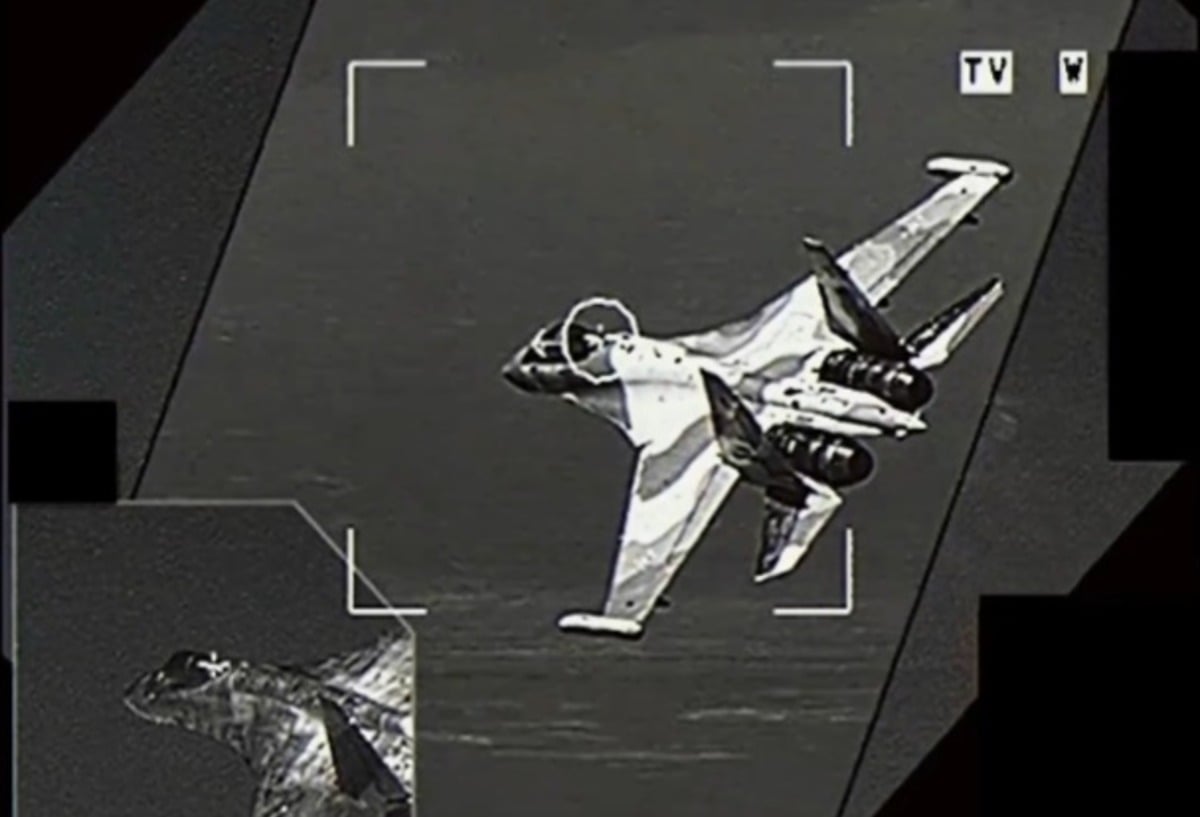
- French Rafales from Baltic Air Policing 71 detachment at Šiauliai scrambled June 2 to intercept six Russian aircraft including an Su-35, Su-34, Su-24, Il-76, An-12, and An-30.
- France's Joint Staff published targeting camera footage showing a Rafale conducting a close-range visual intercept of the Russian Su-35 over the Baltic Sea.
France’s Joint Staff published video showing a Rafale from the Baltic Air Policing mission conducting a close-range visual interception of a Russian Sukhoi Su-35, the most capable non-stealth fighter in Moscow’s current inventory, in a tense but controlled encounter that NATO described as concluding without further escalation.
The French Armed Forces confirmed that two Rafale fighters from the Baltic Air Policing 71 detachment, based at Šiauliai Air Base in northern Lithuania, scrambled on June 2 to intercept and escort multiple Russian aircraft operating within the Baltic area of responsibility.
The Su-35, designated Su-35S in its production variant, is the aircraft Russia considers its premier air superiority fighter until the Su-57 stealth jet reaches meaningful production numbers. Developed by the Sukhoi design bureau as a deep modernization of the Su-27 Flanker family, the Su-35S features the powerful N035 Irbis-E passive electronically scanned array radar, capable of tracking multiple airborne targets simultaneously at ranges exceeding 200 km (124 miles), paired with AL-41F1S engines, commonly listed at about 86 kN (19,300 lb) of dry thrust and about 142 kN (31,900 lb) with afterburner each. Its three-dimensional thrust-vectoring nozzles give the aircraft maneuverability at low speeds that few Western fighters can match, give the aircraft strong low-speed maneuverability, particularly in visual-range engagements, making the reported visual intercept notable from an air-combat perspective.
The Rafale that conducted the interception is France’s frontline multirole combat aircraft, built by Dassault Aviation and operated exclusively by the French Air and Space Force and French Navy. A fourth-generation plus aircraft equipped with the RBE2-AA active electronically scanned array radar, the SPECTRA electronic warfare suite, and the ability to carry nuclear weapons as part of France’s independent nuclear deterrent, the Rafale has established a strong export record in recent years with sales to Egypt, India, Greece, Qatar, Croatia, Indonesia, and the United Arab Emirates. Its presence in the Baltic Air Policing mission reflects France’s consistent contribution to NATO’s collective air defense of the three Baltic states, Estonia, Latvia, and Lithuania, none of which operate fast jet interceptors of their own.
The Baltic Air Policing 71 detachment designation identifies this as France’s 71st rotation into the mission, a number that reflects the sustained and long-running nature of NATO’s commitment to Baltic airspace since the three countries joined the alliance in 2004. Detachments rotate on a quarterly basis among NATO member nations, with each contributing a small number of fighters and the support personnel needed to maintain quick-reaction alert coverage from Šiauliai, the primary northern hub, and Ämari Air Base in Estonia, which serves the southern sector. Since Russia’s full-scale invasion of Ukraine in February 2022, the size and capability level of these rotations have increased, with nations increasingly sending their most capable aircraft rather than older variants.
The package of six Russian aircraft intercepted on June 2 represented an unusually broad cross-section of Russian military aviation capability operating simultaneously in the same area of responsibility. Beyond the Su-35, the French Rafales and their Swedish Gripen wingmen identified a Su-34, a dedicated supersonic strike bomber that Russia has used extensively in Ukraine for both precision and unguided munitions delivery; a Su-24, an older swing-wing strike aircraft still in active Russian service; an Il-76, a large four-engine military transport; an An-12, a medium turboprop transport; and an An-30, a specialized airborne reconnaissance and survey platform equipped with cameras and imagery intelligence sensors. The breadth of that mix, spanning air superiority, strike, heavy lift, and intelligence collection in a single coordinated activity, points to a deliberate Russian effort to exercise multiple mission profiles simultaneously while probing allied response times and procedures.
France’s official statement noted that the situation was monitored by French pilots without further escalation, a phrase that carries deliberate meaning in the language of military aviation diplomacy. It confirms that the Russian aircraft did not maneuver aggressively, did not activate weapons systems in a threatening manner, and did not enter NATO member state airspace without authorization, while also confirming that French pilots maintained close enough proximity to make that assessment definitively. The publication of the intercept footage adds a layer of transparency to that statement, showing rather than just telling what a routine but operationally significant Baltic interception looks like from the cockpit.