

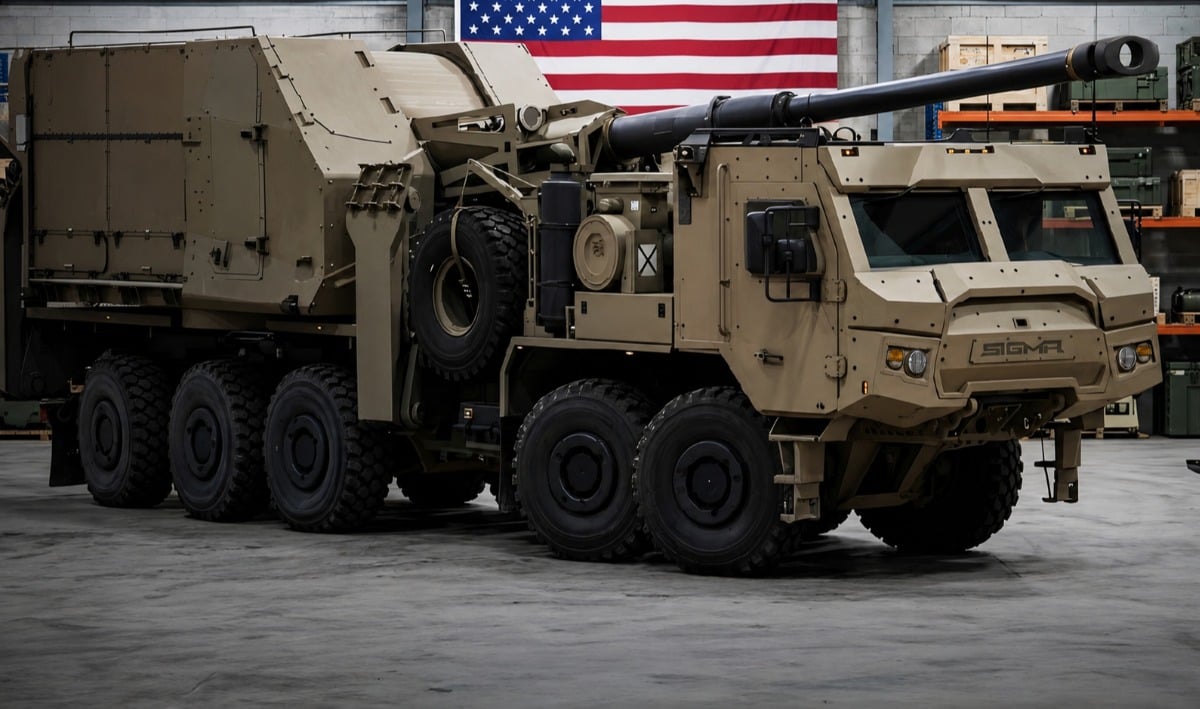
- Elbit Systems of America and Anduril Industries announced a teaming agreement on June 2, 2026, to offer the SIGMA Mobile Tactical Cannon for the U.S. Army's Self-Propelled Howitzer Modernization program.
- Team SIGMA also includes Oshkosh Defense as chassis manufacturer and more than 300 U.S. suppliers, with Anduril contributing its Lattice autonomy and battle management software platform.
Two of the U.S. defense industry’s most closely watched companies announced they are joining forces to compete for one of the Army’s most significant ground combat modernization programs, pairing a combat-proven Israeli-American cannon system with Silicon Valley’s most prominent defense technology firm.
Elbit Systems of America and Anduril Industries announced a strategic teaming agreement on June 2, to offer the SIGMA Mobile Tactical Cannon for the U.S. Army’s Self-Propelled Howitzer Modernization program. The partnership brings together Elbit America’s experience as a systems integrator and large ground vehicle manufacturer with Anduril’s expertise in command, control, communications, computers, cyber, intelligence, surveillance, and reconnaissance software, along with its Lattice battle management and autonomy platform. Oshkosh Defense, the Wisconsin-based manufacturer that produces the system’s 10×10 wheeled chassis, is also part of the team, alongside more than 300 U.S. suppliers contributing engineering, manufacturing, and sustainment depth across the domestic industrial base.
The Army’s Self-Propelled Howitzer Modernization program is seeking a replacement for the M109 Paladin, the tracked 155 mm (6.1 in) self-propelled howitzer that has been the backbone of U.S. Army cannon artillery since the 1960s. The Paladin has been upgraded repeatedly, with the current M109A7 Paladin Integrated Management variant incorporating improved electronics, a new power pack, and a redesigned cab, but the platform’s fundamental tracked architecture dates to an era when mobility requirements and digital integration standards looked very different from what the Army needs today. The modernization program is intended to field a system with greater strategic and operational mobility, deeper integration with Army digital fire control and command networks, and the kind of software-defined flexibility that allows capabilities to be updated through the lifecycle rather than locked in at the time of manufacture.
SIGMA is Elbit America’s entry into that competition. Based on the ATMOS 155 mm (6.1 in) self-propelled wheeled howitzer developed by Elbit Systems in Israel, SIGMA mounts a 155 mm cannon on Oshkosh’s 10×10 wheeled platform, trading the tracked Paladin’s cross-country capability for significantly greater road speed, strategic transportability, and a smaller logistical footprint. The ATMOS family has been exported to multiple countries and has seen operational use, giving it a foundation of real-world performance data that purpose-built competition entrants may lack. Wheeled self-propelled artillery has gained considerable traction internationally over the past two decades, with systems like France’s CAESAR, which has been used extensively in Ukraine with notable effectiveness, demonstrating that a wheeled platform can deliver accurate, sustained fires with substantially better strategic mobility than a tracked equivalent.
The addition of Anduril to Team SIGMA is aimed squarely at the digital integration challenge that the Army has made central to its modernization requirements. Anduril’s Lattice platform is an AI-enabled software system designed to fuse sensor data, track targets, and coordinate fires and autonomous systems across a networked force. The company has built Lattice into counter-drone systems, autonomous surveillance towers, and undersea vehicles, and has been expanding its footprint across all U.S. military services at a pace that has made it one of the most consequential new entrants in American defense technology in recent years. Integrating Lattice into SIGMA would give the cannon system a direct software pathway into existing Army command and control architectures, reducing the network integration risk that has complicated previous artillery modernization efforts and shortening the time from contract award to fielded capability.
“We’re proud to team with Anduril to reduce network integration risk and accelerate fielding,” said Luke Savoie, president and CEO of Elbit America. “Built in the U.S. with a fully domestic supply chain, SIGMA is a combat-proven system that provides the modernization and reliability the Army needs now.”
Michael Roder, managing director at Anduril, framed his company’s contribution in terms of software architecture. “On Team SIGMA, we’re providing expertise in software, edge compute and autonomy to deliver a connected, software-defined mobile artillery solution that will integrate seamlessly into existing Army Command and Control and fire control architectures,” Roder said.
The all-American supply chain argument the team is making carries real weight in the current procurement environment. Elbit America is headquartered in Fort Worth, Texas, where the SIGMA system’s U.S. manufacturing would be centered, and the involvement of Oshkosh Defense, a major American vehicle manufacturer with existing Army contracts across multiple programs including the Joint Light Tactical Vehicle, adds domestic production credibility that purely imported solutions cannot match. U.S. Representative Craig Goldman, whose district includes Fort Worth, noted the local dimension explicitly.
“Excited to see Elbit Systems of America and Anduril Industries working together to manufacture a cutting-edge military vehicle right here in America,” Goldman said. “The men and women at Elbit America’s headquarters in Fort Worth are truly at the forefront in developing the capabilities to strengthen America’s warfighters and preserve America’s national security.”