


- Volatus Aerospace says its Canary unmanned aircraft can be adapted for military last-mile resupply, building on its existing use in regulated civilian airspace.
- The platform carries 4.6 kg of cargo, operates with low acoustic and thermal signature, and can deliver medical supplies, components, communications gear, and ammunition.
A Canadian-made unmanned aircraft originally developed for civilian medical logistics is being positioned for potential military use as modern conflict zones demand faster, quieter and more survivable small-scale resupply capabilities.
Volatus Aerospace says its Canary unmanned aircraft system (UAS), now used for hospital-to-hospital medical transport, can be adapted for frontline logistics where traditional supply routes are too exposed or communications too unreliable.
In a statement on the platform’s military potential, Ethan Clarke, Vice President at Volatus Aerospace, said: “The Volatus Aerospace Canary UAS is highly proven in the civilian sphere for BVLOS emergency resupply…with only a few small adaptations it would prove to be a highly potent military platform for the delivery of emergency medical equipment, essential spare parts, orders, and ammunition.”
According to the company, the Canary’s current medical-transport role has already hardened it for operations in challenging airspace. In Canada, the aircraft routinely flies below commercial jet traffic, navigating a constantly changing air picture and using detect-and-avoid systems to autonomously adjust altitude and heading. Volatus says this behavior directly parallels what is required in contested military airspace, where drones, loitering munitions, and low-flying aircraft may appear unpredictably.
The aircraft carries 4.6 kilograms of cargo with 23 minutes of flight time at full payload, extending to about 30 minutes in emergency scenarios. With no payload, endurance increases to roughly 36 minutes. The company says this payload class is aligned with what forward units actually require: batteries, radios, encrypted modules, medical supplies, fuses, and other small mission-critical components.
Volatus also highlights the platform’s acoustic, thermal, and radar-profile advantages. The Canary’s electric propulsion and enclosed fuselage reduce acoustic signature, thermal emissions, and radar reflectivity compared to larger quadcopter-based logistics drones. The company argues this allows supplies to reach dispersed teams without revealing troop positions or risk to larger transport platforms.
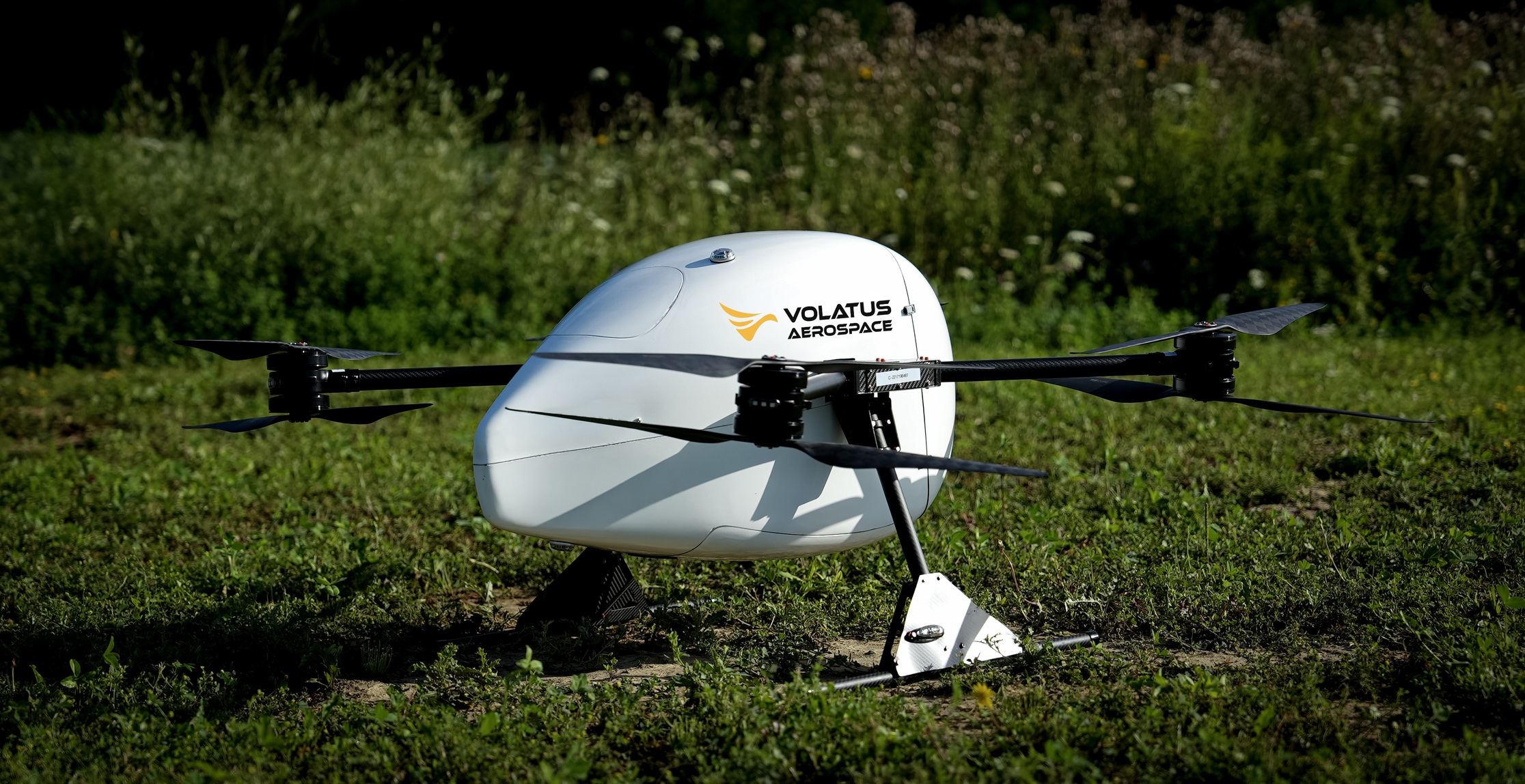
The UAS features internal cargo carriage rather than external pods, maintaining aerodynamic efficiency and protecting sensitive items from dust, debris, and weather. Volatus says this approach preserves the integrity of medical supplies such as blood products and pharmaceuticals while also shielding ammunition, pyrotechnics, and other sensitive cargo.
The Canary includes automatic load sensing, which warns operators when payloads exceed its safe envelope, though the system can be overridden in emergencies. An automatic drop mechanism allows resupply without landing, supporting units on the move or those operating under threat from artillery, electronic warfare, or drone surveillance. The platform can deliver maintenance components, communications devices, cryptographic materials, physical orders, small amounts of ammunition, and batteries for unmanned systems.
Volatus says it plans to integrate the Canary with unmanned ground vehicles, unmanned surface vessels, and manned platforms to create mobile launch and recovery options. The company’s Aerieport drone-nesting station, designed for autonomous flight cycles, can be deployed to forward bases or small outposts and repositioned as front lines shift.
The aircraft has undergone cold-weather testing at –35°C, heat testing at +50°C, high-altitude validation at 5,900 feet above sea level, and long-range trials beyond 20 kilometers at full payload. It is approved to fly over people and settlements under Transport Canada regulations. Volatus says these certifications exceed what most defense-focused micro-logistics drones undergo today.
Clarke argues that the Canary’s suitability for military logistics stems from real-world civilian use rather than conceptual projections. As the company describes it, the platform offers a combination of low signature, proven reliability, and autonomy matched to the fragmented and fast-moving character of today’s battlefields.