

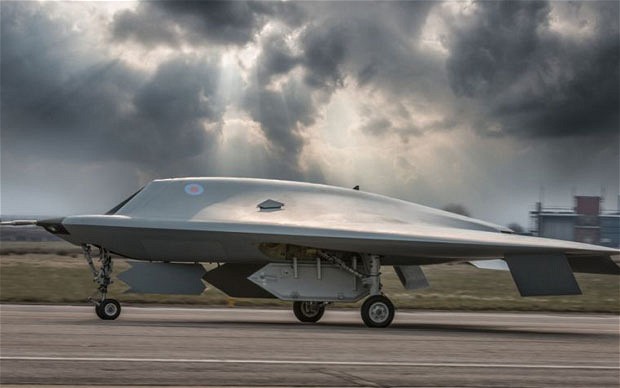
Britain’s top secret stealth drone will complete its third and possibly final round of test flights later this year, the Ministry of Defence has said.The £200 million Taranis programme, making the most advanced aircraft ever built by British engineers, will have achieved all its objectives if this year’s trials go well, officials said. No decision has been made on further tests.The remotely-piloted drone, constructed by BAE Systems, is a “combat vehicle demonstrator” to test and develop technology for future generations of fighters and unmanned vehicles.Though unarmed it is expected to provide the basis for future fleets of supersonic stealth drone bombers that can attack deep into enemy territory, while evading sophisticated defences.
Tests on the unmanned aircraft named after the Celtic god of thunder have included “simulated weapon release”.Taranis has already completed two sets of test flights and officials have released film of it flying from but an unnamed location, believed to have been in Woomera, Australia.Details of what it can do have been closely guarded. Officials say while it is controlled by a pilot in a distant base, it has “a degree of automated capability”.Tests have looked at its stealth technology, its control systems and its sensors.
The Ministry of Defence declined to say where the next round of trials would be.Once the tests are finished engineers will spend months going over the data which will be used to decide how drones could be used in the future RAF fleet.Lessons learnt from the drone will one day help in producing a replacement for the Typhoon and F35 fighters, Philip Dunne, the minister for defence equipment, has said.Britain is also collaborating with France to devise future combat drones.The growing importance of unmanned military aircraft was highlighted last week when David Cameron acknowledged that an RAF Reaper drone had carried out a targeted killing of a British jihadist inside Syria.A forecast last week predicted naval operations would be dominated by “networks of unmanned surface and underwater vessels” within 15 years.
Naval drones could be used to hunt for mines or submarines and distribute humanitarian aid to disaster zones, the forecast by defence firm Qinetiq.A spokeswoman for the Ministry of Defence said: “The most technologically advanced demonstration aircraft ever built in the UK, Taranis took its maiden flight in 2013, with further flight trials planned to complete by the end of 2015. In addition to helping influence the next generation of military aircraft, the investment will benefit the wider UK economy and help achieve long-term growth”