


The U.S. Navy, in collaboration with aerospace firm Skydweller Aero, has completed a continuous 73-hour unmanned flight using solar power alone.
The test, conducted out of Stennis, Mississippi, represents a major step forward in applying solar-powered aircraft for maritime intelligence, surveillance, and reconnaissance (ISR) operations.
The demonstration was led by the Naval Air Warfare Center Aircraft Division (NAWCAD), which oversees the Navy’s test and evaluation enterprise. Officials said the flight not only proved Skydweller’s ability to sustain power from solar energy throughout day and night cycles, but also validated its command-and-control systems, autonomous response features, and resilience to weather disturbances.
“This demonstration is a prime example of how NAWCAD partners with industry to deliver what the fleet needs,” said Rear Adm. Todd Evans, NAWCAD Commander. “It also reflects the technical depth of our workforce and our ability to translate ideas into capability.”
The Skydweller UAS—a large-wing solar-electric aircraft adapted from a proven manned platform—demonstrated the ability to maintain a positive energy balance, a critical benchmark for continuous operations without fuel or external power.
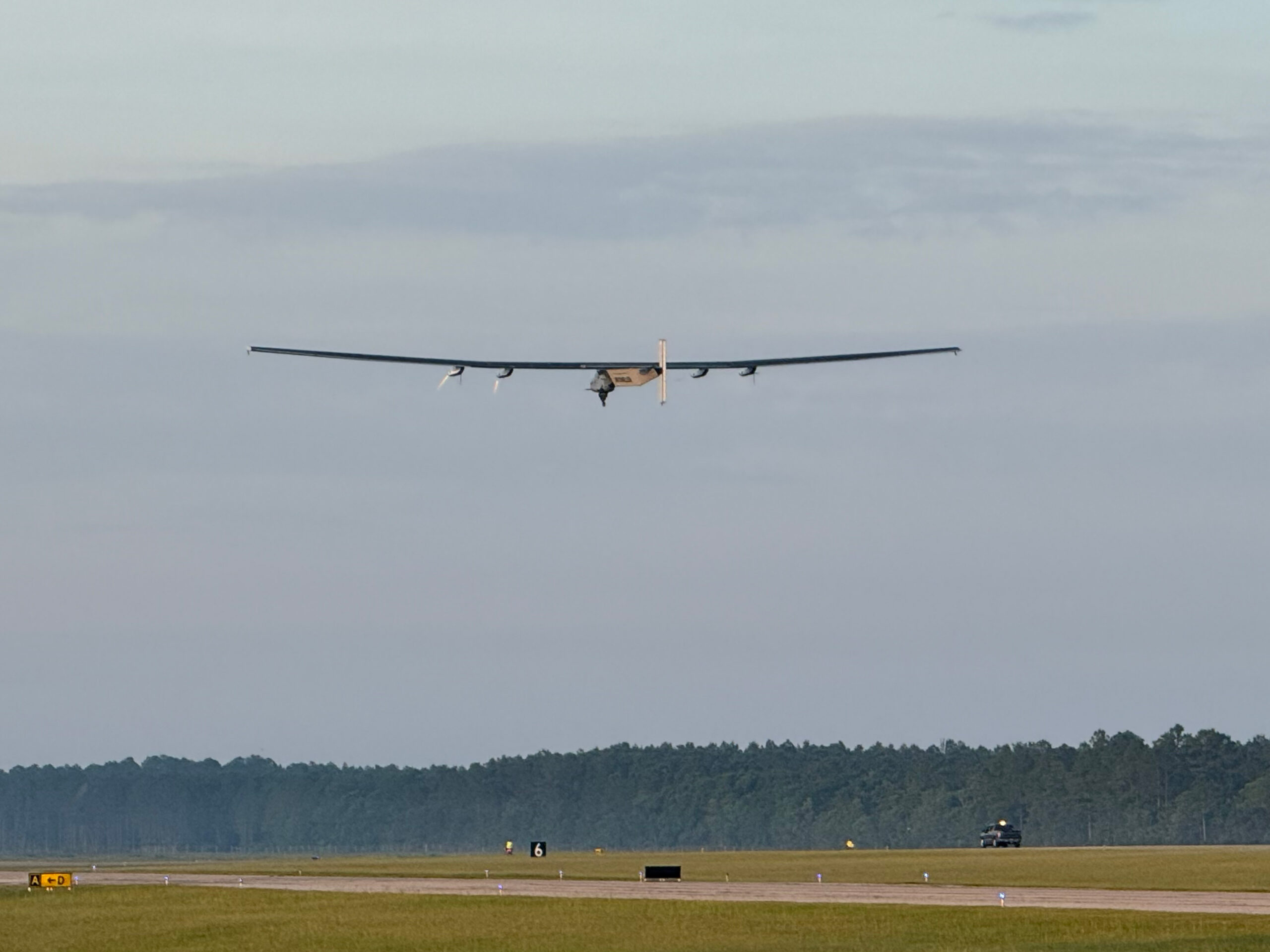
During the three-day flight, the system also proved it could remain in contact, make real-time decisions autonomously, and adapt dynamically to turbulent conditions, Navy officials said.
Bill Macchione, Special Purpose UAS lead at NAWCAD, said integrating Skydweller into the Navy’s ISR network creates a more flexible and resilient surveillance architecture. “This collaborative approach ensures we have the right platform for the right mission, optimizing our resources and enhancing our overall maritime domain awareness,” he said.
The system’s endurance and low operating footprint allow it to cover wide areas persistently, freeing more complex or expensive assets for missions requiring greater speed, payload, or responsiveness. Skydweller’s platform is particularly suited for broad-area surveillance, including long-duration maritime patrol, persistent monitoring of key sea lanes, and support for interdiction operations.
NAWCAD began work with Skydweller in 2020, initially focusing on operational gaps identified by U.S. Southern Command (SOUTHCOM). These challenges include narcotics trafficking, unregulated maritime activity, and cross-border smuggling. The solar-powered drone is expected to support persistent surveillance missions in SOUTHCOM’s expansive area of responsibility, which covers large swaths of the Caribbean, Central America, and South America.
Further testing is scheduled for later this summer within the SOUTHCOM region. Officials say the next phase will focus on integrating Skydweller’s ISR feed into real-time mission sets, assessing its performance over maritime routes used by traffickers and other illicit actors.
The aircraft’s long endurance, coupled with its low acoustic and visual signature, makes it an ideal platform for operations in areas where persistent observation is required without the constant launch-and-recovery cycle of conventional drones. Unlike traditional unmanned systems, Skydweller relies entirely on solar power, charging onboard batteries during daylight hours and operating through the night.
If future testing meets operational benchmarks, the Navy could incorporate solar-powered UAS like Skydweller into its layered ISR strategy—pairing them with manned platforms, satellites, and fast-response drones to improve awareness and responsiveness across maritime domains.