

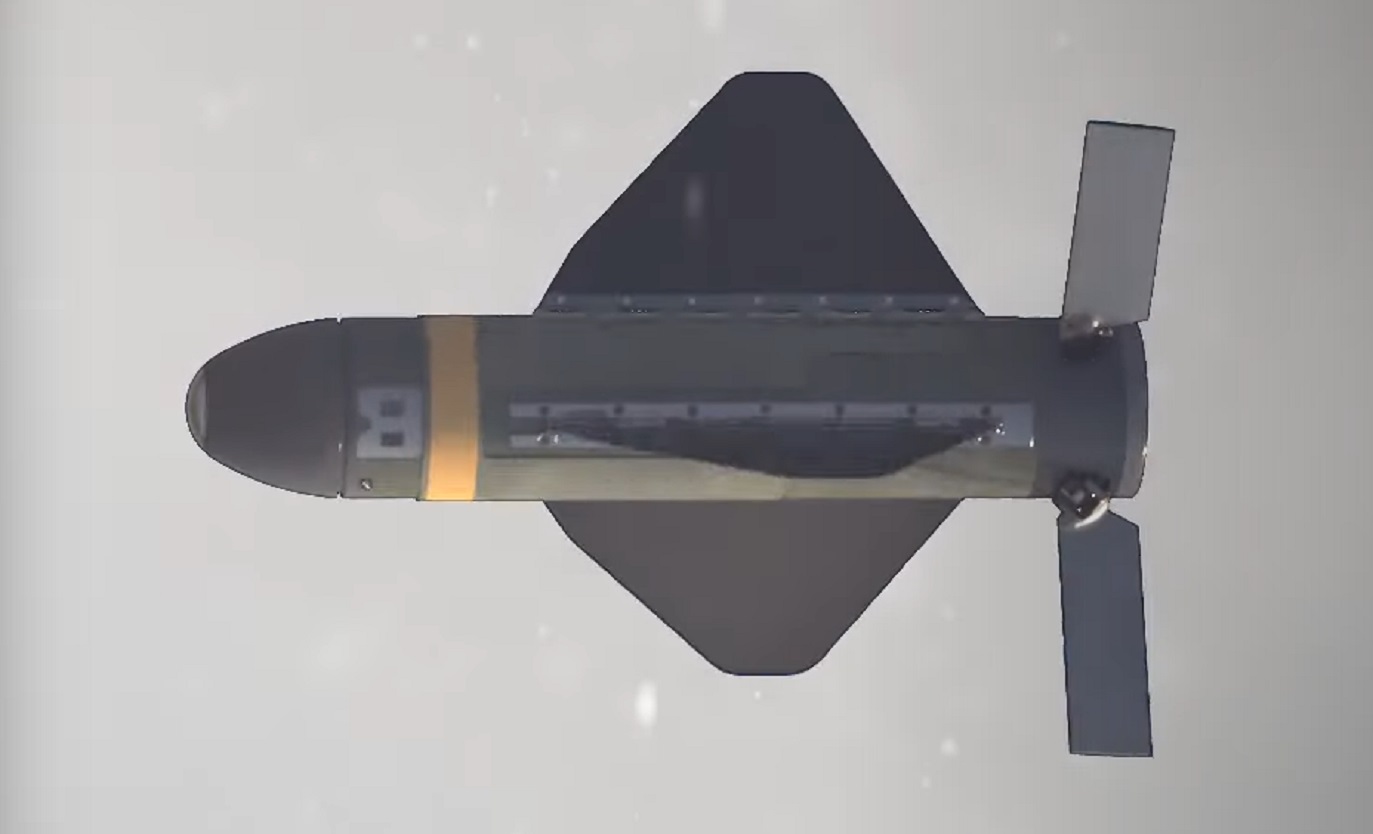
Defense giant Northrop Grumman Corp. has announced that its Hatchet miniature strike munition underwent multiple live fire exercises.
According to a press release from NG, Hatchet munition recently participated in several Department of Defense tests where a smart mini bomb was employed for the first time from Group-3 Unmanned Aircraft System (UAS) platforms.
One of the featured demonstrations was the U.S. Army’s premier experimental exercise, Project Convergence 2022, where Hatchet was rapidly integrated with an AeroVironment Jump 20 UAS. Aircraft safety and stores communication was facilitated by the Naval Surface Warfare Center – Dahlgren Division’s Battle Management System (BMS). This U.S. Government-owned micro-BMS provides an open architecture, platform agnostic, stores management system with the capability to launch several weapon types – it now includes the Hatchet miniature precision strike weapon.
“Over the last six months, Hatchet underwent multiple Department of Defense live fire exercises, showcasing its operational capability and integration maturation,” said Joe Esler, business development for Northrop Grumman. “These demonstrations move Hatchet one step closer to field deployment and operational readiness.”

Hatchet’s compressed carriage design provides multiple weapon loadouts without adversely affecting aircraft endurance.
Hatchet is a miniature lightweight, precision-guided munition that achieves high lethality by adaptively coupling its fragmenting warhead effects with an innovative terminal guidance design. When dropped from a Group-3 UAS on both stationary and moving targets, Hatchet’s accuracy to target was consistently less than two meters. The size, accuracy, and lethality of Hatchet is ideal for use on all aircraft, but specifically enhances unmanned aircraft missions.
“By arming the smaller, organic unmanned systems, the soldiers on the ground become less reliant on the larger, low density, high demand aircraft assets to accomplish their mission,” said Esler. “As we have seen in Ukraine, these smaller, weaponized UAS systems have been proven very effective on the battlefield.”