

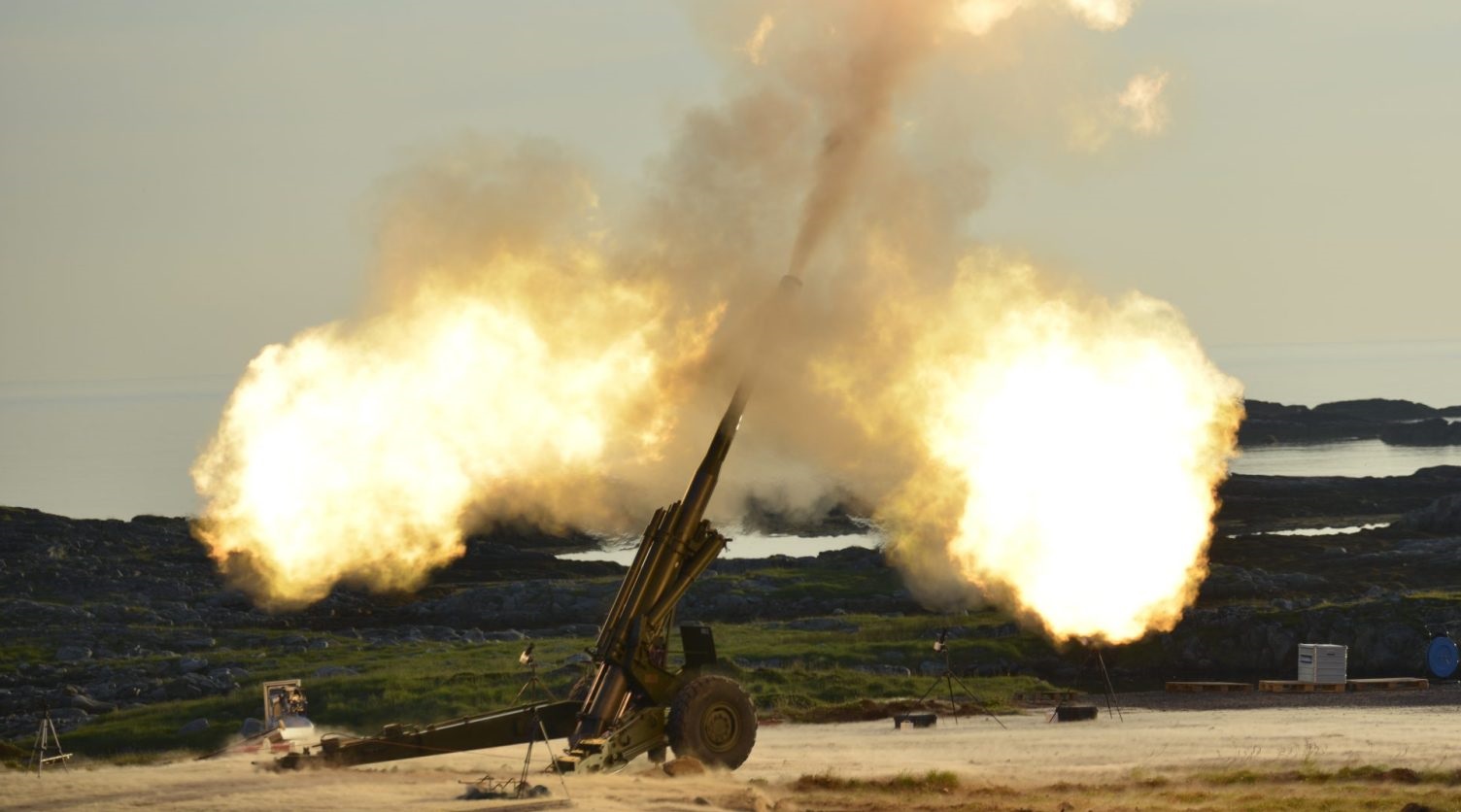
Norway’s Nammo and U.S. aerospace giant Boeing have jointly test-fired a ramjet-powered artillery shell that any standard 155mm howitzer can fire at targets more than 50 miles (80km) away.
According to a press release from Nammo, during the June 28 test at the Andoya Test Center in Norway, a Boeing Ramjet 155 projectile was fired out of a cannon and its ramjet engine ignited successfully. It demonstrated flight stability with a well-controlled engine combustion process.
“We believe the Boeing Ramjet 155, with continued technology maturation and testing, can help the U.S. Army meet its long-range precision fires modernization priorities,” said Steve Nordlund, Boeing Phantom Works vice president and general manager. “This successful test is evidence that we are making great progress.”
“This is a historic moment for Nammo,” said Nammo Chief Executive Officer Morten Brandtzæg. “The test results demonstrate that ramjets are viable and can fundamentally change the future of artillery.

“We have great confidence in the ramjet concept,” Brandtzæg added. “The test – with all aspects from cannon firing, to the projectile body, fins, and trajectory all functioning perfectly – represents a real technological breakthrough in artillery, and a major success for Boeing, Nammo, and the U.S. Army.”
The long-range test at Andøya follows years of research, development and testing by Boeing and Nammo of ramjet technology, including more than 450 static or short-range tests.
Boeing Phantom Works and Nammo have been working together under a strategic partnership to jointly develop and produce the next generation of boosted artillery projectiles. In July 2019, the Boeing-Nammo team was awarded a contract under the U.S. Army’s XM1155 program to develop and mature the Ramjet 155 projectile. In May 2021, the team was awarded a Phase II technology development contract.
Ramjet 155 uses an engine in which the air drawn in for combustion is compressed solely by the forward motion of the projectile at supersonic speeds. Considered a hybrid between guided artillery and missiles, the program has an objective of a common round design that can be used in L39 and L58 cannons.
The team continues to develop and mature the technology, with further testing and demonstrations planned in the coming months.
As noted by the company, NAMMO also developing an extended range version that goes out to 80km or 150km.