

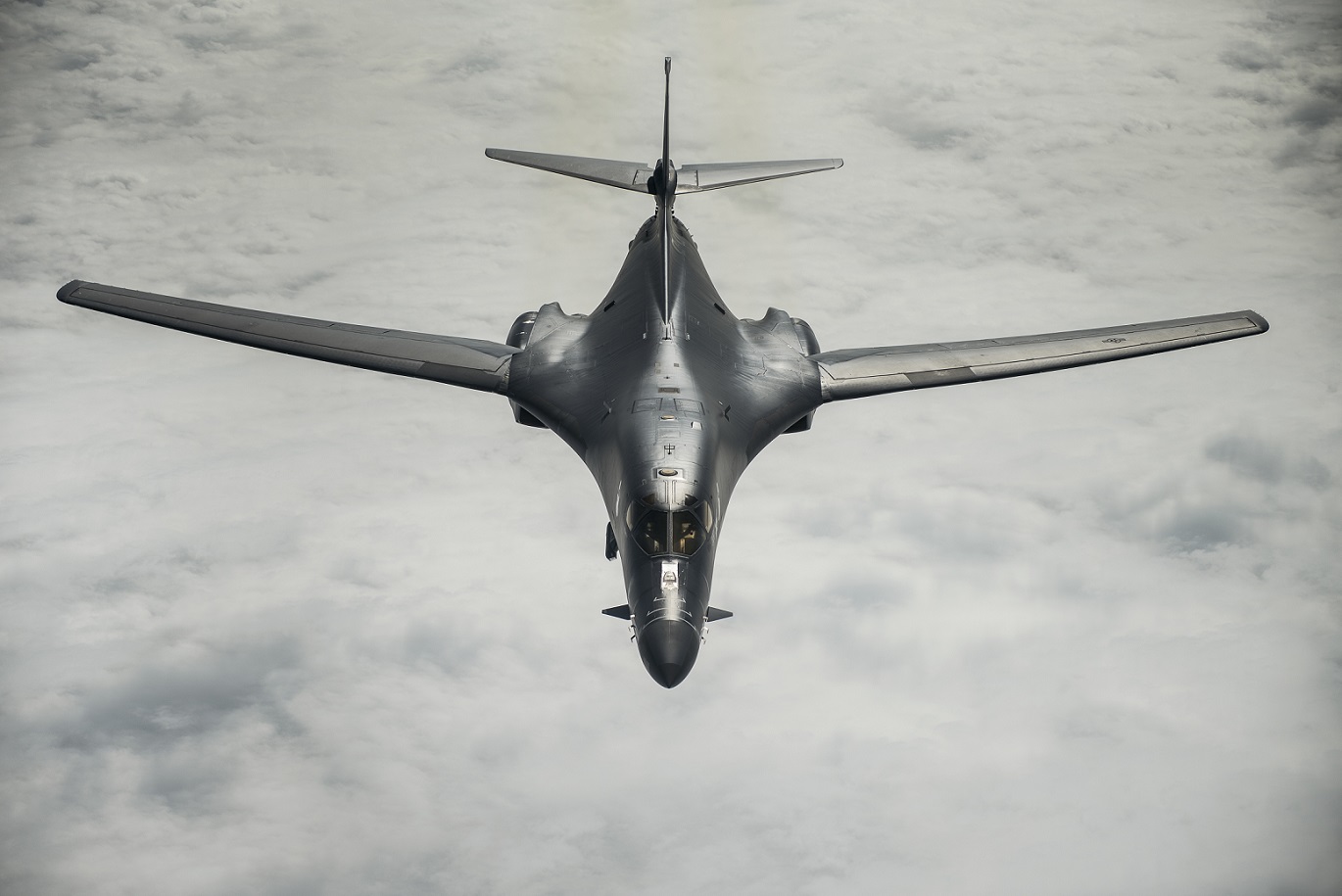
Thirty-five years ago, the first B-1B Lancer long-range, multi-mission, supersonic conventional bomber was delivered to the U.S. Air Force.
On June 29th, 1985, at 1:55 PM, a B-1B nicknamed Star of Abilene was the first example of the bomber to land at Dyess Air Force Base, Texas as part of a delivery ceremony in front of an air show crowd of 45,000. Initial operational capability was reached on 1 October 1986 and the B-1B was placed on nuclear alert status.
Originally designed for nuclear capabilities, the B-1 switched to an exclusively conventional combat role in the mid-1990s. In 1999, during Operation Allied Force, six B-1s flew 2 percent of the strike missions, yet dropped 20 percent of the ordnance, and during Operation Enduring Freedom the B-1 flew on 2 percent of the sorties while dropping over 40 percent of the precision weapons. The B-1 has been nearly continuously deployed in combat operations over Afghanistan, Iraq and Syria since 2001.
The B-1 can carry the largest conventional payload of both guided and unguided weapons in the U.S. Air Force.
The B-1 is able to carry a larger payload of Joint Air-to-Surface Standoff Missiles and a larger payload of 2,000-pound class Joint Direct Attack Munitions. Additionally, the B-1 is able to carry the Long Range Anti-Ship Missile, giving it an advanced stand-off, counter-ship capability. It also has an advanced self-protection suite and is able to transit at supersonic speeds to enhance offensive and defensive capabilities.
Even today, the B-1B is evolving as a weapons platform. The aircraft continues to receive technological upgrades and cutting edge standoff munitions.
The B-1 has come a long way in its first 35 years of combat and has supported the Air Force mission and helped in maintaining the freedom of the United States. And decades later, the B-1 continues to evolve to meet the mission, ready for today’s fight and tomorrow’s needs.