

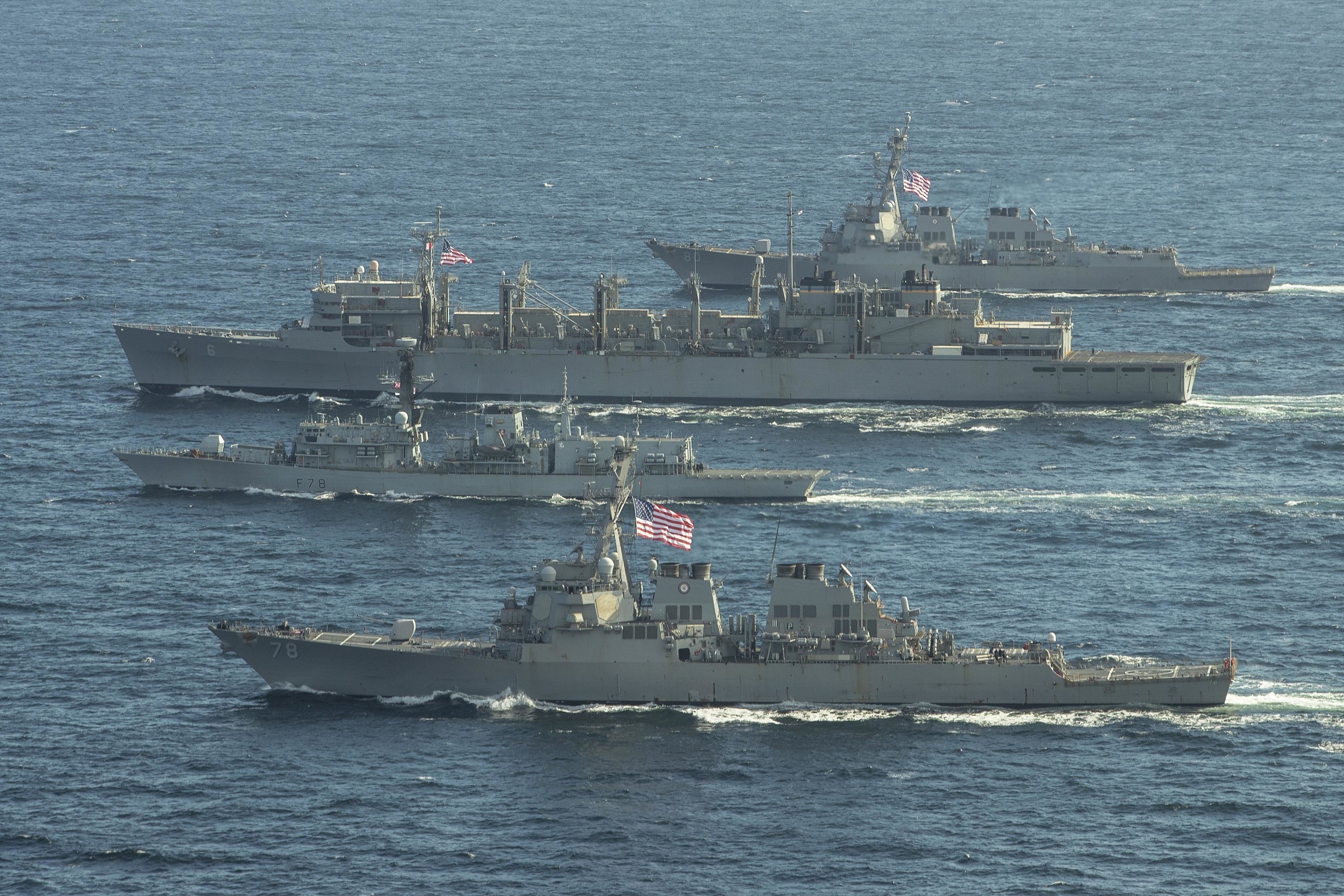
The U.S. Navy has confirmed that U.S. the Arleigh Burke-class guided-missile destroyers and a British Type-23 Duke-class frigate departed the Barents Sea, following seven days of Arctic operations.
The purpose of the operation was “to assert freedom of navigation and demonstrate seamless integration among allies,” U.S. Naval Forces Europe said in a statement.
This is was the first time when U.S. Navy ships have operated in the area of the Barents Sea off Russia’s Arctic coast since the mid-1980s, the height of the Cold War.
The surface action group (SAG) comprised of U.S. 6th Fleet (C6F) Arleigh Burke-class Aegis destroyers USS Donald Cook (DDG 75), USS Porter (DDG 78), USS Roosevelt (DDG 80), fast combat support ship USNS Supply (T-AOE 6), and Royal Navy’s HMS Kent (F 78) entered the Barents Sea on May 4 to conduct training and operations in the challenging conditions of the Arctic region. Along with the warships, U.S. Navy P-8A Poseidon maritime patrol and reconnaissance aircraft (MPRA) and U.S. Air Force RC-135 reconnaissance aircraft provided support during training and operational events.
“The Arctic is an important region and our naval forces operate there, including the Barents Sea, to ensure the security of commerce and demonstrate freedom of navigation in that complex environment,” said Adm. James G. Foggo III, commander, Naval Forces Europe and Africa. “Our operations with the U.K. demonstrate the strength, flexibility, and commitment of the NATO Alliance to freedom of navigation throughout the Arctic and all European waters.”
As the Arctic continues to become more accessible to maritime traffic, naval proficiency in the region is critical to regional security, global commerce, and American national interests. The SAG’s operations provided the opportunity for Sailors to demonstrate their readiness for sustained Arctic operations in the unique and challenging environment.
As CNN previously reported, the Barents Sea is part of the Arctic Ocean and borders northern Norway and Russia. The Russian port of Murmansk, which hosts the Russian Navy’s Northern Fleet, sits on the sea.