

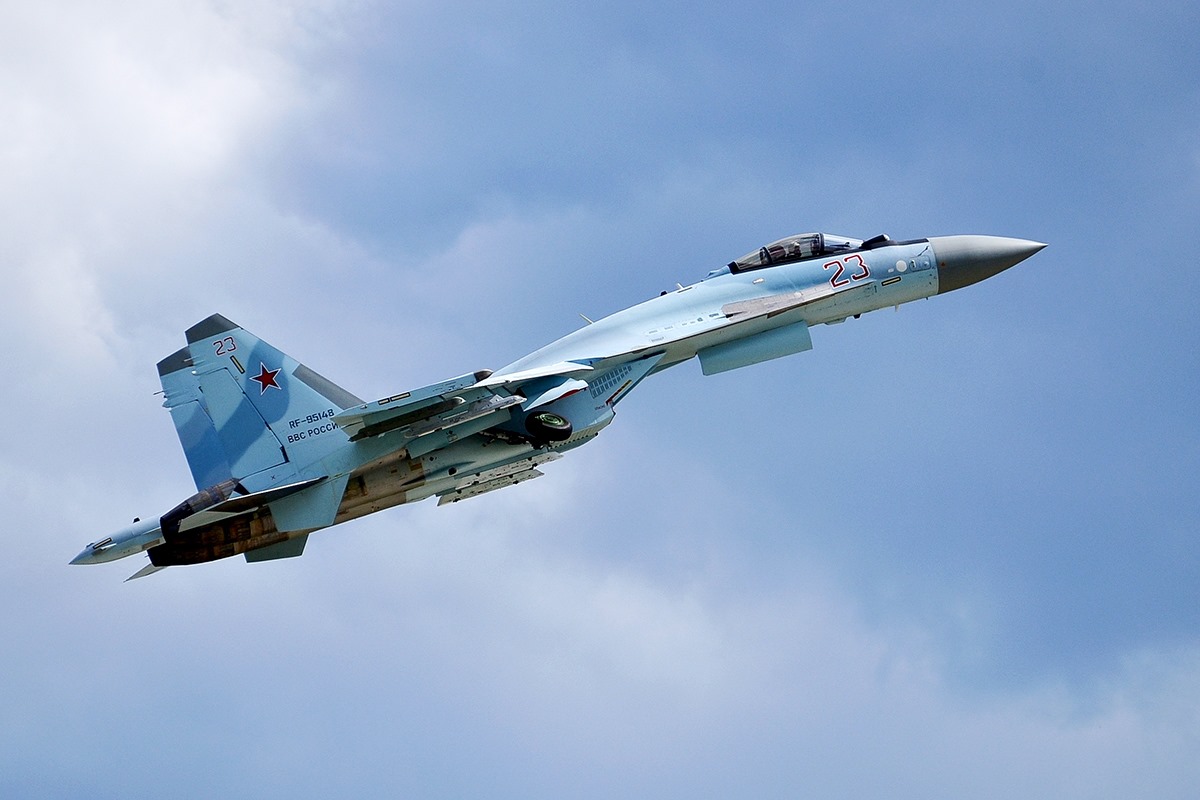
Su-35 fighter jets were scrambled to intercept the U.S Navy P-8A submarine reconnaissance aircraft as he approached Syrian airspace, the Russian Ministry of Defense has said.
The Russian Su-35 fighters scrambled to intercept American reconnaissance aircraft, which was heading towards military facilities in Syria on 20 April.
It is also noted that the intercepting of the American plane also took place in the sky above the Mediterranean Sea on Sunday, April 19. The fighter rose from the Khmeimim air base to identify an unknown object in the airspace.
“On April 19, the Russian equipment controlling the airspace over the neutral waters of the Mediterranean Sea detected an air target performing a flight towards Russia’s military facilities in the Syrian Arab Republic. A fighter jet from the air defense alert quick reaction force of the Hmeymim air base was scrambled to identify the target,” the ministry said in a statement.
The plane belonged to the U.S. Navy.
After the U.S. plane changed its course, the Russian fighter returned to its air base, the ministry added.
“The aircraft of Russia’s Aerospace Force performed and perform all flights in strict compliance with the international rules of using the airspace over neutral waters,” the statement says.
The U.S. military’s statement said that a Russian fighter plane on Sunday cut within 25 feet of a U.S. military aircraft, marking the second time in less than a week that unsafe maneuvers by Russian pilots put Navy pilots at risk.
BREAKING: Another unsafe #Russian 🇷🇺 intercept of 🇺🇸 @USNavy P-8 in international airspace above #Mediterranean Sea! The Russian aircraft got within 25 feet of the P-8, putting both crews in harm’s way. We expect nothing less than professional & safe interactions!@USEmbRuPress pic.twitter.com/gDdcQQRkOi
— U.S. Naval Forces Europe-Africa/U.S. 6th Fleet (@USNavyEurope) April 19, 2020
The incident over the eastern Mediterranean Sea involved a Russian SU-35 fighter conducting two high-speed intercepts of a U.S. P-8A submarine reconnaissance plane, U.S. Naval Forces Europe-Africa said late Sunday, without specifying the location.
While the first intercept was judged safe, the second was deemed “unsafe and unprofessional due to the SU-35 conducting a high-speed, high-powered maneuver that decreased aircraft separation to within 25 feet,” NAVEUR said in a statement.