

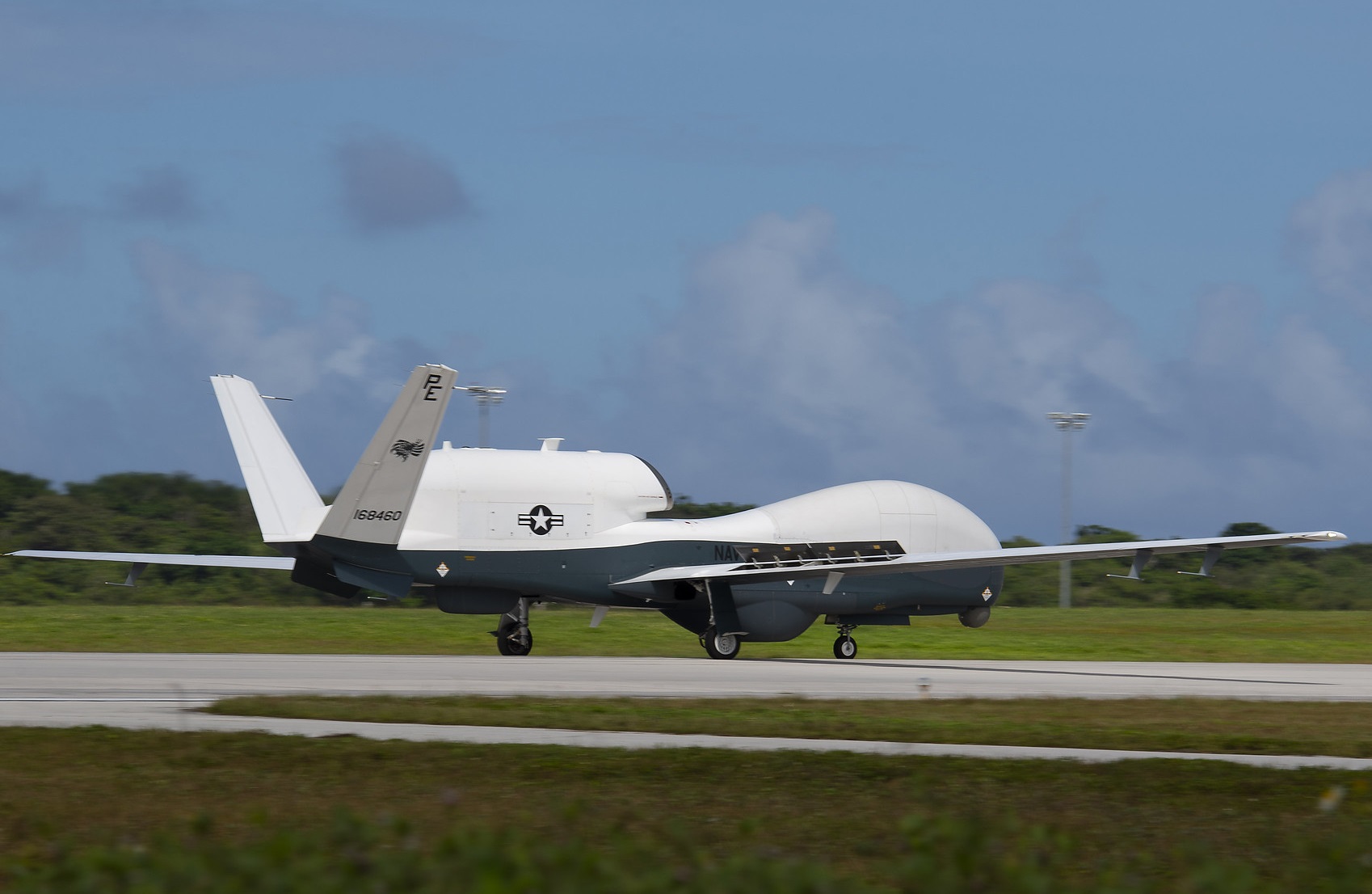
U.S. Pacific Fleet Public Affairs has reported that Navy’s first MQ-4C Triton unmanned aircraft systems (UAS) have arrived in Guam for their initial deployment in the Pacific theater.
Unmanned Patrol Squadron (VUP) 19, the first Triton UAS squadron, will operate and maintain two aircraft as part of an early operational capability (EOC) to further develop the concept of operations and fleet learning associated with operating a high-altitude, long-endurance system in the maritime domain.
The Tritons forward-deployed to Guam, both of which have arrived at Andersen Air Force base as of Jan. 26, will fall under Commander, Task Force (CTF) 72, lead for patrol, reconnaissance and surveillance forces in 7th Fleet.
“The introduction of MQ-4C Triton to the Seventh Fleet area of operations expands the reach of the U.S. Navy’s maritime patrol and reconnaissance force in the Western Pacific,” said Capt. Matt Rutherford, commander of CTF-72. “Coupling the capabilities of the MQ-4C with the proven performance of P-8, P-3 and EP-3 will enable improved maritime domain awareness in support of regional and national security objectives.”
The Navy’s Persistent Maritime UAS program office at Patuxent River, managed by Capt. Dan Mackin, and industry partner Northrop Grumman, worked closely with VUP-19 in preparation for EOC. Prior to flying the aircraft to Guam, the team completed extensive operational test and unit level training.
“This is a significant milestone in the MQ-4C Triton program,” said Doug Shaffer, vice president and program manager, Triton program, Northrop Grumman. “Our partnership with the U.S. Navy has been crucial in developing this system that will help commanders build a better common operational picture.”
The U.S. Navy’s newest and most technologically advanced ISR platform, Triton’s autonomous suite of maritime sensors allows operators to detect, track, classify and identify vessels on the ocean or in the littorals in some of the world’s busiest shipping lanes.
Triton’s ability to fly at high altitude and remain airborne in excess of 24 hours allows commanders to surveil a larger maritime area than ever before. Designed to operate in a manned-unmanned teaming concept, Triton provides an unblinking eye over massive swaths of ocean and littoral areas, enabling manned aircraft such as the U.S. Navy’s P-8 Poseidon to focus on anti-surface and anti-sub-surface warfare.
Unmanned Patrol Squadron One Nine, or VUP-19, is the first squadron to operate the MQ-4C.
Northrop Grumman solves the toughest problems in space, aeronautics, defense and cyberspace to meet the ever evolving needs of our customers worldwide. Our 85,000 employees define possible every day using science, technology and engineering to create and deliver advanced systems, products and services.