

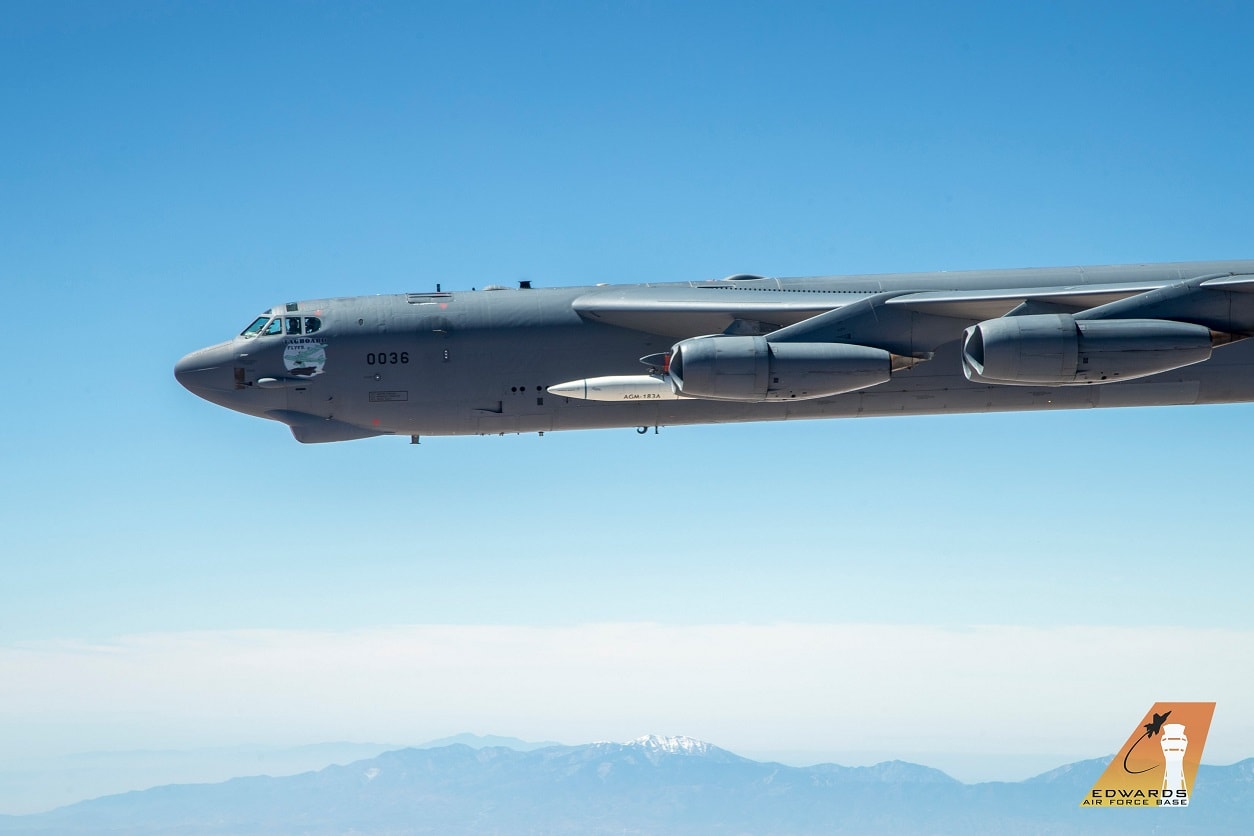
The U.S. defense giant Lockheed Martin provide more details of AGM-183A Air-Launched Rapid Response Weapon (ARRW) hypersonic flight test.
A statement from the Lockheed Martin claims that the U.S. Air Force and the company successfully flight tested the AGM-183A Air-Launched Rapid Response Weapon (ARRW) on the service’s B-52 Stratofortress out of Edwards Air Force Base, Calif., on June 12, 2019.
This captive carry flight is the most recent step in the U.S. Air Force’s rapid prototyping effort to mature the hypersonic weapon, AGM-183A, which successfully completed a preliminary design review in March. More ground and flight testing will follow over the next three years.
“With hypersonic capabilities being a national security priority, Lockheed Martin and the U.S. Air Force are accelerating the maturation and fielding of a hypersonic weapon system,” said Frank St. John, executive vice president at Lockheed Martin Missiles and Fire Control. “Lockheed Martin is proud to partner with the U.S. Air Force on this important initiative.”
Hypersonic weapons provide a survivable and affordable capability that will overcome distance in contested environments using high speed, altitude and maneuverability. They amplify many of the enduring attributes of airpower – speed, range, flexibility and precision.
Robust experience in high-speed flight has positioned Lockheed Martin to be an industry leader in hypersonic technology, providing the most mature and cost-effective solutions for addressing increasing threats in the global security arena.
Lockheed Martin has played a significant role in the research, development and demonstration of hypersonic technologies for more than 30 years. The corporation has made significant investments in key technology and capability development – including hypersonic strike capabilities and defense systems against emerging hypersonic threats – and is firmly committed to supporting the U.S. government in developing these technologies.