

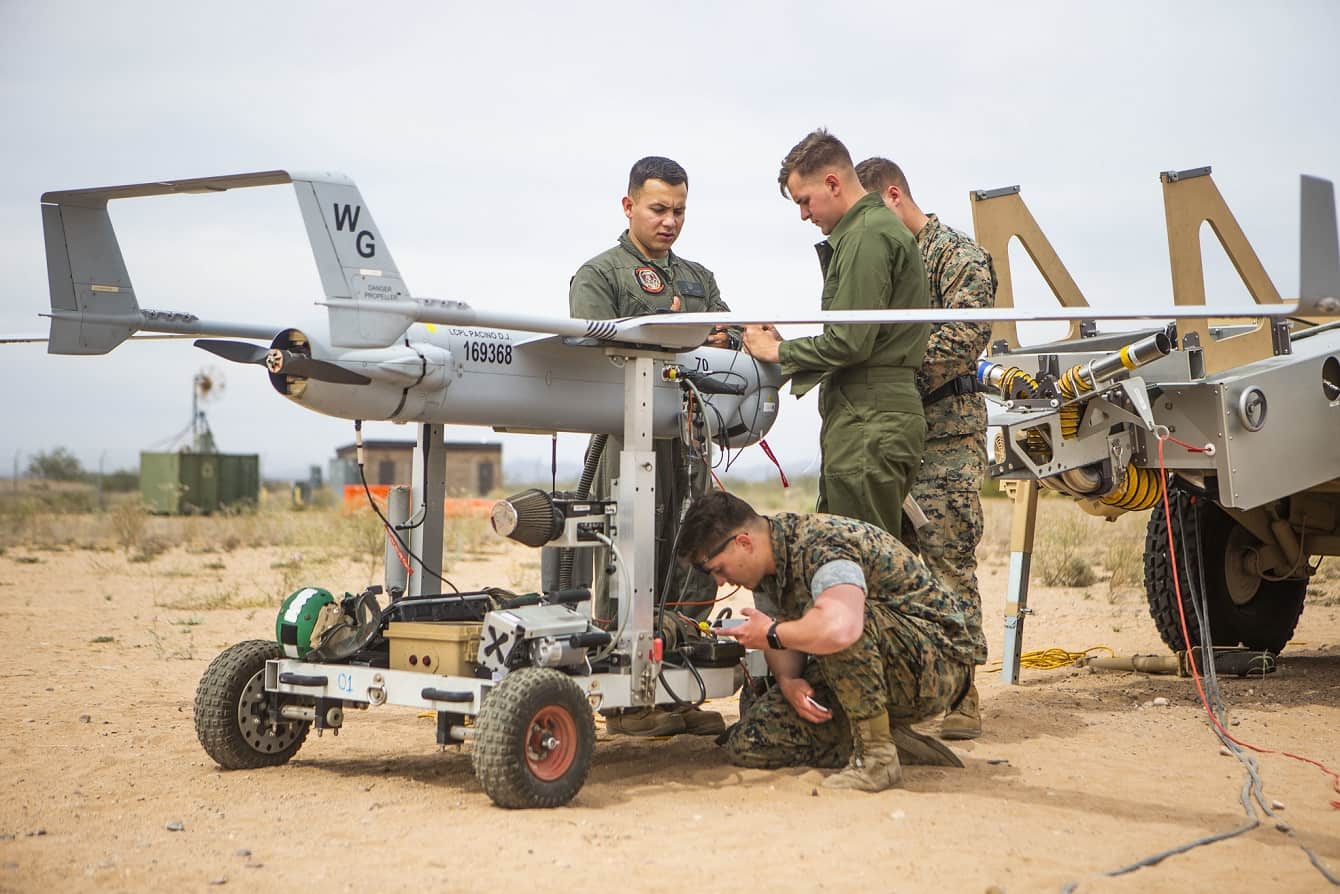
The U.S. Department of State has approved a possible $80 million Foreign Military Sale (FMS) to the United Arab Emirates of a further batch of RQ-21A Blackjack unmanned aerial surveillance system, the Defense Security Cooperation Agency (DSCA) said in a 24 May statement.
The prospective FMS package includes twenty RQ-21A Blackjack Unmanned Air Vehicles (UAVs). Also included are forty Global Positioning Systems (GPS) with Selective Availability Anti-Spoofing Module (SAASM) Type II (MPE-S); air vehicle support equipment including eight Ground Control Stations (GCS), four launchers, and four retrievers; spare and repair parts; publications; training; and technical support services.
The Secretary of State has determined and provided detailed justification that an emergency exists that requires the immediate sale to the United Arab Emirates of the above defense articles (and defense services) in the national security interests of the United States, thereby waiving the Congressional review requirements under Section 36(b) of the Arms Export Control Act, as amended.
The proposed sale, which still needs to be approved by the U.S. Congress, is aimed to provide UAE with “developing and maintaining a strong and ready self-defense capability and enhancing interoperability with U.S. forces”, said the DSCA, adding that “The UAE will have no difficulty absorbing these UAVs into its armed forces”.
The prime contractor will be Insitu, Bingen, WA, a wholly owned subsidiary of the Boeing Company.
The Blackjack surveillance system provides the warfighter with dedicated day and night intelligence, surveillance, and reconnaissance coverage, target acquisition, and communication relay via a dedicated and cost effective airborne sensor system capable of delivering actionable intelligence to the tactical commander in real time.
The RQ-21A Blackjack can safeguard military bases and activities through a pattern of life identification and explosive device detection. It is equipped with an electro-optic/infrared payload that supports the real-time monitoring to provide indications and threat warnings, and its plug-and-play payloads enable multi-intelligence capability to support a broad range of operations.