

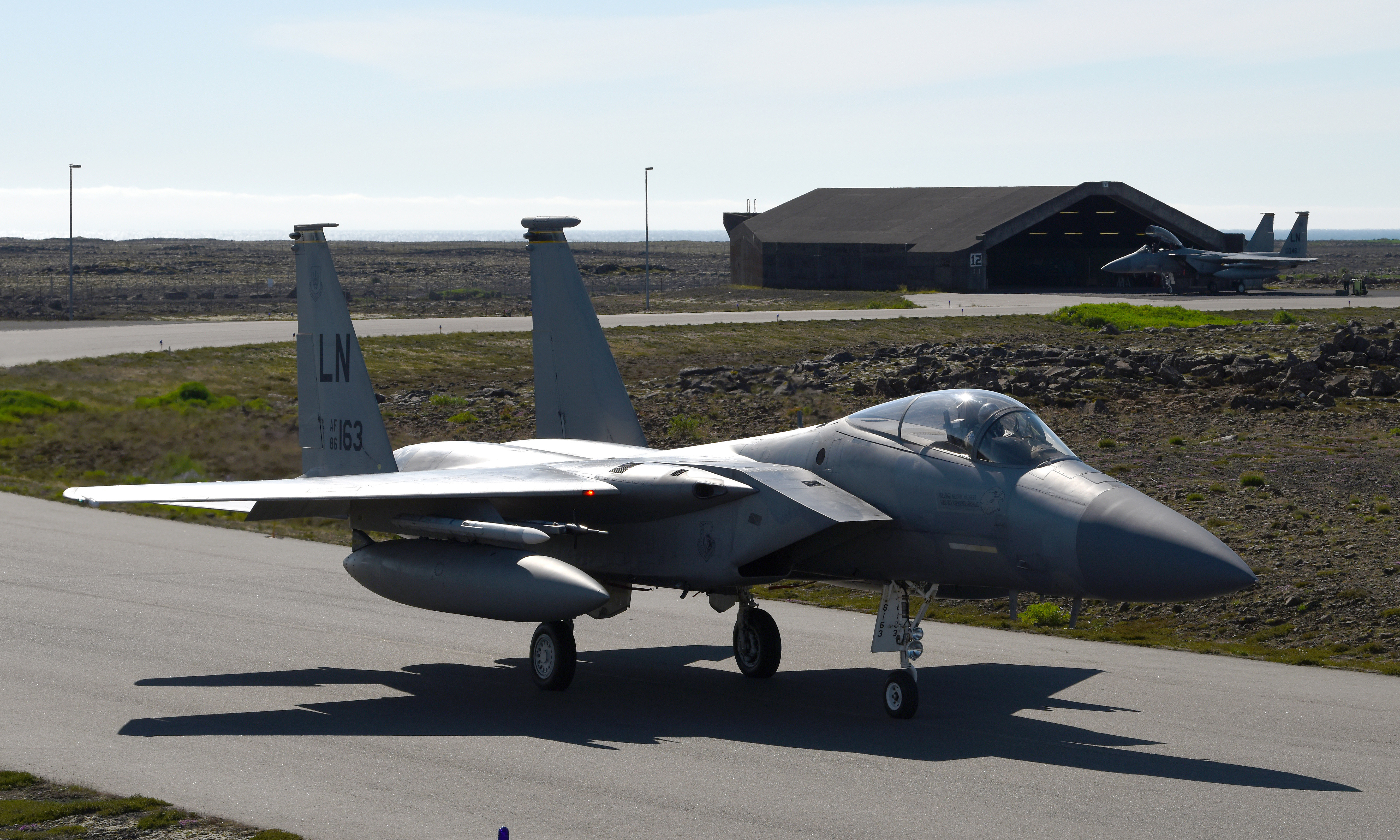
The U.S. Department of Defense (DoD) announced in a 6 August statement that the 493rd Expeditionary Fighter Squadron are helping to guard the skies over Iceland for the eleventh time since NATO’s Icelandic Air Surveillance mission began.
According to the statement, U.S. Air Force F-15 Eagle pilots from the 493rd Expeditionary Fighter Squadron began flying operations here this week in support of the mission, highlighting America’s commitment to NATO and the strength of its ties with Iceland.
The squadron is tasked with supplying airborne surveillance and interception capabilities to meet its host’s peacetime preparedness needs and bolster the security and defense of allied nations.
During their rotation, the squadron will maintain an alert status 24 hours a day, seven days a week as part of their peacetime mission. This means they are ready to respond within minutes to any aircraft that may not properly identify themselves, communicate with air traffic control or have a flight path on file.
“This deployment gives us the opportunity to strengthen our NATO partnerships and alliances and train in a different location while continuing to improve our readiness and capability for our alert commitment,” said Air Force Lt. Col. Cody Blake, 493rd EFS commander. “Our overall expectation is to maintain a professional presence in everything we do.”
To remain vigilant, the squadron performs daily “training scrambles” in which they simulate real-world alert notification and execute planned protocols to ensure a speedy response.
More than 250 airmen assigned to U.S. Air Forces in Europe-Air Forces Africa and 13 F-15C/D Eagles deployed from Royal Air Force Lakenheath, England, with additional support from U.S. airmen assigned to Aviano Air Base, Italy. Four of the aircraft are tasked with direct support of the Icelandic Air Surveillance mission, while the additional nine aircraft will conduct training missions, providing pilots invaluable experience operating in unfamiliar airspace.
While providing critical infrastructure and support, Iceland has looked to its NATO allies to provide airborne surveillance and interception capabilities to meet its peacetime preparedness needs since 2008.
“Every year, we experience how qualified the air forces of the NATO nations are and how well trained they are to conduct the mission,” said Icelandic Coast Guard Capt. Jon B. Gudnason, Keflavik Air Base commander. “This is what makes NATO such a great partner.”
NATO allies deploy aircraft and personnel to support this critical mission three times a year, with the U.S. responsible for at least one rotation annually. So far, nine nations have held the reigns in support of Iceland: Canada, the Czech Republic, Denmark, France, Germany, Italy, Norway, Portugal and the U.S.