


The U.S. Air Force has acquired the wreckage of a downed UH-1 Iroquois helicopter and transported the iconic airframe to Dyess Air Force Base, Texas, where it will serve as a hands-on teaching platform for accident investigation and flight safety courses.
The helicopter, nicknamed “Huey,” crashed during a training mission at the Wyoming Air National Guard Base in Cheyenne in 2023. All three aircrew members survived the incident. Now, through a coordinated effort involving multiple Air Force commands and units, the aircraft is being repurposed as an educational asset for the 436th Training Squadron (TRS), which specializes in accident investigation, life science equipment analysis, and weapons and occupational safety training.
“The acquisition of the UH-1 will give 100% hands-on training and experience to AMIC, Life Science Equipment Investigation, Weapons and Occupational Safety students,” said Capt. Matthew Greene, 436th TRS flight safety commander.
On September 17, 2025, before dawn broke over Dyess Air Force Base, four public affairs specialists from the 7th Bomb Wing and 436th TRS joined a C-130J Hercules flight crew from the 39th Airlift Squadron with a clear objective: retrieve the UH-1 wreckage from Wyoming and deliver it safely to its new home in Texas.
The complex mission was the result of weeks of planning and coordination involving the Air Force Global Strike Command, Air Combat Command, and Air Mobility Command, along with the Wyoming Air National Guard’s 153rd Airlift Wing and the 317th Airlift Wing based at Dyess. Greene also worked closely with logisticians from the 90th Missile Wing Logistics Readiness Squadron at Francis E. Warren AFB and aircrew from the 39th AS to prepare for the unique load and transport operation.
“The Flight Safety cadre wanted to have all labs in person to provide excellent hands-on training,” Greene said, explaining the decision to retrieve the helicopter rather than rely on mock-ups or simulations.
The 2.5-ton aircraft was carefully loaded and prepared for transport by the 153rd Logistics Readiness Squadron, while Capt. Shannon Hunter, chief of tactics for the 39th Airlift Squadron, led mission planning for the journey from Cheyenne to Dyess.
“The C-130J that was flown has a max takeoff weight of 175,000 pounds with an 89,000-pound basic operating weight and 42,000 pounds of fuel. But cargo weight depends on a lot of different factors,” Hunter said. “From a training aspect, this went well. We were also able to accomplish high-pressure altitude training.”
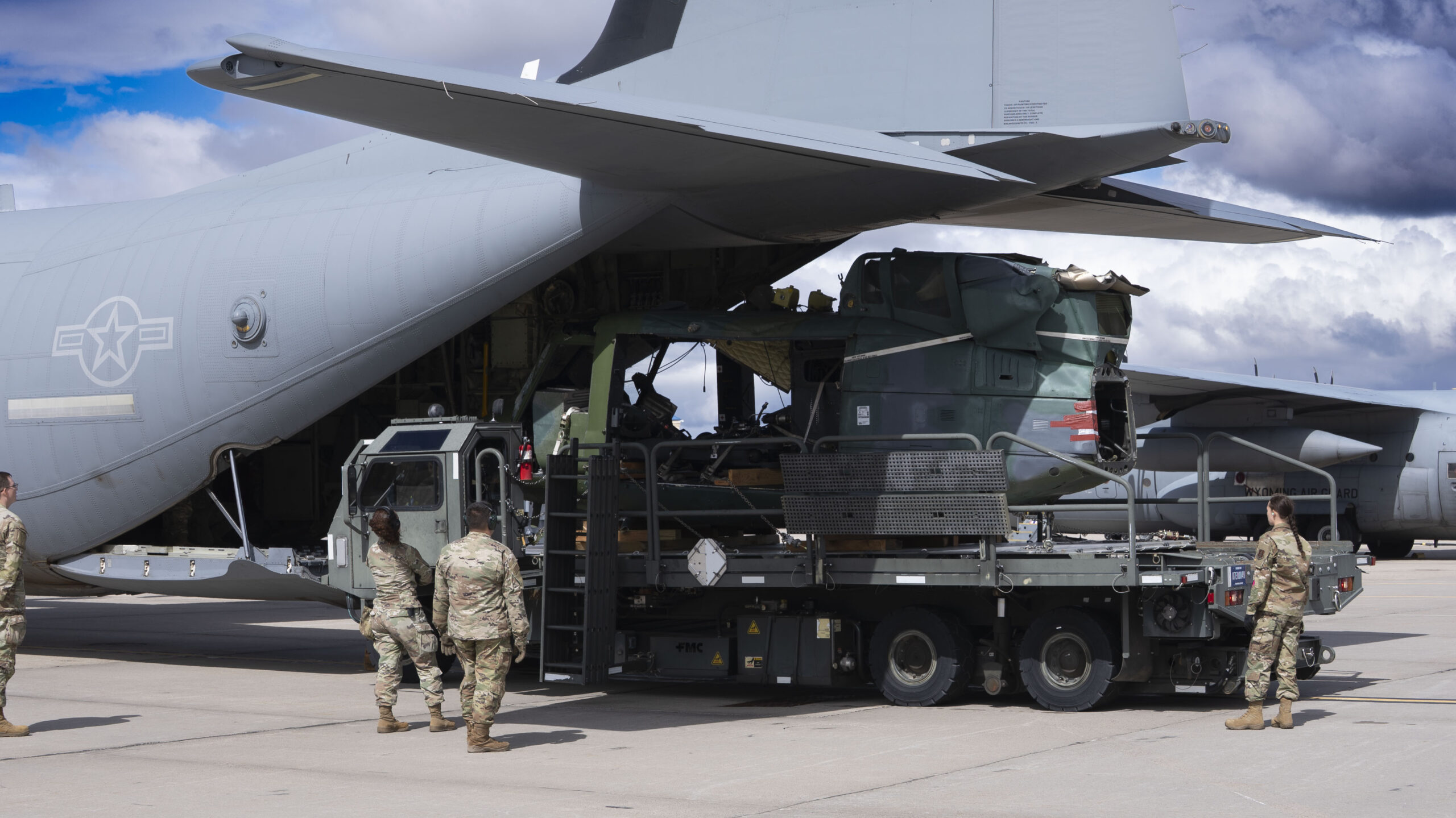
The mission also doubled as a valuable training exercise for aircrew. Senior Airman Cory McCloskey, a 39th AS loadmaster instructor, used the operation to train a new student in real-world cargo handling.
“This mission was extremely rewarding, especially since I was able to bring a new student along and give him hands-on experience with real cargo on a real mission,” McCloskey said. “Working with other units on this retrieval was fascinating, as it was a chance to collaborate with new people and accomplish the mission together.”
The recovered helicopter will now become a centerpiece of the Aircraft Mishap Investigation Course (AMIC), where students learn how to examine aircraft wreckage, identify failure points, and determine the causes of accidents. The authenticity and recency of the UH-1 crash will allow students to sharpen their investigative skills in a real-world context — one that reflects the challenges of modern flight operations.
The 436th TRS Instructional Production Flight also planned and coordinated historical documentation of the recovery mission. These materials will be used as part of future training programs, providing multimedia resources to supplement the hands-on experience.
Master Sgt. Jon Alderman, public affairs superintendent for the 153rd Airlift Wing, volunteered to document the early stages of the project, capturing the helicopter’s transformation “from forgotten aircraft to priceless training asset.”
By repurposing actual wreckage instead of relying on simulations, the service is preparing future investigators and safety specialists to handle the complexities of real-world mishaps — from evidence collection to final reporting.