

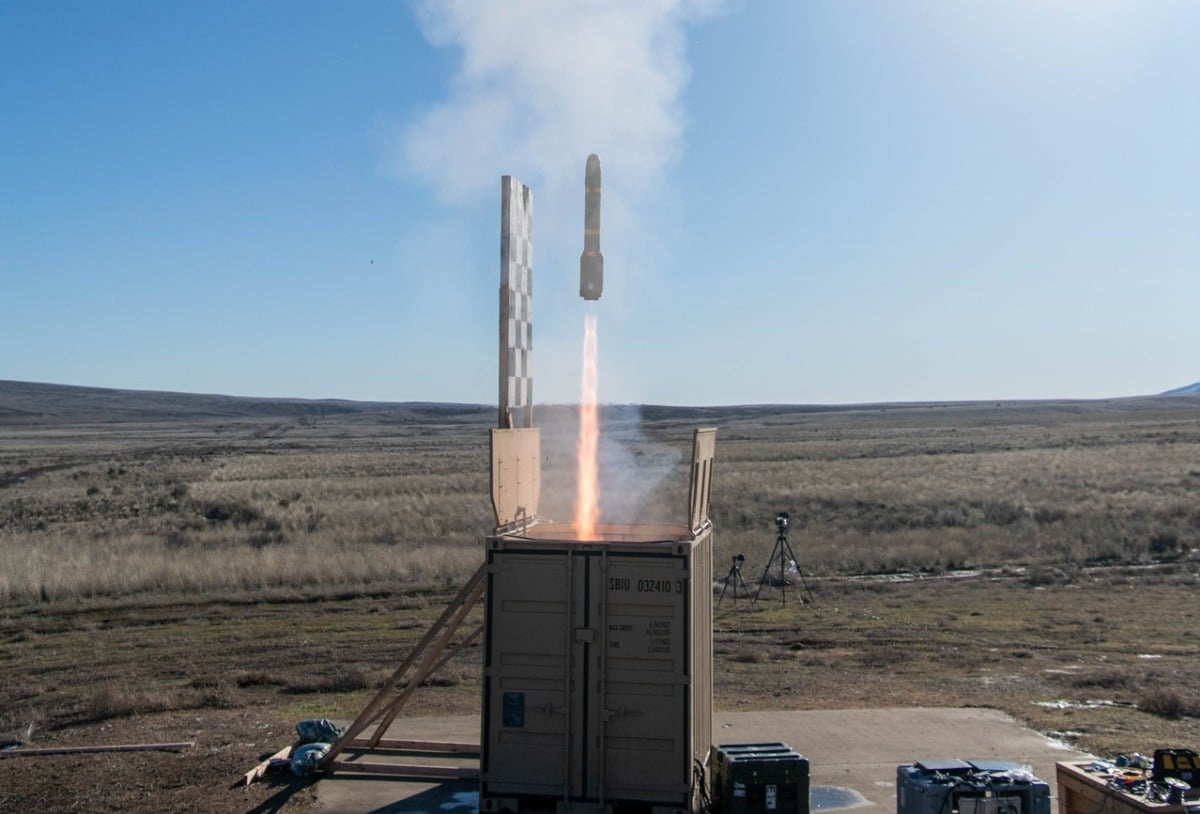
- Lockheed Martin intercepted a Shahed-style drone using a JAGM missile fired from a Grizzly containerized launcher in a live-fire test.
- The full counter-UAS kill chain, using Sanctum AI software and Fortem R40 radar, was assembled and tested in under 45 days.
The drones that have reshaped warfare over Ukraine are now the target of a new American kill chain, and the company behind the F-35 just proved it can destroy one in a live-fire test using a combination of artificial intelligence, battlefield radar, and a missile fired from a shipping-container-sized launcher.
Lockheed Martin, the defense giant and the largest American defense contractor by revenue, said to Axios this week that it had successfully intercepted a Shahed-style attack drone, a one-way kamikaze munition modeled after the Iranian design that Russia has used in mass strikes against Ukrainian cities, using a Joint Air-to-Ground Missile, or JAGM, fired from what the company calls a Grizzly containerized launcher, marking the first time Lockheed had ever used JAGM to kill an unmanned aerial threat of this type.
The significance of the test lies not just in the intercept itself, but in the architecture behind it. Lockheed used its Sanctum system as the battle manager, the central software brain that fuses sensor data, tracks the threat, and cues the weapon to fire. Sanctum, which the company describes as AI-enabled, received targeting data from Fortem Technologies’ R40 radar, a truck-portable detection and tracking sensor built specifically for counter-drone operations, and from that first radar contact through to missile impact, the entire chain worked as a single integrated system.
The timeline has drawn particular attention from analysts and defense watchers. Lockheed Chairman, President, and CEO Jim Taiclet said the company assembled this complete counter-drone capability from existing proven components, integrating the radar, software, missile, and launcher into a working end-to-end system in under 45 days — a figure that stands out sharply in a procurement culture that routinely measures such timelines in years. Lockheed vice president and former Trump White House official Jalen D. put it plainly in a social media post: “A complete counter-drone kill chain delivered in 45 days. That’s the speed today’s threats demand.”
The Shahed-136, the Iranian-designed loitering munition that Russia has manufactured domestically under the name Geran-2 and deployed in hundreds of overnight strikes against Ukrainian power infrastructure, has become a defining weapon of the modern battlefield. It is cheap, roughly $40,000 to $80,000 per unit by most estimates, hard to detect on radar because of its small cross-section, and devastating when it reaches its target. Defending against it at scale using expensive surface-to-air missiles has proven economically unsustainable for Ukraine, and the problem has not been lost on American planners who have been pushing hard for cost-effective, rapidly deployable overhead defenses that can be boxed up, trucked out, and made operational within hours.
The Grizzly launcher concept speaks directly to that requirement. Packaged in a standard military container rather than a fixed installation requiring permanent infrastructure, the system is transportable by truck, rail, or cargo aircraft, and that mobility matters enormously in a contested environment where static air defense sites become priority targets. By pairing a mobile launcher with an AI-driven battle manager and a mature guided missile, Lockheed is offering something the military has been asking for: lethal counter-drone capability that can follow the force.
JAGM is a well-understood weapon with a solid operational record, developed originally to replace the Hellfire missile on Army and Marine helicopters. It uses a multi-mode seeker that can track targets using semi-active laser guidance, millimeter-wave radar, or a combination of the two, carries a shaped-charge warhead capable of defeating both armored vehicles and, as this test confirmed, fast-moving aerial threats, and reaches out to roughly 16 km (10 miles). Repurposing it as a counter-UAS weapon represents an important economy of existing investment, drawing from a missile already in full production rather than funding a new development program from scratch.
Fortem Technologies, a Utah-based startup that has built its reputation on counter-drone radar and intercept technology, developed the R40 as a dedicated low-altitude surveillance radar tuned to the signatures of small and medium unmanned aircraft. Its integration into the Sanctum architecture means the kill chain benefits from a sensor built from the ground up to find exactly the kind of targets the system is designed to kill, rather than adapting a general-purpose radar to a task it was never optimized for.
Sanctum represents Lockheed’s broader bet on software-defined, AI-curated air defense, designed to ingest data from multiple sensor types, correlate tracks, assess threat priority, and assign available weapons automatically, reducing the cognitive burden on human operators who may be managing dozens of simultaneous threats in a compressed timeframe. In a mass drone attack of the kind Russia has launched against Ukraine, where dozens of Shaheds approach from multiple directions at low altitude, the ability to process and engage threats faster than a human crew can react is not a nice-to-have feature. It is the difference between a defended city and a dark one.
Military commanders and Department of War officials have repeatedly flagged the gap between the volume of drone threats likely in a near-peer conflict and the capacity of existing air defense systems to handle them, and programs like the Indirect Fire Protection Capability, which combines radar, directed energy, and interceptors on a single platform, reflect that institutional urgency. Lockheed’s test does not close that gap on its own, but it demonstrates that a viable kill chain can be assembled from mature components, integrated rapidly, and made to work in a live-fire environment.
Whether Sanctum and the Grizzly-JAGM combination will find a place in formal acquisition programs remains to be seen, and a successful live-fire test, however encouraging, is a long way from a fielded capability. But in an era when adversaries are buying Shahed clones by the thousand and the next major conflict may begin with drone swarms before a single soldier crosses a border, the ability to stand up a working kill chain in 45 days is exactly the kind of answer the Pentagon has been looking for.