

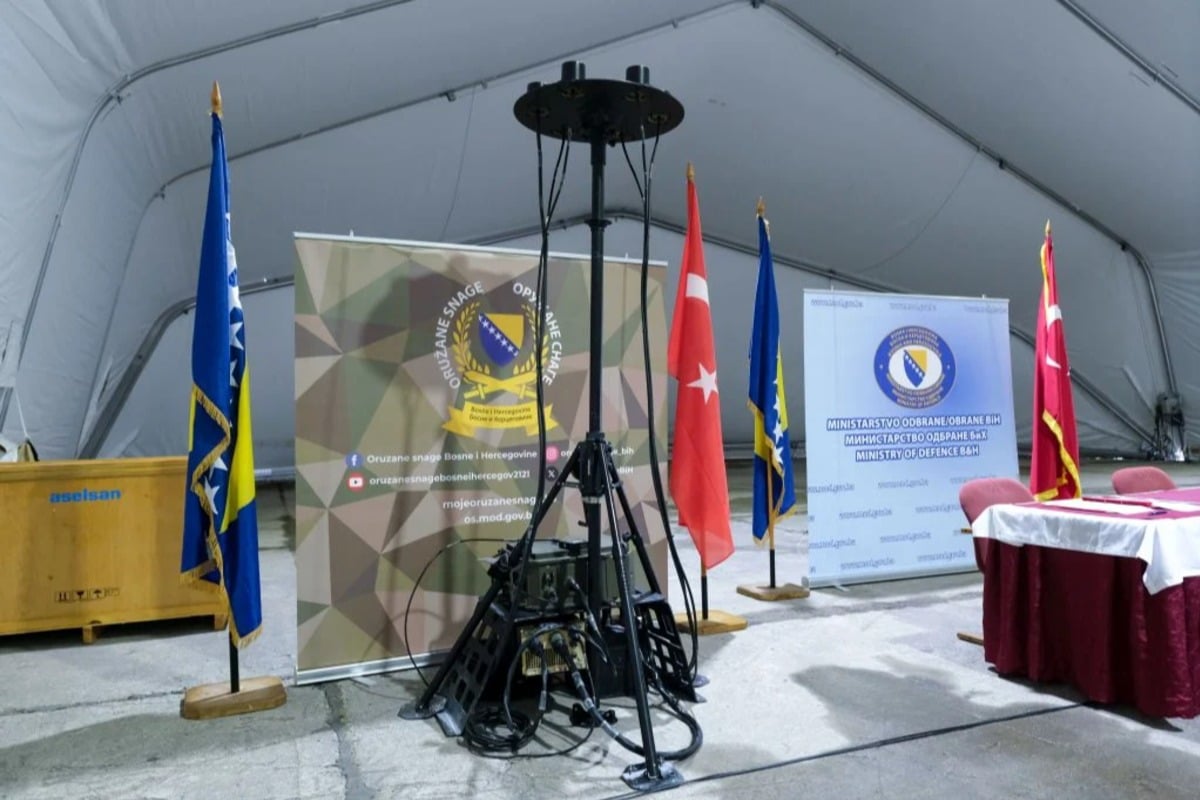
- Bosnia and Herzegovina signed a contract with ASELSAN to acquire 10 KANGAL/ADL 100 anti-drone RF jamming systems.
- Turkey previously donated a KANGAL FPV Anti-Drone System to Bosnia's military in May 2025, part of a broader pattern of Turkish defense support.
Bosnia and Herzegovina is doubling down on Turkish anti-drone technology, signing a new contract to acquire 10 KANGAL/ADL 100 radio-frequency jamming systems from Türkiye-based defense manufacturer ASELSAN, Turkish defense outlet Ulusavunma reported.
The deal marks the latest step in a defense relationship that has already put Turkish-made drones, armored vehicles and counter-drone hardware into Bosnian military hands over the past year.
The KANGAL/ADL 100 is built to blind hostile drones rather than shoot them down, using what the industry calls active radio-frequency jamming to sever the connection between an enemy drone and its operator. The system disrupts the remote-control links, video feeds and data transmissions a drone pilot relies on to fly the aircraft, while simultaneously jamming GPS and GLONASS satellite navigation signals the drone uses to know its own position, according to ASELSAN. That combination matters because modern attack drones increasingly rely on satellite navigation as a backup if their radio link gets cut, so a jammer that only blocks one channel leaves an attacker with a fallback option. The KANGAL/ADL 100 avoids that gap through what ASELSAN describes as a software-defined architecture built around DDS networking standards and FPGA-controlled swept jamming technology, paired with high-efficiency multiband power amplifiers that let a single unit jam every targeted frequency band simultaneously rather than switching between them. The system runs on a lithium-ion battery, giving operators roughly 1.5 hours of continuous jamming coverage before needing a recharge or battery swap.
Türkiye donated a KANGAL FPV Anti-Drone System to the Bosnian military in May 2025, in a handover ceremony at the Rajlovac military barracks in Sarajevo attended by Bosnian Defense Minister Zukan Helez and Turkish officials. That earlier system was designed to protect fixed sites like military facilities, government buildings and checkpoints, and it addressed a threat that has become especially visible during the war in Ukraine, where cheap, first-person-view attack drones have proven capable of destroying vehicles and equipment worth vastly more than the drones themselves. This week’s KANGAL/ADL 100 contract expands that protection with dedicated jamming hardware focused specifically on the radio and satellite navigation links these smaller drones depend on.
Bosnia’s Federation News Agency described the agreement as a donation, while the country’s Defense Ministry referred to it as an acquisition contract, a distinction that matters because it isn’t yet clear from available reporting whether Bosnia is paying for the systems or receiving them at no cost the way it did with the original KANGAL FPV system. Helez, who signed the new agreement alongside ASELSAN CEO Ahmet Akyol at Sarajevo’s Armed Forces Hall, called the equipment the third piece of support arranged with ASELSAN, following the earlier KANGAL donation and a separate transfer of 400 military radios that Bosnia secured through NATO’s Defence and Related Security Capacity Building Initiative, a program that channels voluntary contributions from NATO member states to help partner nations build up their defense capabilities.
The KANGAL/ADL 100 deal fits inside a much broader pattern of Turkish military support flowing into Bosnia over roughly the past 18 months. Türkiye has separately delivered Bayraktar TB2 armed drones, Kirpi II armored vehicles, and additional Kangal-brand equipment to Bosnian forces, while also providing helicopter pilot training and other military assistance, a relationship Bosnian officials have consistently framed as strengthening the country’s ability to defend its own airspace and territory without leaning entirely on more distant Western partners. That framing carries particular weight in Bosnia, a country whose fragile postwar political structure and periodic secessionist tensions from Republika Srpska have made military modernization a genuinely sensitive subject, one where the source and terms of foreign defense assistance draw close domestic scrutiny.
ASELSAN itself has built a substantial international footprint well beyond the Balkans, ranking among Türkiye’s largest defense companies with roughly $3.5 billion in 2024 revenue and technology now in use across more than 90 countries. The company has developed an extensive counter-drone product line beyond the KANGAL family, including systems like the AD 200 Ejderha directed-energy weapon and the SARP 100/35 turret, reflecting a broader Turkish defense industry push to position itself as a leading global supplier of counter-drone technology at a moment when militaries worldwide are scrambling to catch up with how cheaply and effectively small drones can now be weaponized.