

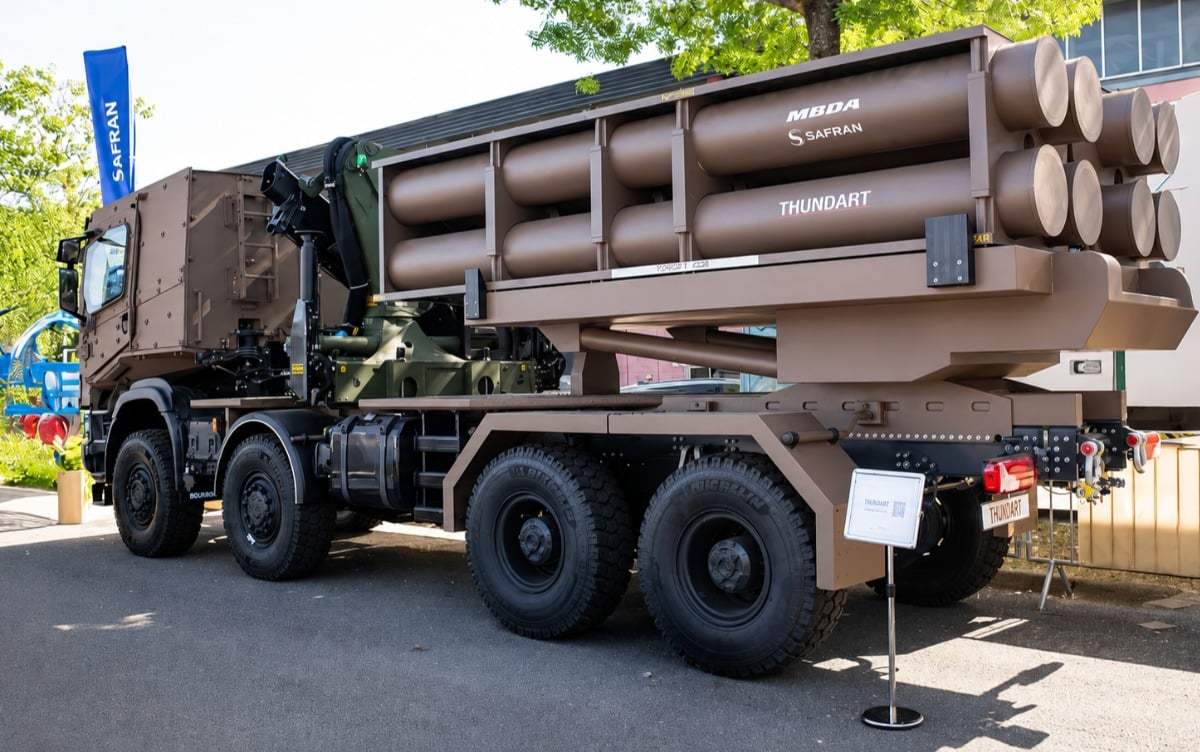
- An anonymous source cited by the X account French Aid to Europe claims THUNDART prototypes will be tested in Ukraine to earn a "combat-proven" label before French Army delivery.
- France selected the MBDA-Safran THUNDART system in June 2026 to replace its LRU rocket launchers, offering roughly 150 km of precision strike range.
France’s next long-range strike weapon might get its first real trial on Ukraine’s front line against Russian forces. According to French Aid to Europe, citing an anonymous source, prototypes of THUNDART, the system set to become the French Army’s future deep-strike capability, are expected to be tested in Ukraine.
“According to an anonymous source, prototypes of the THUNDART system, which will be the future deep-strike capability of the French Army and which will succeed the LRU, are expected to be tested in Ukraine to obtain the ‘combat-proven’ label,” French Aid to Europe wrote.
The claim has not been confirmed by MBDA, Safran, or France’s Ministry of Armed Forces, and it should be treated as unverified until one of those parties weighs in directly.
France currently operates modernized versions of the American M270 rocket system whose guided rockets reach roughly 70 km (43 miles) and are approaching the end of their service lives. THUNDART, developed jointly by missile maker MBDA and Safran Electronics & Defense, is designed to roughly double that range, offering precision strikes out to about 150 km (93 miles) as the winning solution in France’s Frappe Longue Portée Terrestre program, a deep-strike competition run by the French defense procurement agency known as the DGA. French Armed Forces Minister Catherine Vautrin announced in June 2026 that France had entered exclusive negotiations with the Safran-MBDA team, beating out a rival bid from ArianeGroup and Thales as well as an eleventh-hour offer from Lockheed Martin to supply its off-the-shelf HIMARS system, a choice French officials and reporting have tied directly to wanting a sovereign system France can build, export and modify without needing American export licenses.
The technology inside THUNDART already has a real combat pedigree, even if the specific claim about Ukrainian battlefield testing remains unconfirmed. The rocket’s guidance system is derived from the AASM Hammer, a precision-guided bomb Safran builds that Ukraine’s Air Force has used extensively in its own war against Russia, giving THUNDART’s core targeting technology a track record under actual combat conditions well before the rocket system itself has been finalized. MBDA has similarly described THUNDART as built from subassemblies already combat-proven within European militaries, language that reflects a deliberate strategy of assembling a new weapon from components that have already survived real-world use rather than developing every part from scratch.
Sending an actual THUNDART prototype into Ukraine specifically to earn that same distinction would fit a pattern Ukraine has actively encouraged over the past year. Ukraine’s state-backed defense innovation platform, Brave1, launched a program called “Test in Ukraine” in July 2025 that invites foreign arms manufacturers to send weapons prototypes directly to Ukrainian forces for real combat trials, with Kyiv then providing manufacturers a detailed after-action report on how the weapon performed. Mykhailo Fedorov, Ukraine’s ex-minister for digital transformation and defense, said at the program’s launch that the opportunity offers manufacturers a kind of battlefield feedback impossible to replicate in a lab.
“We’re ready to help companies from partner nations develop, test, and refine technologies that actually work on the battlefield,” Fedorov said. “This is a chance to gain experience that simply cannot be simulated in a lab.”
That program has already drawn interest from manufacturers working on drones, robotic ground vehicles, missiles and laser weapons, categories the initiative specifically prioritizes, and if the anonymous claim about THUNDART proves accurate, it would represent one of the more prominent European-designed weapons systems to seek that same real-world validation. For a system built explicitly around the idea of sovereign, ITAR-free European deep-strike capability, testing under actual combat conditions against the same adversary the weapon is ultimately designed to deter would carry obvious marketing value, giving MBDA and Safran a battlefield-tested selling point when pitching THUNDART to export customers well beyond France.
Belgium has already emerged as a likely early export customer, with the commander of Belgian Land Forces stating he wants to acquire the same missile system France selected, according to Belgian publication FOB, and Belgian defense officials reportedly working to accelerate their own long-range rocket procurement timeline toward 2030 to align with a shared combined-arms brigade planned alongside France. A combat-tested reputation, even one earned through prototype trials rather than a fielded production system, could meaningfully strengthen that sales pitch to Belgium and any other European militaries weighing their own deep-strike options against Russia’s continued aggression.
THUNDART itself remains on track for potential operational service as early as 2030, according to the companies’ own public statements, and whatever role Ukraine’s battlefield ultimately plays in getting it there, the underlying strategic logic is clear enough on its own: Europe’s newest deep-strike weapon is being built, tested and marketed against the backdrop of a war that has already reshaped what “combat-proven” is expected to mean.