

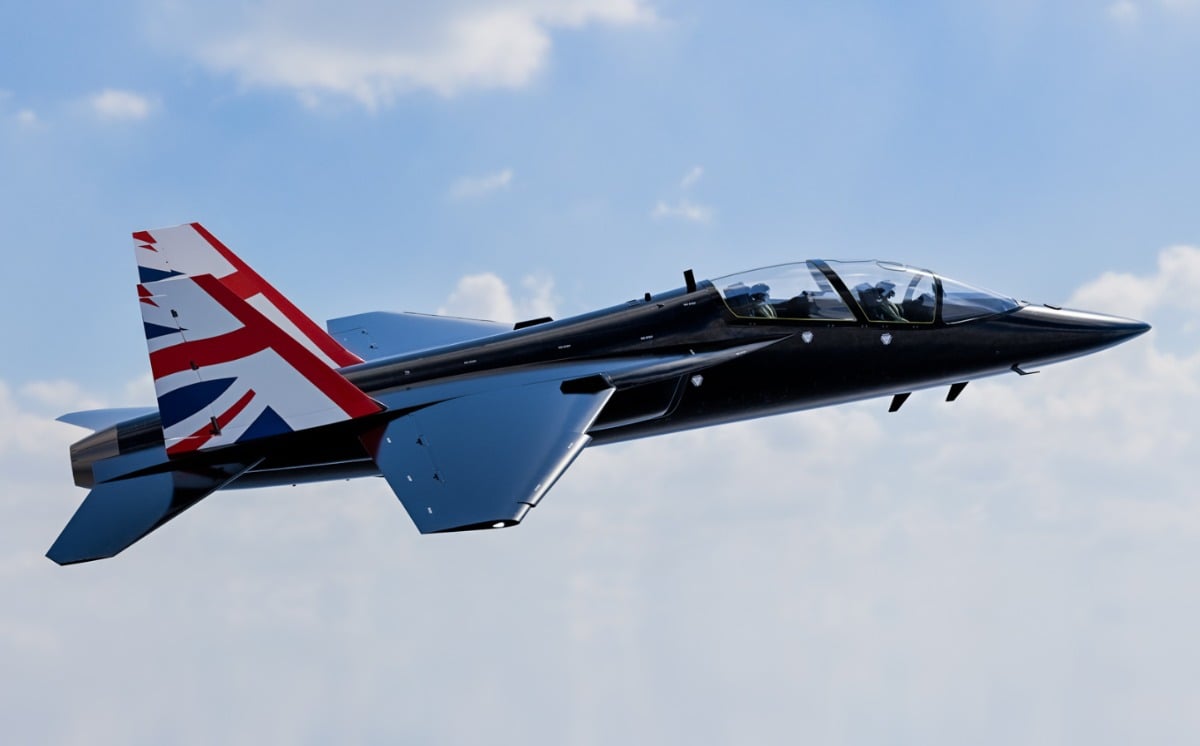
- BAE Systems, Boeing and Saab signed a teaming agreement on July 21, 2026 to jointly pursue the UK's next generation pilot training program based on the Boeing T-7 jet.
- The agreement commits the partners to building a new UK-based final assembly and integration facility, though no contract value or timeline was disclosed.
BAE Systems, Boeing and Saab announced they have signed a formal teaming agreement to jointly pursue the UK’s next generation pilot training program, built around Boeing’s T-7 trainer jet, and the deal commits the companies to building a brand new final assembly and integration facility inside Britain.
Advanced fast jet training currently runs through the Hawk T2, a twin-seat jet that entered RAF service in 2012 as part of the UK Military Flying Training System, but the fleet of 28 aircraft has been plagued by engine reliability issues that limit how many jets are actually available to fly on any given day. That shortfall has forced Britain to outsource some of its advanced pilot training to programs in the United States and elsewhere just to keep enough students moving through the pipeline, and last year’s Strategic Defence Review concluded that continuing to prop up the aging Hawk fleet was no longer sustainable, calling instead for a single cost-effective replacement trainer with British industry given priority in the competition.
Boeing’s answer to that requirement is the T-7A Red Hawk, a twin-seat jet trainer designed from the ground up using digital engineering, meaning its structure and systems were modeled and tested extensively in software before a single piece of metal was cut, a method Boeing and the U.S. Air Force credit with speeding up development and easing long-term maintenance. The jet has already cleared a major hurdle with its intended customer. The U.S. Air Force approved Milestone C for the T-7A on April 23, 2026, the acquisition gate that authorizes a program to shift from development into actual manufacturing, and awarded Boeing a $219 million contract for the first 14 production aircraft along with spares, support equipment and training. The full American program calls for 351 T-7A jets and 46 ground simulators across five training bases over the next decade, replacing the Air Force’s T-38 Talon, a trainer that has been flying since 1961 and was temporarily grounded fleet-wide in May 2026 after a crash in Mississippi, underscoring just how overdue that replacement has become.
BAE Systems, Boeing and Saab describe the offer as an integrated package that combines live flying with advanced simulation, designed to prepare pilots for the RAF’s current frontline jets, the Eurofighter Typhoon and the F-35, while remaining adaptable enough to evolve alongside whatever comes next, including Britain’s planned sixth-generation combat aircraft under the Global Combat Air Programme. That flexibility matters because a training system bought today typically has to serve for decades, and locking in hardware and software that can’t be upgraded as frontline jets change has been one of the persistent complaints about the aging Hawk fleet.
“By bringing together this international team of leading defence companies, we are in an excellent position to support the UK’s future training requirements,” said Charles Woodburn, chief executive officer of BAE Systems.
“Our offer represents a modern, integrated training solution which aligns with the ambition of the Defence Investment Plan, while strengthening the UK’s sovereign industrial capability,” Woodburn said.
“This collaboration with Saab and BAE Systems is an important step in advancing the United Kingdom’s future fast-jet training capability,” said Steve Parker, president and chief executive officer of Boeing Defense, Space & Security.
“With the T-7 as its foundation, our modern training system can help deliver sovereign pilot training solutions while supporting high-value jobs and industrial capability across the UK,” Parker said.
“We are delighted to continue our co-operation with BAE Systems,” said Micael Johansson, president and chief executive officer of Saab.
“The collaboration between Saab, Boeing and BAE Systems promises to strengthen the T-7’s position for the UK as the future-proof solution for the RAF,” Johansson said.
The partners say the offer would create hundreds of high-value jobs and position a UK supply chain to play a role across the entire lifecycle of a potential RAF T-7 program, giving Britain what the companies describe as sovereign control over its own training requirements rather than depending entirely on components and support built overseas. Saab already has skin in the T-7 program beyond this UK bid, manufacturing major aft fuselage sections for the jet at a facility in West Lafayette, Indiana, so the partnership brings genuine production experience rather than a paper proposal built solely around winning a British contract.
BAE Systems, Boeing and Saab signed a letter of intent in November 2025 to explore working together on the UK requirement, and the companies say they have spent the time since then identifying potential locations for the new UK final assembly facility and mapping out a domestic supply chain built on each company’s existing industrial base in Britain. Neither the teaming agreement nor the companies’ statements disclosed a contract value, a timeline for when a final assembly site might be chosen, or how many aircraft a UK order might eventually cover, and the RAF has not yet confirmed the T-7 as its selected Hawk replacement, meaning this remains a formal industry pitch rather than a done deal.