

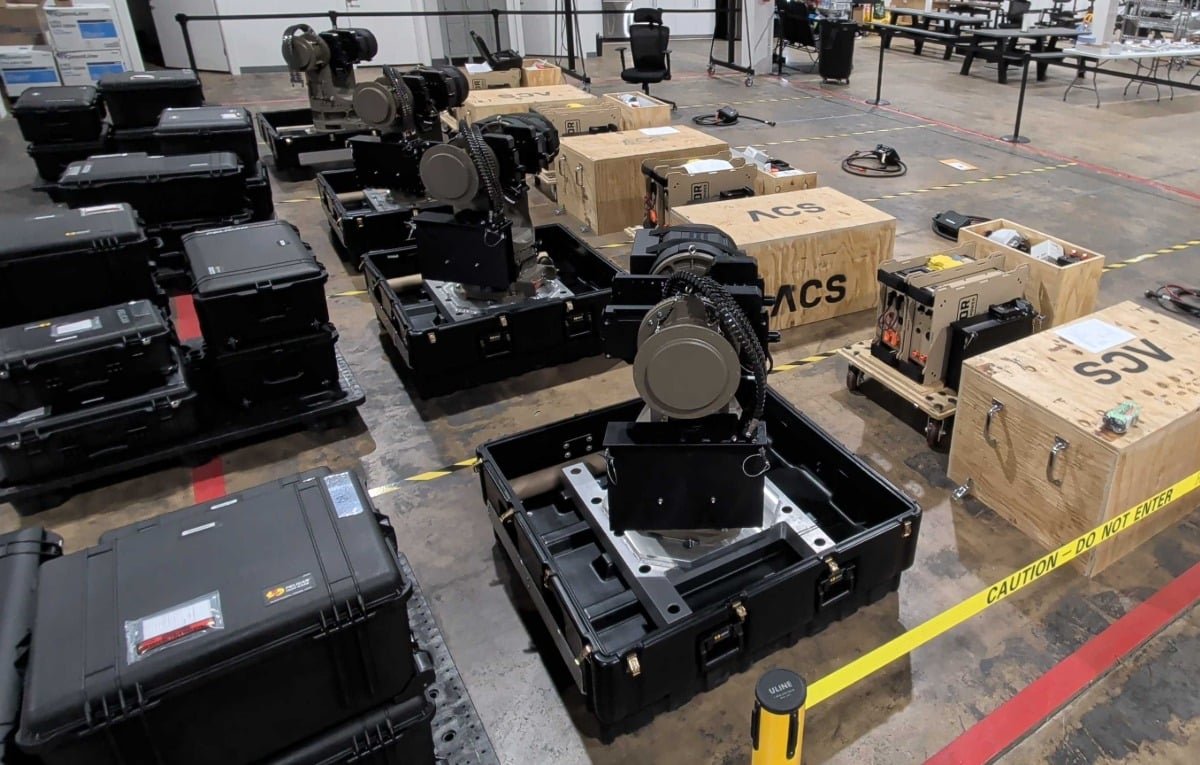
- The U.S. Marine Corps selected Allen Control Systems' Bullfrog autonomous weapon station for its Ground Based Air Defense program.
- Bullfrog will integrate into the L-MADIS platform through a prototype contract worth roughly $6.2 million.
A robotic gun mount built by a Texas firm just landed a spot on one of the Marine Corps’ most important counter-drone vehicles, giving Marines a way to turn an ordinary machine gun into an autonomous, AI-guided weapon.
Allen Control Systems announced that the Marine Corps selected its Bullfrog autonomous weapon station for the service’s Ground Based Air Defense program, with the system set to integrate into the Light Marine Air Defense Integrated System, known as L-MADIS, the Corps’ most expeditionary counter-drone platform currently in service.
Bullfrog is not a new weapon in itself but rather a robotic mount that takes an existing firearm, in this case the M240 machine gun, and turns it into an autonomous system capable of detecting, tracking, and engaging a target with far less human input than a soldier manually aiming and firing would require. The system weighs roughly 300 pounds (136 kilograms) without ammunition, fires standard 7.62 by 51 millimeter (0.3 by 2 inch) NATO ammunition at a maximum rate of 850 rounds per minute, and relies on a fully passive sensor suite, meaning it detects and tracks targets using cameras and processing rather than emitting radar or other signals that could reveal the weapon’s position to an adversary scanning the battlefield for exactly that kind of transmission.
L-MADIS itself consists of two Polaris MRZR all-terrain vehicles working in tandem, with one functioning as a command vehicle and the other carrying an electronic warfare suite built to jam and disrupt hostile drones, according to reporting from Breaking Defense. Bullfrog will integrate onto that existing platform through what the government calls a prototype Other Transaction Agreement, a flexible contracting method the Pentagon increasingly uses to move new technology from demonstration to fielded use faster than traditional acquisition rules typically allow. Breaking Defense reported the initial contract value with the Marine Corps at roughly $6.2 million, a modest starting figure against the backdrop of the Corps’ broader ambitions for the program, since the service is requesting approximately $1.27 billion in its fiscal 2027 budget specifically for Ground Based Air Defense capabilities.
Mike Wior, co-founder and chief executive officer of Allen Control Systems, framed the selection as validation of technology the company has spent years refining for exactly this kind of mission.
“The Marine Corps requires the most sophisticated and accurate possible capabilities to carry out its critical missions,” Wior said. “We are honored to support Marines with fast, scalable, and cost-effective counter-drone solutions that integrate seamlessly into existing platforms.”
Drone warfare from Ukraine to the Middle East has repeatedly exposed a brutal economic mismatch, where militaries have often relied on missile interceptors costing hundreds of thousands or even millions of dollars to shoot down drones that cost a fraction of that amount to build and launch. Bullfrog addresses that imbalance by using conventional bullets rather than a guided missile for each engagement, letting a single weapon station potentially defeat dozens of incoming drones using ammunition that costs a tiny fraction of what a dedicated interceptor round would run, all while retaining a human authorization requirement before the system fires, since Bullfrog operates in autonomous or semi-autonomous modes but still requires a person to approve any engagement rather than making that decision entirely on its own.
Bullfrog’s selection for the Marine Corps program builds on a track record the company has steadily assembled across multiple branches of the U.S. military and beyond. The system first drew serious Pentagon attention during the Department of War’s Technology Readiness Experimentation event at Camp Atterbury, Indiana, in August 2024, where it consistently defeated drone targets across a two-week evaluation period in front of more than 30 visiting officials, including then-Undersecretary of Defense for Research and Engineering Heidi Shyu and representatives from both U.S. Special Operations Command and the Marine Corps. The Army’s own Applications Lab separately awarded Allen Control Systems a contract worth up to $4.5 million in December 2025 to evaluate Bullfrog’s integration across five of the Army’s most widely deployed combat vehicles, and the company’s press release states Bullfrog has already deployed with the Army and Navy and been validated through Joint Interagency Task Force 401, the Pentagon’s counter-drone coordination unit responsible for evaluating and fielding systems specifically aimed at defeating unmanned aerial threats. Allen Control Systems has also secured export contracts with South Korea’s armed forces and the United Arab Emirates military, along with a memorandum of understanding to co-produce the system locally with Romania’s armed forces.
Bullfrog comes in four different weapon configurations beyond the M240 variant heading to the Marine Corps, including versions built around the heavier M2 machine gun, the M230 automatic cannon, and the M134 Gatling-style rotary gun, giving customers flexibility to match the weapon station’s firepower to whatever specific threat level or platform they need to defend. Each configuration is rated to engage drones across what the military classifies as Group 1 through Group 3, covering everything from small commercial-style quadcopters up to larger fixed-wing tactical drones weighing as much as 1,320 pounds (599 kilograms), with a maximum effective range against point targets reaching up to 1,500 meters (4,921 feet) depending on which weapon variant a customer selects.
For Marines operating increasingly exposed to cheap, mass-produced drones on contested battlefields, a system that turns an already-familiar weapon into an autonomous defense against exactly that threat offers something the service has been actively searching for: a way to restore the kind of maneuverability drone swarms have started to erode, without asking every unit to carry an entirely new, unfamiliar weapon system into the field.