

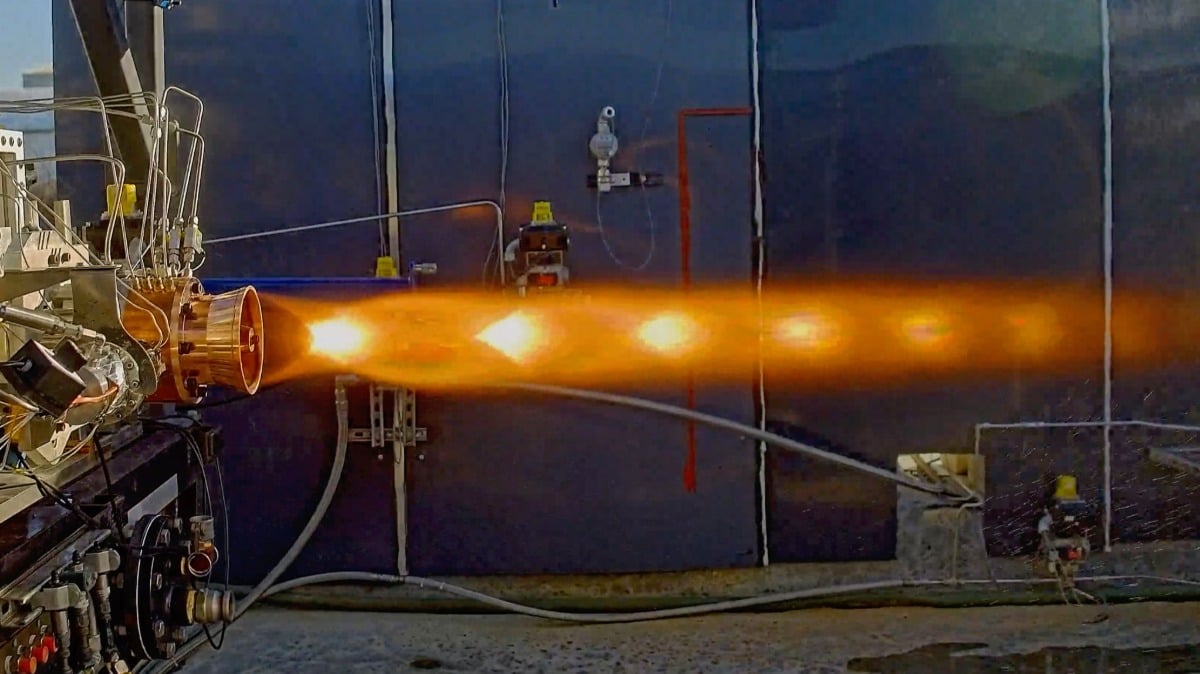
- The U.S. Air Force Research Laboratory published a Request for Information on July 14, 2026 seeking industry input on rocket-based combined cycle propulsion.
- Responses on Rotating Detonation Rocket Engine technology using storable propellants are due by August 10, 2026.
The U.S. Air Force has asked American rocket companies for their best ideas on an engine that could let a single missile take off like a rocket, cruise like a jet, and skip the giant fuel tanks that usually make that kind of flexibility impossible.
The Air Force Research Laboratory’s Rocket and Space Propulsion Division, based at the AFRL Rocket Lab at Edwards Air Force Base in California, published a formal Request for Information on July 14, seeking input from industry on what the notice calls Rocket-Based Combined Cycle propulsion, or RBCC, a type of engine designed to combine a rocket’s ability to launch from a dead stop with an air-breathing jet engine’s efficiency once a vehicle reaches high speed. A Request for Information is essentially the Air Force asking companies to describe what they can already build and what it would take to build more, without committing to buy anything or issue an actual contract, a step the service typically takes before deciding whether a full competition is even worth running.
What makes this particular request notable is the specific technology the Air Force wants industry to focus on: Rotating Detonation Rocket Engines, or RDREs, a newer combustion approach that burns fuel using a supersonic shockwave traveling continuously around a ring-shaped chamber rather than the smoother, steadier burn conventional rocket engines rely on. That detonation wave packs combustion into a much smaller space while generating higher chamber pressure and more thrust for the same size engine, and the Air Force Research Laboratory has already run roughly 300 hot-fire tests of the technology using methane and oxygen propellants since 2021, building a substantial base of internal expertise the lab is now trying to translate into an actual fielded weapon system rather than a laboratory curiosity.
The request specifically asks industry to pair that detonation engine with storable propellants rather than the cryogenic fuels, like liquid hydrogen or liquid oxygen, that require constant refrigeration to stay in liquid form. Cryogenic propellants work well for a rocket launching from a fixed pad with hours of preparation time, but a weapon that needs to sit ready inside a missile or aircraft for months at a time cannot practically be topped off with supercooled fuel on short notice, which is why the Air Force wants solutions built around liquid oxidizers like High Test Peroxide that can simply sit stored and ready without specialized handling infrastructure. Pairing that storable oxidizer with rocket propellant or standard jet fuel would let a single weapon system share fuel logistics with existing aircraft rather than requiring an entirely separate supply chain, a practical consideration that matters enormously for any system the military actually wants to deploy at scale rather than test once and shelve.
The RFI lays out a demanding list of technical priorities for any company hoping to compete for future work, including minimizing the engine’s weight, keeping the design simple and affordable enough to mass produce rather than relying on exotic materials or complex manufacturing, and shrinking the engine’s physical footprint so it fits efficiently inside a missile or aircraft’s outer shape. The Air Force also wants a design where, once the vehicle accelerates past its initial launch phase and reaches cruising speed, the air-breathing portion of the engine takes over as the primary source of thrust, with the rocket engine stepping back to a supporting role that boosts performance rather than continuing to burn through onboard propellant the whole flight, a combination that could meaningfully extend a weapon’s range compared to a pure rocket that burns its entire fuel supply just getting up to speed.
This kind of combined-cycle propulsion has drawn growing attention across the defense industry over the past year, with GE Aerospace and Lockheed Martin announcing a joint demonstration of a rotating detonation ramjet for hypersonic missiles in January 2026, and the Defense Advanced Research Projects Agency separately working with RTX on a program called Gambit that applies similar detonation engine research to supersonic, air-launched standoff missiles. That parallel activity across multiple agencies and contractors suggests the Air Force’s new request fits into a broader, coordinated push within the Department of War to move rotating detonation engine technology out of research labs and toward genuine flight demonstrations, rather than one lab pursuing the idea in isolation.
What the request does confirm is that rotating detonation propulsion has moved decisively from a niche academic curiosity, studied mostly in university labs a decade ago, into a technology the Air Force now considers serious enough to formally survey the entire domestic rocket industry about, a signal that the next generation of American high-speed weapons may burn fuel in a way no fielded system has ever used before.