

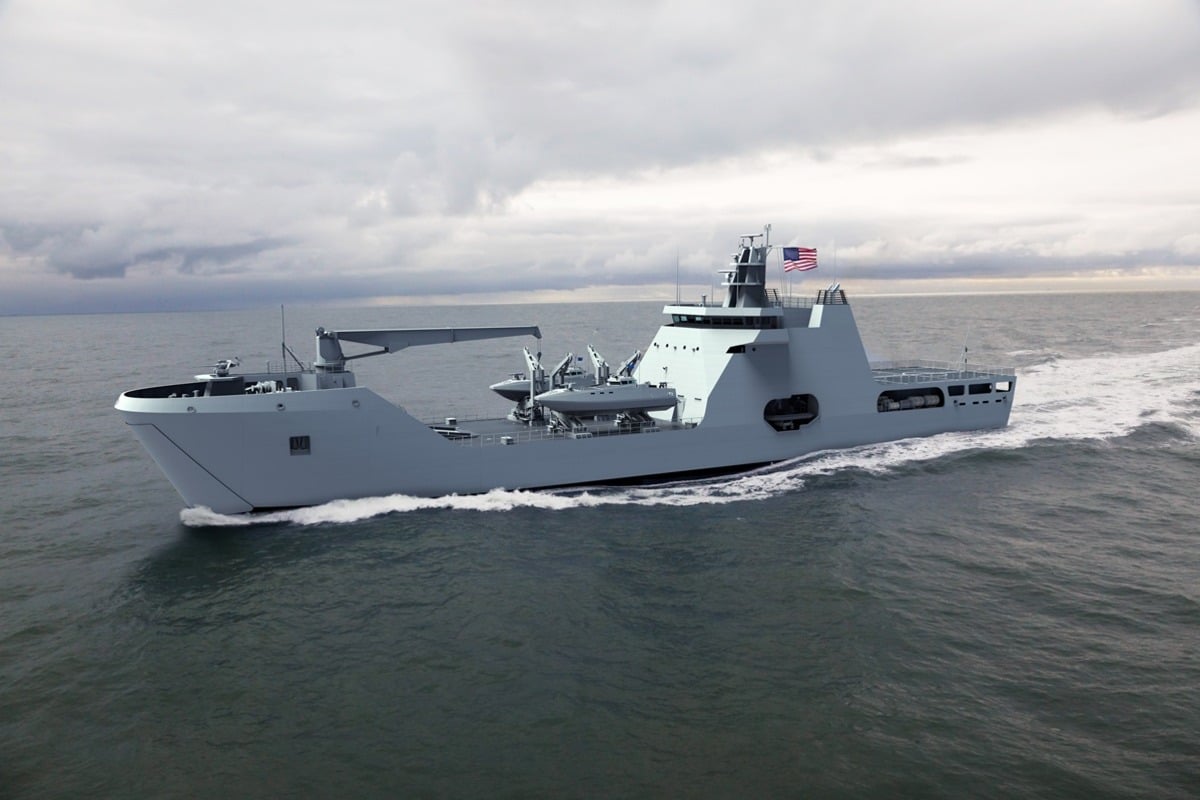
- The Navy awarded TOTE Services a $2.2 billion contract on July 13, 2026 to manage construction of up to eight Medium Landing Ships.
- The ships will be built at Bollinger Shipyards and Fincantieri Marinette Marine, supporting the Navy and Marine Corps' planned 35-ship LSM fleet.
The U.S. Navy has handed a Florida shipping company the job of building a fleet the Marine Corps says it needs to survive a fight with China, awarding TOTE Services a $2.2 billion contract to manage construction of up to eight new landing ships across multiple American shipyards simultaneously.
The contract, announced July 13, makes TOTE Services the Vessel Construction Manager, or VCM, for the Navy’s Medium Landing Ship program, a role that puts the Jacksonville-based company in direct control of coordinating shipyards, suppliers, and designers rather than leaving the Navy to manage each contractor separately the way it traditionally has for major shipbuilding programs. As VCM, TOTE holds the prime contract directly with the Navy’s Portfolio Acquisition Executive for Maritime and will award and manage its own subcontracts with the shipyards actually building the vessels, a structure the Navy is using here for the first time in its history and one that commercial shipping companies have relied on for decades to keep multi-vessel construction programs on schedule and on budget.
“This is a tremendous responsibility and a defining moment for American shipbuilding, the VCM model, and TOTE Services,” said Jeff Dixon, President of TOTE Services.
“We are grateful to PAE Maritime, the Marine Corps, Congress, and the many government leaders who have championed this important program and helped bring the VCM model to a mission of national importance. We look forward to collaborating with and supporting PAE Maritime as we work together on LSM. The U.S. is counting on this program to succeed, and our job is clear: steward the work responsibly, cultivate the best talent and expertise, move with urgency, and deliver for the American people,” Dixon said.
The Medium Landing Ship itself is a deliberately unglamorous vessel by Navy standards, built around a Dutch-designed hull called the LST-100 from shipbuilder Damen that already serves in Nigeria’s navy and is on order for Australia. Displacing roughly 4,000 tonnes (4,409 tons), each ship can carry around 250 Marines and travel roughly 7,408 kilometers (4,000 nautical miles), figures that put it well below the size and cost of the Navy’s traditional amphibious warships but squarely inside the gap the Marine Corps says it desperately needs filled between small ship-to-shore landing craft and the massive, expensive amphibious ships that make up the current fleet. That gap matters because of how the Marine Corps now plans to fight in the Pacific under a concept called Expeditionary Advanced Base Operations, which calls for small units of Marines to hop between islands, set up temporary firing positions armed with anti-ship missiles, and then relocate before an adversary can target them, a style of warfare that depends entirely on having enough smaller, less exquisite vessels to keep those units mobile rather than concentrating everyone aboard a handful of large ships that make tempting targets.
For the first eight ships under this contract, the Navy has already picked the shipyards that will do the actual welding and assembly, directing TOTE to manage subcontracts with Gulf Coast-based Bollinger Shipyards for the lead vessel and Wisconsin-based Fincantieri Marinette Marine for four additional ships, while giving TOTE flexibility to decide how best to award the remaining three. That arrangement, splitting the work across yards on opposite ends of the country rather than concentrating it in one location, reflects the Navy’s stated goal of using the LSM program to strengthen the broader American shipbuilding industrial base, which has struggled for years with limited capacity and a shrinking skilled workforce even as the service tries to grow its overall fleet size. Congress built the requirement for a construction manager directly into law, inserting a provision into the fiscal year 2026 defense authorization act that specifically directed the Navy to select a VCM to help stabilize a program that had already been through one troubled procurement attempt, including a canceled 2024 request for proposals after the Navy concluded the bids it received cost far more than the service could justify.
TOTE Services is not new to this kind of arrangement, having pioneered the VCM model in U.S. government shipbuilding through its work managing construction of the National Security Multi-Mission Vessel program for the Maritime Administration, a five-ship effort supplying training vessels to the nation’s maritime academies. Three of those ships have already been delivered, with the remaining two expected within the next 12 months, giving TOTE a completed track record the Navy could point to when deciding whether an outside construction manager could actually deliver results rather than simply adding another layer of bureaucracy to an already complicated acquisition process.
“The VCM model shows what is possible when government requirements are paired with commercial shipbuilding practices and sustained investment in American shipyards and maritime workers,” said Matthew Paxton, President of the Shipbuilders Council of America.
“The success of the NSMV program has created a strong foundation for expanding domestic shipbuilding capacity and delivering the ships our nation needs,” Paxton said.
TOTE now faces the task of proving that a management model built for cargo ships and training vessels can hold up under the pressure of a program the Marine Corps considers essential to its entire Pacific strategy, with construction expected to begin later this year and the first completed ship due to the Navy by 2029. Whether the broader 35-ship fleet the program envisions ever gets built at that scale will depend heavily on how well this first batch of eight ships comes together, since a shipbuilding program that stumbles early in a peacetime budget environment rarely survives long enough to reach its full planned size.