

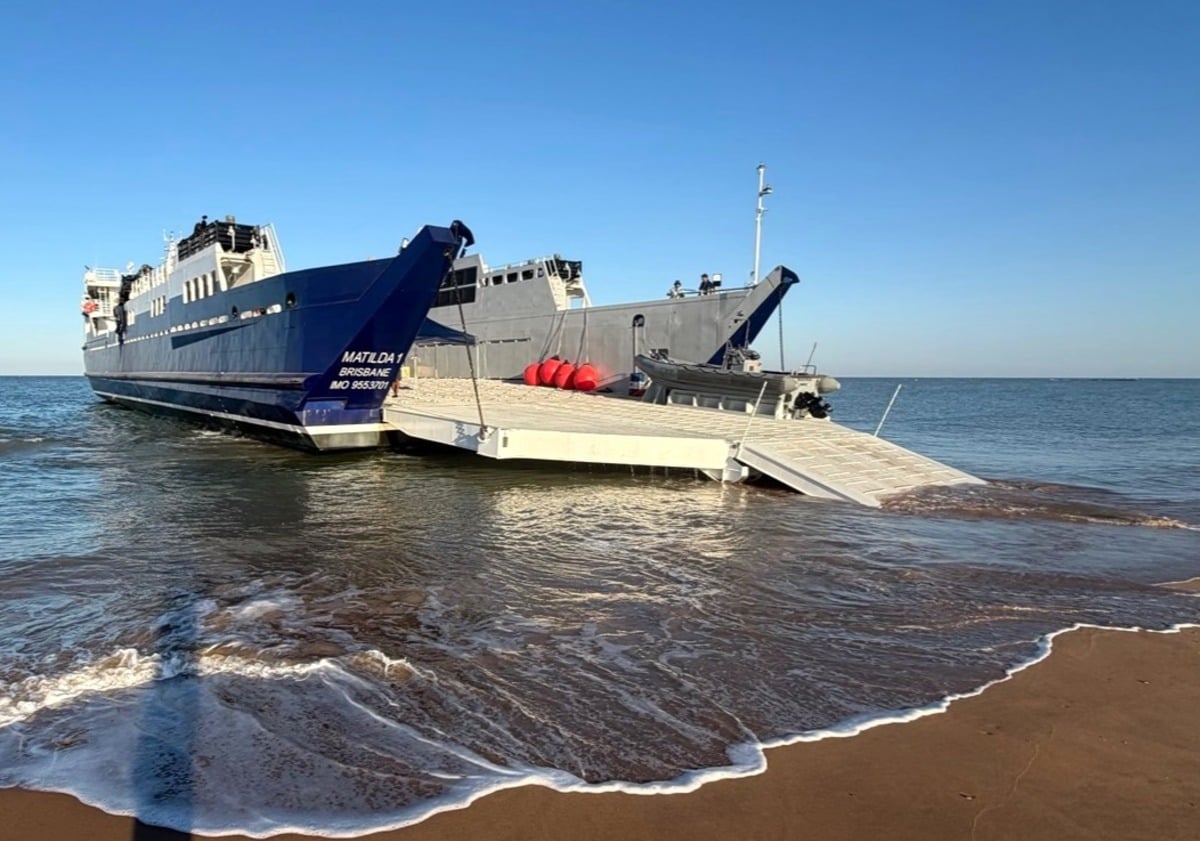
- The Australian-designed stern landing vessel Matilda 1 completed its first military beach landing at Dundee Beach, Australia, on July 8, 2026.
- Matilda 1 is under a three-year lease to the U.S. Marine Corps and can carry 550 tonnes of cargo across 4,000 nautical miles.
An Australian-designed cargo ship just did something no purpose-built military landing vessel has managed before, driving stern-first onto a beach near Darwin, holding position while it dropped a ramp wide enough to drive tanks off, then reversing back out to sea in under a minute.
The 73-meter (240-foot) vessel, named Matilda 1, is a stern landing vessel, or SLV, designed by Queensland-based naval architecture firm SeaTransport and currently under a three-year lease to support the U.S. Marine Corps. On July 8, the ship performed its first beach landing and de-beaching maneuver at Dundee Beach, southwest of Darwin in Australia’s Northern Territory, backing onto the shore, extending its extra-wide stern ramp onto the sand, and holding steady before pulling away and returning to open water in under 60 seconds, according to SeaTransport. The company says the maneuver marks the first beach landing ever completed by an SLV built specifically for military use, a milestone in proving out a design concept that commercial operators have used for years but that no defense force worldwide had adopted until this lease.
What makes a stern landing vessel different from the amphibious craft most people picture, the kind with a wide ramp on the bow that drops straight down onto a beach, comes down to how each design handles the physics of getting close to shore. Traditional bow-ramp landing craft need a relatively flat, shallow approach to work safely, which limits where they can operate and leaves them vulnerable to a phenomenon called hull suction, where the flat bottom of the craft gets pulled toward the seabed as water rushes underneath it in shallow water, sometimes damaging the hull or trapping the vessel. Matilda 1 avoids that problem with a tri-hull design and a ship-shaped bow built for open-ocean travel, backing onto the beach stern-first instead, an approach that protects the vessel’s propulsion gear from grounding damage and lets it access beaches with challenging seabed conditions or large tidal swings that would strand a conventional landing craft.
“Almost all amphibious vessel designs are incapable of long-distance offshore voyages,” Dr. Stuart Ballantyne, SeaTransport’s chief executive, told the maritime outlet Baird Maritime.
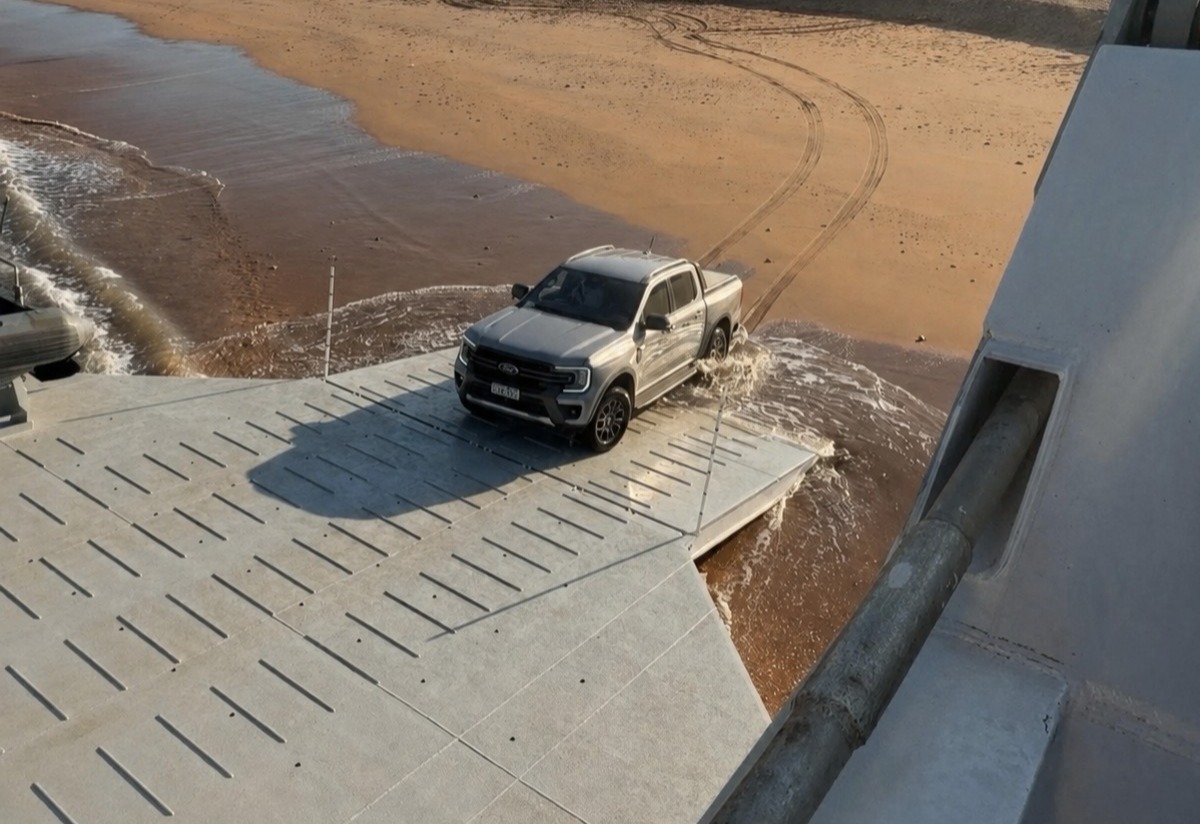
Matilda 1 can carry up to 550 tonnes (606 tons) of cargo across 4,000 nautical miles (7,408 kilometers) of open ocean in high sea states, according to SeaTransport, a combination of payload and range that most amphibious connectors simply cannot match since they are built for short hops between a larger mothership and the shore rather than independent long-distance transits. The ship’s cargo deck spans roughly 670 square meters, close to twice the size of a standard tennis court by the company’s own comparison, with room for bulk supplies, military vehicles, and shipping containers stacked two high, and separate reporting on the vessel’s specifications lists capacity for 84 standard shipping containers or a mixed load that could include roughly 20 Joint Light Tactical Vehicles, 18 HIMARS rocket launchers, or a combination of trucks and amphibious combat vehicles depending on the mission.
The beach landing followed a separate milestone just a week earlier, when Matilda 1 completed dry-out berthing trials in the mangrove mudflats of Hudson Creek, an estuary waterway near Darwin, another environment that punishes conventional flat-bottomed landing craft through the same hull suction effect the ship’s tri-hull design is meant to prevent. Marines were aboard for both the mangrove trials and the beach landing, with members of the Australian Defence Force observing, a joint arrangement that reflects how closely the two militaries have coordinated on testing a vessel concept the Marine Corps has been chasing since 2020 under its Force Design 2030 modernization plan, which called for a new class of connector vessel smaller than a full amphibious warship but far more capable than existing ship-to-shore landing craft.
Before Matilda 1, the Marine Corps tested that concept using a converted commercial offshore support vessel called the HOS Resolution, fitted with a large stern ramp, reinforced deck, and landing legs to simulate what a purpose-built SLV might offer, and put it through evaluations including Project Convergence Capstone 4, where Marines assessed how well the ship-to-shore transition worked with the service’s actual vehicle fleet. Matilda 1 represents the next step beyond that improvised prototype, a vessel designed from the outset for the mission rather than adapted from a commercial hull, and SeaTransport has said the Marine Corps’ lease marks the first time any military anywhere has adopted a true SLV design despite more than 20 similar vessels already operating in commercial service worldwide.