

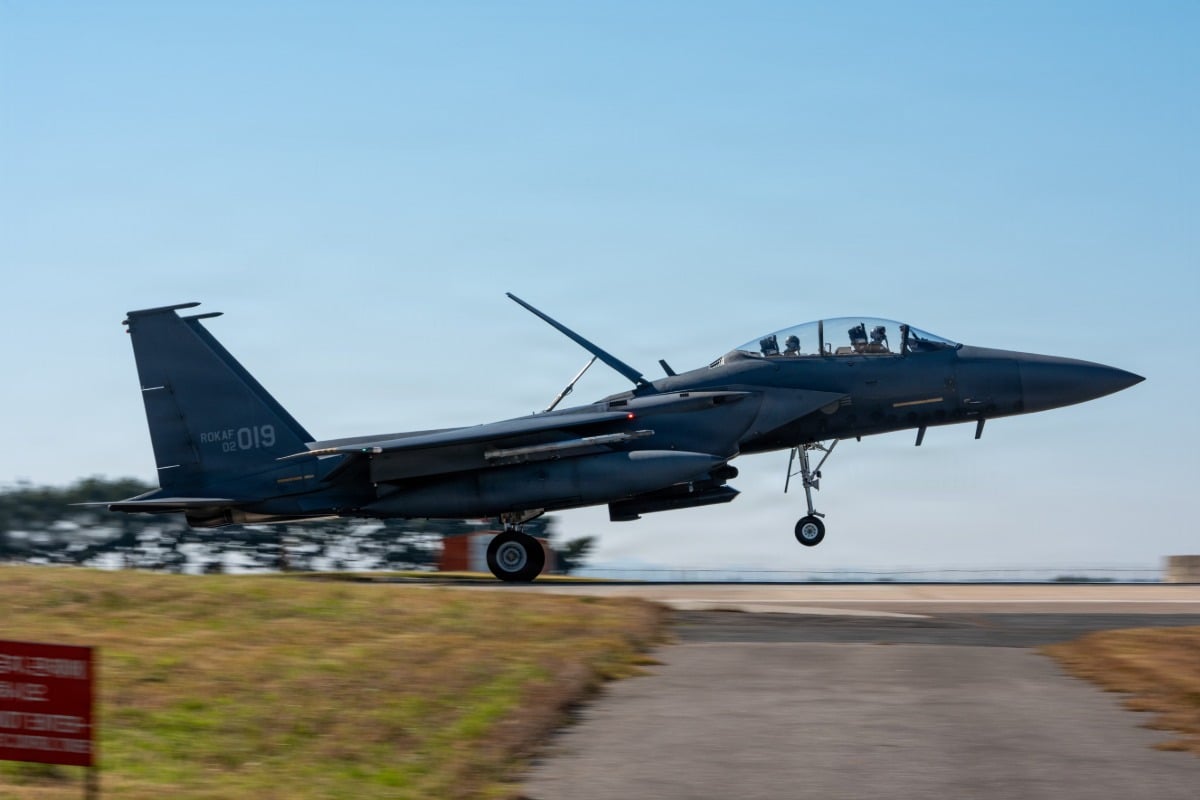
- BAE Systems received a contract from Boeing on July 13, 2026 to supply EPAWSS electronic warfare systems for 59 ROKAF F-15K Slam Eagle jets.
- The upgrade is part of a roughly $3.1 billion program running through 2037, with the first modernized F-15K+ jets expected by late 2028.
BAE Systems will build the electronic eyes and ears that South Korea is betting will keep its aging fleet of F-15K fighter jets alive against modern air defenses, after Boeing awarded the company a contract to supply its AN/ALQ-250 Eagle Passive Active Warning Survivability System, known as EPAWSS, for all 59 of the Republic of Korea Air Force’s F-15K Slam Eagle jets.
EPAWSS is an all-digital electronic warfare system that gives a fighter pilot 360-degree awareness of threats around the aircraft, detecting hostile radar signals and missile launches from any direction and automatically triggering countermeasures like chaff and flares to help the jet survive in what the industry calls a signal-dense environment, meaning airspace crowded with enemy radar, jamming, and communications traffic that can overwhelm older detection systems.
The system replaces the F-15K’s current, comparatively primitive radar warning receiver with hardware that BAE Systems has already proven on the U.S. Air Force’s newest F-15EX Eagle II jets and is retrofitting onto older F-15E Eagle aircraft, meaning South Korea’s air force is essentially buying into hardware the Pentagon has already put through full-rate production rather than an unproven prototype.
“We are working closely with Boeing, the ROKAF and regional industry teams to deliver the most technically advanced EW system for the F-15K aircraft upgrade,” said Phillip Casalegno, F-15 international program director at BAE Systems.
“Our focus is on providing allies with EW capabilities needed to support regional stability and security,” Casalegno said.
The EPAWSS award fits inside a far larger modernization effort that South Korea’s Defense Acquisition Program Administration approved in December 2025, a project with a total cost of roughly $3.1 billion running from 2024 through 2037 and aimed at bringing the country’s entire F-15K fleet closer to the configuration of the U.S. Air Force’s newest Eagles. Beyond the EPAWSS suite, the upgrade package includes 96 Advanced Display Core Processor II mission computers, which the Air Force has described as the fastest mission computers ever installed on a fighter jet, 70 AN/APG-82(v)1 active electronically scanned array radars that let pilots track multiple air and ground targets simultaneously at longer range than the mechanically scanned radars currently on the jets, and 70 AN/AAR-57 Common Missile Warning Systems that use ultraviolet sensors to detect incoming missiles and automatically dispense defensive countermeasures. Boeing itself received a separate $2.8 billion contract in January 2026 from the U.S. Air Force Life Cycle Management Center, part of the Department of War, to oversee the broader upgrade program on South Korea’s behalf, with the first two modernized jets, expected to carry the informal designation F-15K+, scheduled for delivery by late 2028.
South Korea’s F-15K fleet has been flying since the country ordered 61 of the jets in two batches placed in 2002 and 2008, and the fleet has since shrunk to 59 aircraft following the loss of two jets in separate accidents in June 2006 and April 2018.
Despite its age, the F-15K remains one of the most heavily armed aircraft in South Korea’s inventory, capable of carrying the Taurus KEPD 350 stealth cruise missile, Boeing’s SLAM-ER and Harpoon anti-ship missiles, and Joint Direct Attack Munition guided bombs, giving it a strike capability that South Korean planners want to preserve well into the 2030s even as the jet’s underlying electronics grow increasingly outdated compared to newer Chinese and North Korean systems in the region.
Pairing the upgraded F-15K with South Korea’s fleet of Lockheed Martin F-35A stealth fighters would let the F-15K serve as what defense analysts sometimes call a missile truck, hanging back from the most heavily defended airspace while the F-35A’s stealth profile handles the initial penetration of enemy air defenses, then feeding targeting data to the F-15K so it can fire longer-range weapons from a safer distance.