

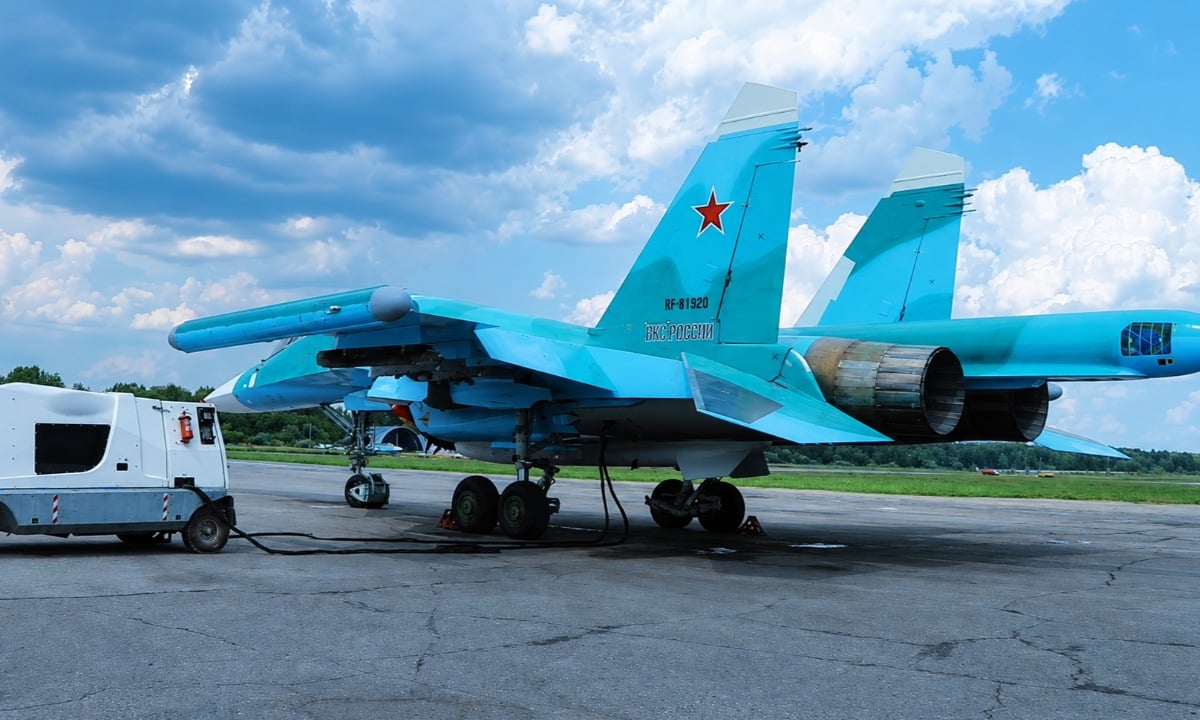
- Russia's Rostec announced the delivery of new Su-30SM2 fighters and Su-34 fighter-bombers, built by United Aircraft Corporation, to Russia's military.
- Open-source group Oryx has documented at least 43 Su-34 and 21 Su-30SM aircraft lost or damaged since Russia's invasion of Ukraine began in 2022.
Russian state defense conglomerate Rostec announced the delivery of a new batch of Su-30SM2 Flanker-C multirole fighters and Su-34 Fullback fighter-bombers to the Russian military, according to a statement from the manufacturer, framing the handover as part of an ongoing effort to modernize a combat aircraft fleet that open-source trackers say has absorbed dozens of confirmed losses since Russia’s full-scale invasion of Ukraine began in 2022.
The aircraft were built by Russia’s United Aircraft Corporation, known by its Russian acronym OAK, and Rostec’s statement said the jets completed a full cycle of ground and flight factory testing before being handed over for operational service.
The Su-30SM2 represents an upgraded version of the Su-30SM, a twin-seat, twin-engine multirole fighter that has formed a core part of Russia’s Aerospace Forces for over a decade. According to Rostec’s own description, the SM2 variant received what the company called a deep modernization that significantly expanded the aircraft’s capabilities, centered on a more powerful radar system that lets the fighter detect and track targets at considerably greater range than the earlier version, letting it strike ground, air, and maritime targets without needing to enter the engagement range of enemy air defense systems. That kind of standoff engagement capability has become increasingly central to how the Russian air force says it wants to operate following years of contested airspace over Ukraine, where getting close enough to conventional targets has repeatedly exposed Russian aircraft to Ukrainian air defense systems.
The Su-34, a twin-seat, twin-engine fighter-bomber that has served as one of Russia’s primary strike aircraft since entering service in 2014, fills a somewhat different role in Rostec’s announcement.
The aircraft measures roughly 23.34 meters (76.6 feet) in length with a 14.7-meter (48-foot) wingspan and can carry up to 14 tonnes (30,865 lb) of ordnance, according to independent technical assessments, making it one of the heaviest-payload strike aircraft in Russia’s current inventory. Rostec’s statement described the Su-34 as designed to strike ground, surface, and air targets along with infrastructure sites protected by air defense systems and positioned well beyond its home airfield, and said the aircraft can also be used for aerial reconnaissance missions.
Rostec’s announcement included a testimonial from an unnamed Su-34 pilot serving with Russia’s Aerospace Forces, presented without further identifying detail in the company’s statement.
“The Su-34 aircraft has proven itself in the area of the special military operation in the best possible way,” the pilot said, according to Rostec’s statement. “It is an excellent aviation system with substantial room for future growth, offering a wide range of weapons options with the ability to employ advanced strike systems to accomplish assigned missions.”
That characterization arrives against a backdrop of substantial, independently documented losses among exactly the aircraft types Rostec is now delivering. The open-source intelligence group Oryx, which compiles visually confirmed equipment losses using photographic and video evidence rather than official government claims from either side, has documented at least 43 Su-34 aircraft lost or damaged and at least 21 Su-30s lost or damaged since Russia’s full-scale invasion began in 2022, figures that represent a meaningful share of Russia’s pre-war inventory of both aircraft types.
Separate reporting citing Oryx data has placed Russia’s pre-war Su-34 fleet at roughly 140 aircraft, meaning confirmed losses alone would account for close to a third of that original inventory even before factoring in aircraft removed from service for damage, maintenance, or crew shortages that never appear in visual-confirmation loss trackers. Neither Rostec’s statement nor independent reporting specifies exactly how many aircraft were included in this particular delivery batch, leaving the scale of this specific handover unclear even as it fits into a broader, ongoing pattern of replacement deliveries.