

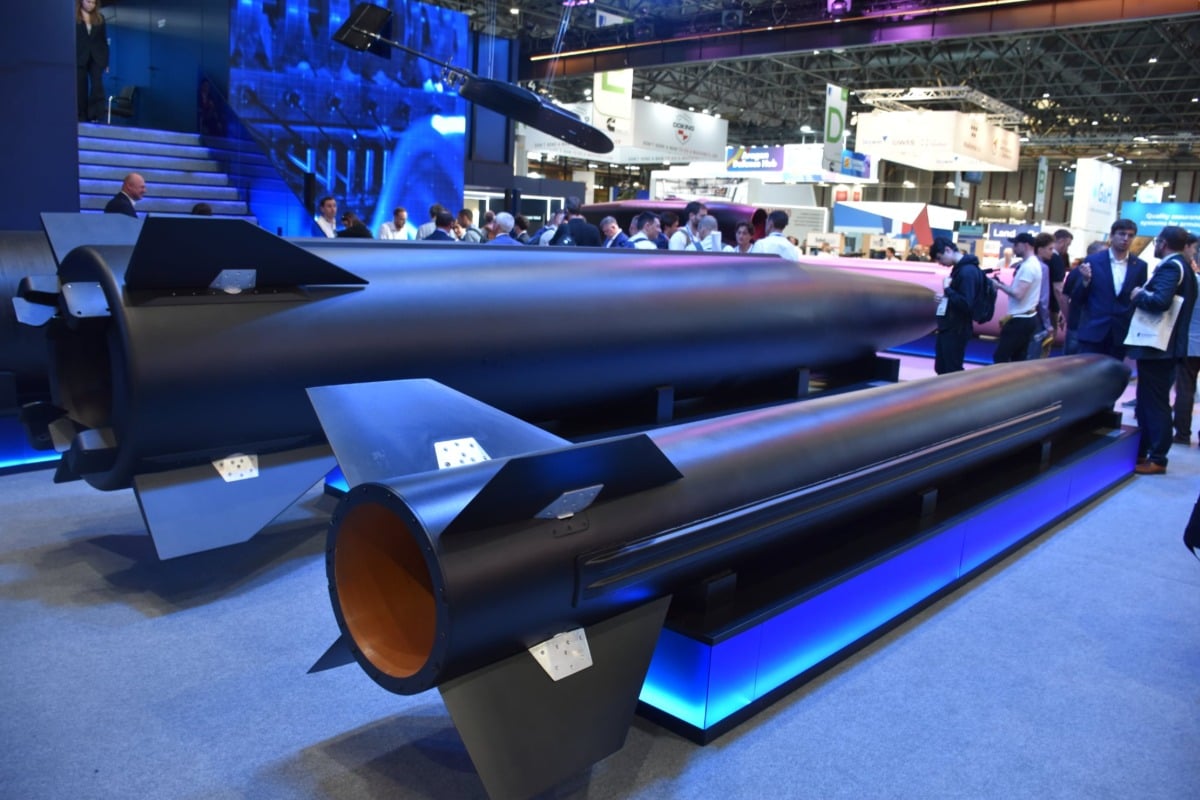
- Fire Point chief designer Denys Shtilerman said the FP-9 ballistic missile, with an 855 km range and 800 kg warhead, awaits only engine testing before first flight.
- The FP-9 is designed to reach Moscow and St. Petersburg and is expected to receive Ukrainian Ministry of Defense codification in 2026.
Ukraine is on the verge of test-launching its first domestically produced long-range ballistic missile capable of striking Moscow, the founder of the company building it said in a rare on-camera interview filmed inside one of the firm’s production facilities, according to the Ukrainian YouTube channel Pressing.
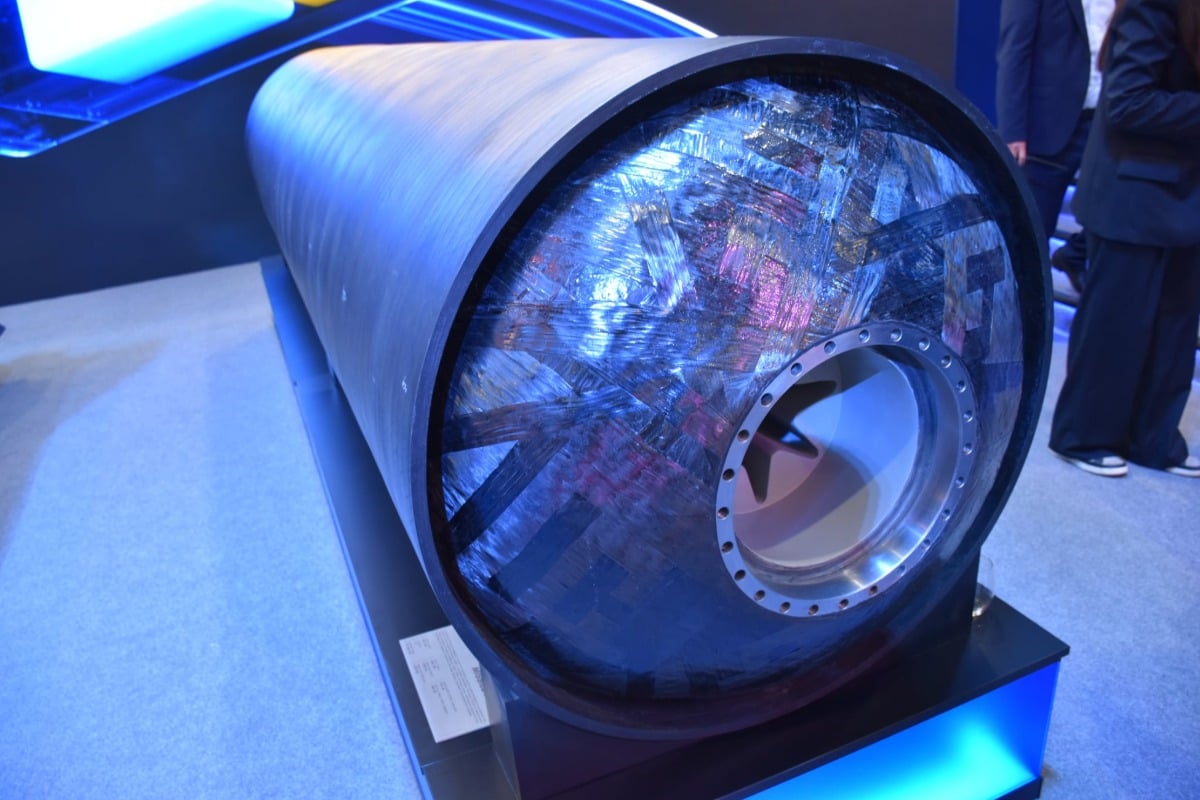
Denys Shtilerman, chief designer and co-founder of Fire Point, said the FP-9 ballistic missile has completed all major development milestones except its solid-fuel engine, which was undergoing ground testing at the time of filming, and that the first test flight to a target in Moscow could follow shortly after a successful engine validation.
“We have everything for the FP-9, which can reach Moscow, except the engine,” Shtilerman told Pressing. “We will test the engine this month and expect to begin test flights soon. As soon as a test flight shows that everything is working properly, the next flight should be launched toward Moscow.”
Fire Point, a Kyiv-based defense startup founded in 2022 by a group of engineers, architects, and game designers with no prior military industry experience, has become one of the most closely watched companies in Ukraine’s wartime defense sector. It produces more than half of Ukraine’s long-range attack drones, according to Ukraine’s General Staff, and has already fielded the FP-5 Flamingo, a ground-launched cruise missile weighing 6,000 kg (13,228 lb) with a 1,150 kg (2,535 lb) warhead and a range of up to 3,000 km (1,864 miles). The FP-9 represents a different category of weapon entirely: a short-range ballistic missile designed to reach targets at 855 km (531 miles) in under three minutes of flight time, delivering an 800 kg (1,764 lb) warhead at speeds exceeding 2,200 meters per second (Mach 7), with a circular error probable of 20 m (66 ft). The missile measures 9.5 m (31 ft) in length and 1.1 m (3.6 ft) in diameter, making it larger than Russia’s Iskander-M ballistic missile, which is 7.2 m (23.6 ft) long and 0.95 m (3.1 ft) in diameter.
The significance of that range figure is straightforward: Moscow lies approximately 800 km (497 miles) from Ukraine’s northeastern border, placing it within the FP-9’s declared operating envelope. Shtilerman told Pressing that St. Petersburg, where President Vladimir Putin was born, also falls within range. He described Russia as a monocentric country where military-industrial infrastructure, command nodes, and political authority are concentrated in a small geographic area, making long-range ballistic missiles a categorically different strategic instrument than cruise missiles or drones. A ballistic missile traveling at Mach 7 compresses the warning time available to Russian air defense systems in ways that a cruise missile flying at subsonic or low-supersonic speeds does not, and intercept rates at that velocity place heavy demands even on advanced systems like the S-400 and the newer S-500, neither of which has demonstrated reliable intercept performance against modern ballistic missiles in actual combat conditions.
Shtilerman addressed the economics of ballistic missiles directly in the Pressing interview, and his reasoning challenges a common assumption that ballistic missiles are inherently more cost-effective than cruise missiles for long-range strikes. He said a 300 km (186-mile) ballistic missile with a 200 kg (441 lb) warhead would cost approximately $600,000 per shot, while the same 200 kg warhead could be delivered 380 km (236 miles) by a modified FP-2 drone for roughly $40,000, making short-range ballistic missiles economically irrational unless speed is the critical operational requirement. The FP-9’s 855 km range, he said, is where the arithmetic changes: no cruise missile in Ukraine’s current arsenal can cover that distance while surviving the layered air defenses surrounding Moscow, making the ballistic trajectory the only viable delivery mechanism for targets in that range band.
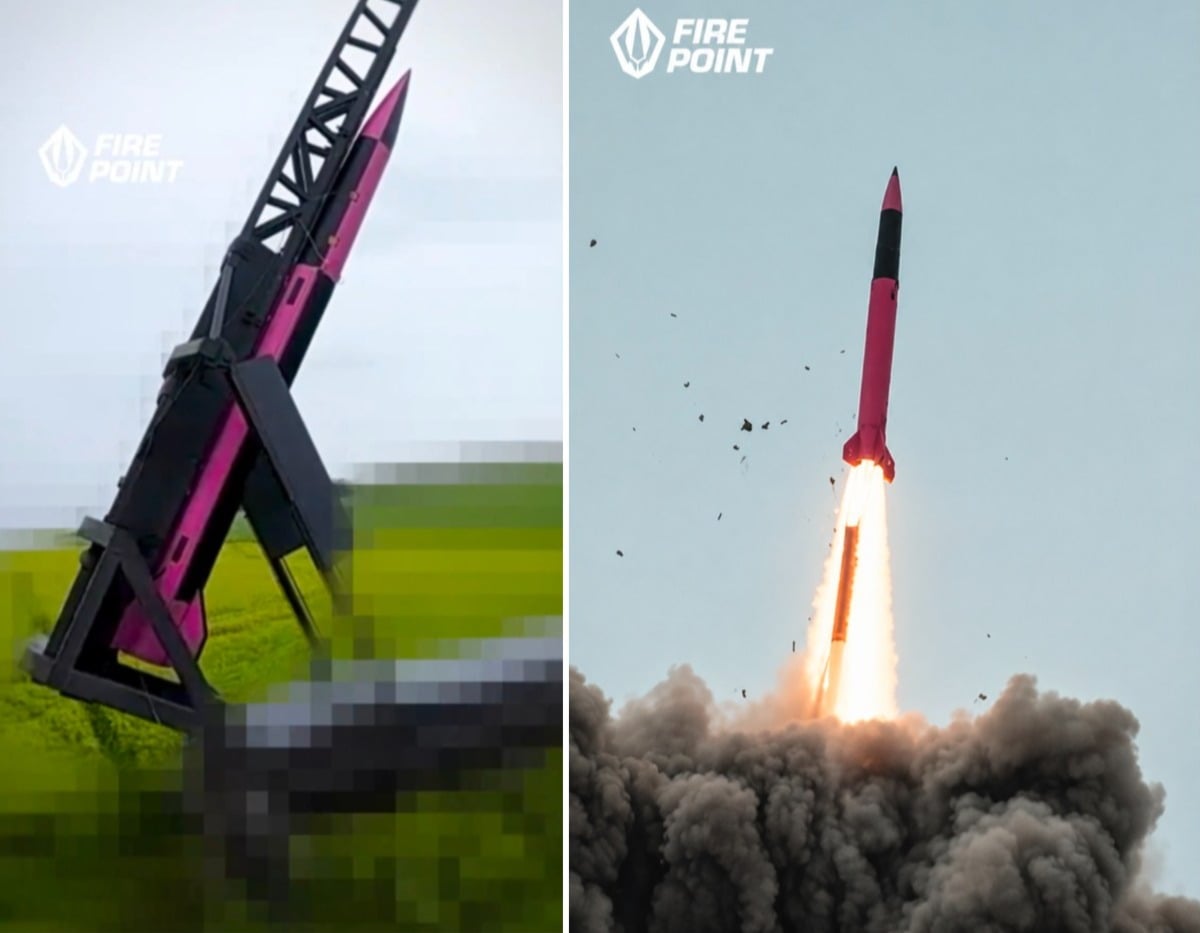
The FP-9 program sits inside a broader ballistic missile roadmap that Fire Point is building in parallel. The FP-7, a shorter-range ballistic missile based on the airframe of the Soviet-era 48N6 interceptor missile used in S-400 air defense systems, completed its first controlled test flight in February 2026, with Shtilerman posting confirmation of the launch on social media. According to technical specifications published by Militarnyi, the FP-7 has a range of up to 200 km (124 miles), a 150 kg (331 lb) warhead, a maximum speed of 1,500 m/s, and a circular error probable of 14 m (46 ft), making it roughly analogous to the American Army Tactical Missile System at approximately half the cost, per Fire Point’s own claims. The FP-9 pushes that logic to a qualitatively different scale, with a warhead more than five times heavier and a range four times greater. Codification by Ukraine’s Ministry of Defense, the formal approval process that clears a weapon for operational military use, is expected in 2026, according to the company.
The production challenge Shtilerman described publicly is the solid-fuel propellant plant. Building a ballistic missile’s solid-fuel motor requires a specialized mixing and casting facility capable of handling large volumes of propellant in a single pour, an industrial capability Ukraine did not possess before Fire Point began building one from scratch. Shtilerman told Pressing the facility is now complete after more than a year of construction and experimentation, during which the company had to develop its own propellant formulations, cure cycles, and quality verification methods without access to existing Soviet or Russian technical documentation. He said Ukraine lost more than a year because a promised technical library of Soviet missile engineering blueprints, which would have given Ukrainian engineers access to decades of solved problems, was never compiled despite commitments from two successive ministers of defense.
Fire Point’s ambitions extend beyond the FP-9 into an entirely separate program Shtilerman calls Project Freya, a Ukrainian anti-ballistic missile system designed as a lower-cost alternative to the Patriot. On June 3, 2026, Fire Point published footage of the FP-7x, described as a maneuvering interceptor missile, conducting a controlled flight test. Shtilerman told Pressing that the Freya system uses the FP-7 interceptor as its kill vehicle, integrates with existing Western radars including the Saab Giraffe, Thales Ground Master 400, and Hensoldt TRML-4D, and is built around an open software architecture specifically designed to prevent the kind of remote shutdown that rendered Qatar’s Patriot batteries inoperable when the United States suspended access during an Israeli operation targeting Hamas leadership. He characterized the entire Freya architecture as a deliberate response to the strategic vulnerability of depending on weapons that foreign governments can switch off unilaterally.
The Pressing interview also disclosed fresh details about Fire Point’s valuation and ownership disputes. Shtilerman said the company’s current capitalization exceeds $5 billion, citing an unsolicited proposal from an investment bank to conduct a private placement at a $5.8 billion valuation, which the company declined. He rejected any sale of the entire company as legally impossible under Ukrainian arms export control regulations and described an ongoing, coordinated campaign to force nationalization of the company, which he characterized as an attack on the private defense industrial base. The company’s co-founder said his own name was disclosed publicly without consent by journalists, a disclosure he connected to the fact that two of his children were living with his former wife in Russia at the time, creating a direct personal security vulnerability.
A small Ukrainian startup founded by people who had never built a weapon now operates production lines turning out cruise missiles, drones, and shortly, ballistic missiles, all without access to the technical inheritance that Russian rocket engineers have spent seventy years accumulating. The engine test Shtilerman described in the Pressing interview is the last major technical gate before FP-9 flies. If it clears that gate, the next destination, he said, is Moscow.