

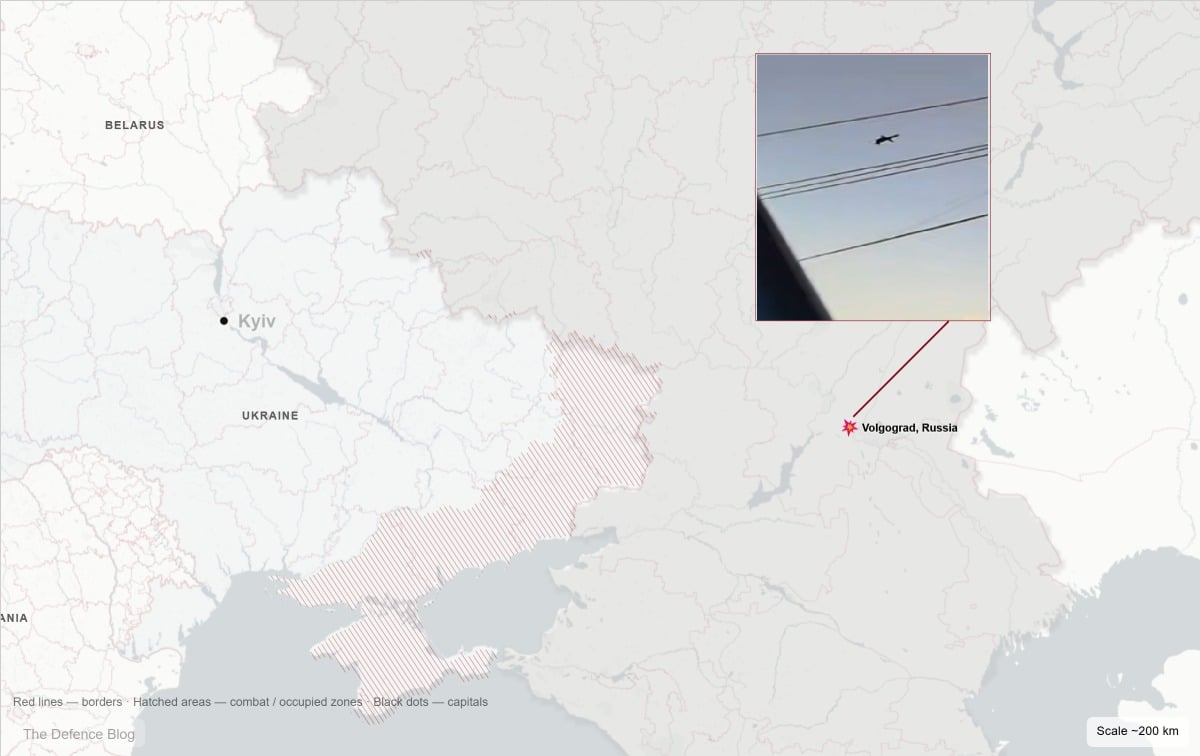
- Ukrainian FP-5 Flamingo cruise missiles struck the Titan-Barrikady defense plant in Volgograd on June 27, with at least three confirmed hits.
- Volgograd Oblast Governor Andrey Bocharov confirmed damage to production facilities in Krasnooktyabrsky District and reported ten people injured.
Thick smoke was still rising over Volgograd’s Krasnooktyabrsky District on the morning of June 27 when open-source analysts began piecing together what had just happened to one of Russia’s most critical defense manufacturing sites. According to the monitoring Telegram channel Exilenova+, FP-5 Flamingo cruise missiles struck the Titan-Barrikady plant at least three times, with footage capturing the moment of impact at the compound. OSINT analyst from Russian independent outlet Astra geolocated footage filmed from Moskovskaya Street, placing the camera approximately 6.5 km (4 miles) from the facility, and concluded the smoke originated from the Titan-Barrikady site.
Volgograd Oblast Governor Andrey Bocharov confirmed that Ukrainian “high-speed aerial targets” struck the city overnight, damaging “production facilities at one of Volgograd’s enterprises in the Krasnooktyabrsky District.” He did not name the facility, but Titan-Barrikady is located in the district he named, and Bocharov confirmed 10 people were injured in the attack and were receiving medical attention, adding that localized fires were quickly extinguished and that no residential buildings were damaged.
The Ukrainian OSINT community CyberBoroshno, which conducted preliminary GEOINT analysis of the strike, assessed that five FP-5 Flamingo missiles were used in the attack, with at least three confirmed to have hit their targets. According to CyberBoroshno’s initial damage assessment, the missiles struck three separate structures inside the compound: workshop No. 2, the production building of workshop No. 38, and a third facility whose designation has not yet been determined. Ukraine has not officially claimed the strike, and independent verification of the internal damage pattern remains ongoing.
JSC Federal Scientific and Production Center Titan-Barrikady is a subsidiary of the Moscow Institute of Thermal Technology and part of the Roscosmos state corporation — the developer and manufacturer of the Iskander-M self-propelled missile launcher, the Topol-M autonomous missile launcher, the Msta-S artillery unit, and related systems. According to open-source data cited by the CyberBoroshno OSINT community, Titan-Barrikady is the only enterprise in Russia producing launch vehicles for the Iskander-M complex — the short-range ballistic missile system that Moscow deploys across all fronts of its war in Ukraine and that carries both conventional and nuclear-capable warheads. Satellite imagery and electronic activity indicators showed increased construction and operational intensity at the Volgograd facility from 2023 to 2025, with production expanding to support surges in output for Iskander missile launch systems amid heightened military demand.
Ukrainian media also reported possible involvement of the Titan-Barrikady production facility in the Oreshnik hypersonic ballistic missile program, the weapon Russia used in a high-profile strike on Ukrainian territory in late 2024. If that connection is confirmed, the strategic significance of the strike multiplies substantially — disrupting not just the tactical missile supply chain but potentially a system that Moscow has publicly framed as a nuclear signaling instrument.
The weapons used in the attack, Fire Point’s FP-5 Flamingo, represent a qualitatively new instrument in Ukraine’s deep-strike toolkit. The Flamingo weighs 6,000 kilograms (13,228 lb), measures up to 14 meters (46 ft) in length, has a wingspan of 6 meters (20 ft), carries a 1,150-kilogram (2,535 lb) warhead, and has an operational range of 3,000 kilometers (1,864 miles). The warhead is an American Mk 84 aerial bomb or BLU-109/B bunker-buster variant, according to Defense Express analysis, carrying approximately 429 kg (946 lb) of Tritonal high explosives — enough, in the bunker-buster configuration, to punch through reinforced concrete structures before detonating. Volgograd sits roughly 1,000 km (620 miles) from Ukraine’s eastern border, well within the Flamingo’s effective reach.
The Volgograd strike is the latest in a series of increasingly consequential Flamingo employment operations. In February 2026, a Flamingo strike hit an arsenal of the Main Missile and Artillery Directorate of the Russian army in Kotluban, Volgograd region, destroying a reinforced bunker with an external area of approximately 3,600 square meters (38,750 sq ft). Later that month, Flamingo missiles struck the Votkinsk Plant in Udmurtia, which manufactures rocket engines for Iskander missiles and intercontinental ballistic missiles including the Oreshnik. In March 2026, OSINT analysts recorded a Flamingo hit on the explosives production facility of Promsintez in Chapayevsk, Samara region, an enterprise supplying explosive substances for ammunition, aerial bombs, and missiles.