

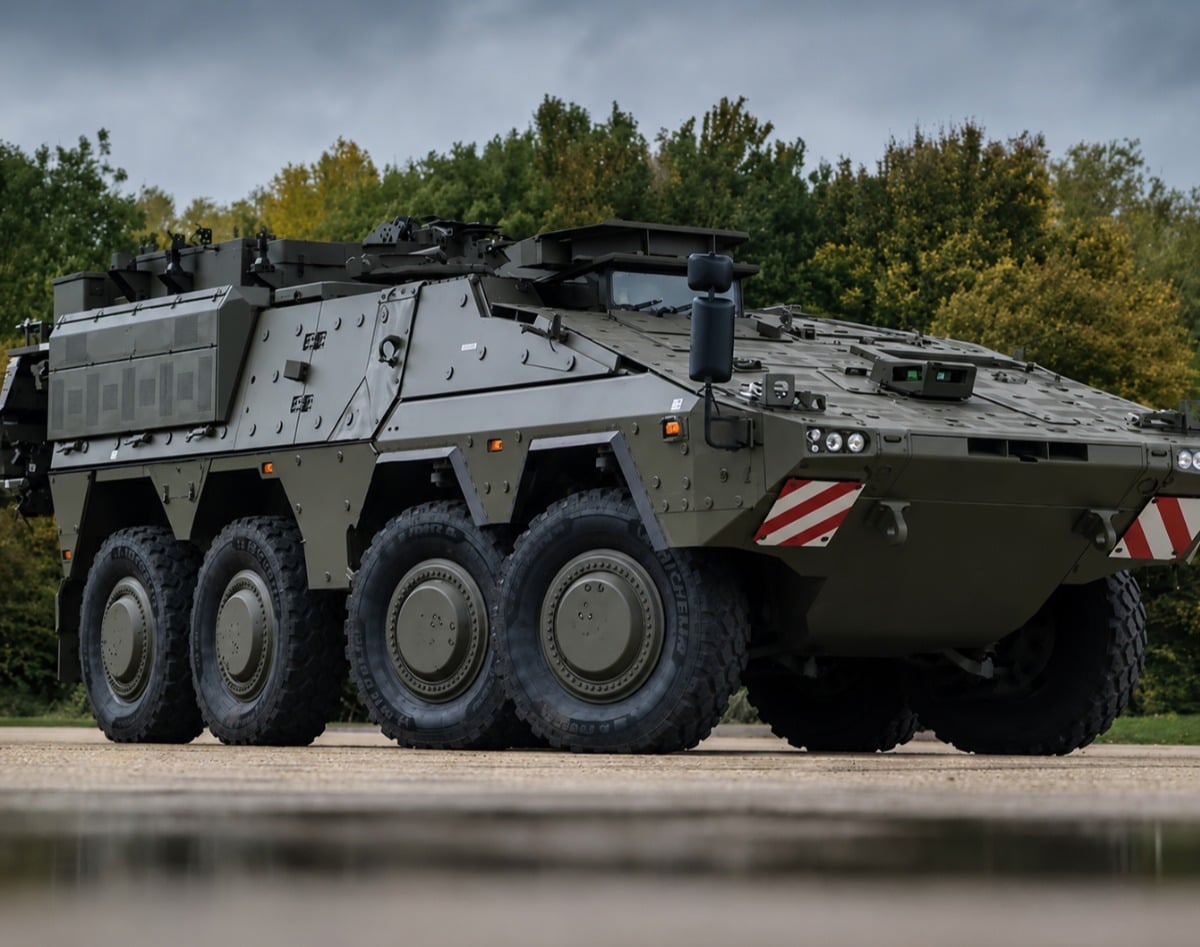
- Team Boxer UK delivered the 100th Boxer Mechanised Infantry Vehicle to the UK Ministry of Defence on June 25, 2026, built at facilities in Telford and Stockport.
- The programme involves Rheinmetall, KNDS, OCCAR, ARTEC, the British Army, NAD Group, and Defence Equipment and Support across a UK-wide supply chain.
Britain has delivered its 100th Boxer armored infantry vehicle to the British Army, hitting a landmark production milestone for one of the most significant land warfare modernization programs in the country’s recent defense history, with all vehicles built at two manufacturing facilities on British soil.
The 100th Boxer Mechanised Infantry Vehicle rolled off the production line on June 25, 2026, the result of a manufacturing effort split between Rheinmetall BAE Systems Land, known as RBSL, at its facility in Telford, and KNDS UK in Stockport, two cities in the English Midlands and northwest that have become the physical centers of Britain’s armored vehicle industrial revival. The milestone matters not just as a production number but as confirmation that the United Kingdom has successfully rebuilt a sovereign armored vehicle manufacturing capability after decades during which British governments repeatedly chose to source military equipment abroad rather than maintain the industrial infrastructure to build it at home.
The Boxer is a German-designed modular armored vehicle built around an innovative concept that distinguishes it from most conventional armored personnel carriers: the vehicle separates its drive module, which contains the engine, transmission, and running gear, from a mission module that sits in the rear and can be swapped out in the field depending on what the mission requires. In the infantry carrier configuration being delivered to the British Army, the mission module carries soldiers in protected conditions across contested terrain. The same drive module can accept different mission modules configured for command and control, ambulance operations, engineering support, or direct fire, giving commanders a fleet that adapts to operational requirements without needing entirely separate vehicle types for each role. That modularity is the Boxer’s defining operational advantage, and it is why the British Army selected the platform as a central element of its future warfighting structure after years of operating the aging Warrior infantry fighting vehicle.
The Boxer weighs approximately 38,500 kg (84,877 lb) in its infantry carrier configuration and is protected to NATO STANAG 4569 Level 4 as a baseline, meaning it can withstand 14.5 mm (0.57 in) armor-piercing rounds and artillery shell fragments, with additional armor packages available to increase protection further depending on the threat environment. The vehicle carries a crew and up to eight infantry soldiers, moves at road speeds of approximately 103 km/h (64 mph), and has a road range of around 1,050 km (652 miles) on a single fuel load, giving it the strategic mobility to reposition across a theater of operations without requiring constant refueling stops. Those figures place it in the upper tier of infantry carrier capability among NATO armies.
The programme’s delivery structure involves a partnership so complex it reflects the realities of modern European defense collaboration more than any single nation’s industrial ambition. The organizational framework includes OCCAR, the Organisation for Joint Armament Cooperation that manages multinational European defense programs; ARTEC, the industrial consortium that holds the Boxer development and production rights; Rheinmetall, the German armored vehicle and ammunition manufacturer that is one of Europe’s most significant defense industrialists; KNDS, the Franco-German vehicle manufacturer formed from the merger of Krauss-Maffei Wegmann and Nexter; the British Army; and the National Armaments Director Group and Defence Equipment and Support on the British government side. Each layer of that structure contributed something the others could not provide alone, and the technology transfer dimension has been particularly significant for British industry, rebuilding armored vehicle manufacturing knowledge that had eroded over the preceding two decades.
Martyn Williams, Senior Responsible Owner for Boxer at the NAD Group, pointed directly to that technology transfer dimension. “The delivery of the 100th Boxer to the UK Ministry of Defence is a significant milestone and reflects the tremendous work done by OCCAR, ARTEC, KNDS, Rheinmetall, the NAD Group and wider MOD to establish two UK Boxer production lines and the broad supply chains across the UK. The international collaboration through OCCAR and ARTEC has seen technology transfer to the UK, building on the UK’s proud history of armoured vehicle manufacturing,” Williams said.
Rebecca Richards, Managing Director of Rheinmetall UK, addressed the workforce and industrial capacity dimension that production milestones tend to obscure behind the headline vehicle count. “Reaching the 100-vehicle milestone is a significant achievement for the teams delivering Boxer in the UK. It reflects the dedication and expertise of our workforce, suppliers and partners, whose contribution is helping to build long-term manufacturing capacity and strengthen sovereign industrial capability. Boxer is creating lasting skills and investment while delivering a world-class capability for the British Army and supporting prosperity across the UK,” Richards said.
Tony Webb, Operations Director at KNDS UK, framed the milestone in terms of strategic industrial advantage rather than immediate military capability. “The delivery of the 100th Boxer vehicle demonstrates the value of long-term investment in sovereign defence capability and the strength of the UK’s defence industrial base. Programmes such as Boxer sustain critical skills, support SMEs across a resilient national supply chain and drive investment in advanced manufacturing. This milestone reflects the power of collaboration between government, industry and international partners to generate lasting strategic advantage for the UK,” Webb said.
The supply chain that supports Boxer production spans the United Kingdom, employing hundreds of engineers, technicians, apprentices, and program specialists whose work represents the kind of advanced manufacturing investment that defense programs uniquely sustain in regional economies. Telford and Stockport are not traditional defense manufacturing centers in the way that cities like Bristol or Derby have historically been, and the establishment of production lines in both locations reflects a deliberate effort to distribute the economic benefits of the program across Britain rather than concentrating them in existing defense industrial clusters.