

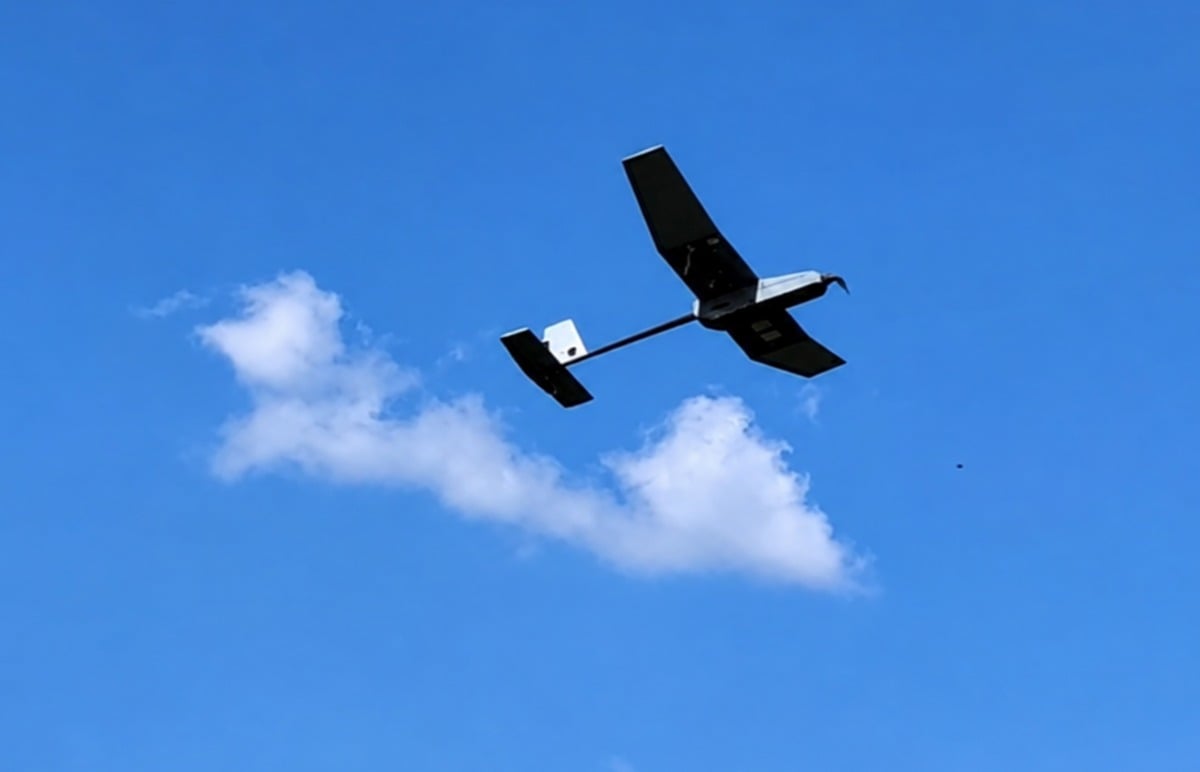
- Ukrainian company General Chereshnya developed the Sweetheart drone, weighing 4 kg, with 150 km range, three-hour endurance, and electronic warfare resistance.
- Serial deliveries of the hand-launched reconnaissance drone are expected to begin in autumn 2026 after ongoing combat testing with Ukrainian military units.
A Ukrainian defense firm has developed a hand-launched reconnaissance drone capable of flying 150 km (93 miles) into enemy territory while resisting electronic jamming, with serial deliveries expected to begin this autumn, the Ukrainian defense outlet Militarny reported.
The drone is called Sweetheart, and the company behind it is General Chereshnya, a Ukrainian developer whose name translates roughly as “General Cherry.” Founded by Yaroslav Hryshyn, the company set out to build a reconnaissance aircraft that solves a specific problem Ukrainian commanders face daily: the need for persistent, long-range intelligence collection deep behind Russian lines, using a platform cheap enough that losing it does not paralyze a unit’s operational budget or its willingness to take risks. The war in Ukraine has produced dozens of drone developers pursuing variations of that requirement, but Sweetheart’s combination of range, endurance, and price point places it in a category where relatively few Ukrainian designs currently compete.
The aircraft weighs 4 kg (8.8 lb) and spans 1.7 m (5.6 ft) across its wings, dimensions that allow a single soldier to carry and launch it without any ground support equipment. No catapult, no launch rail, no trailer. A simple hand throw gets it airborne, a feature that matters considerably in forward positions where bringing additional equipment forward invites attention and consumes logistics capacity that front-line units rarely have to spare. Once airborne, Sweetheart can remain in the air for up to three hours and operate at distances of up to 150 km (93 miles) from its operator, a range that puts it well into the category of systems capable of reaching Russian rear-area logistics nodes, command posts, artillery positions, and supply routes that shorter-range drones cannot touch.
The sensor package reflects the intelligence priorities that Ukrainian forces have developed through more than four years of high-intensity warfare. Sweetheart carries a digital video link, a gimbaled zoom camera for stabilized long-distance observation, and a laser rangefinder that allows operators to calculate precise distances to targets they observe, a capability that matters both for direct artillery targeting and for planning ground operations. The communications architecture received particular engineering attention, with General Chereshnya designing the datalink to resist electronic warfare interference, the category of threat that has degraded or destroyed more Ukrainian drone operations than any other single factor since Russia deployed its most capable jamming systems to the eastern front.
Acoustic stealth adds another layer of survivability that the specification sheet alone does not capture. At altitudes between 50 m and 70 m (164 ft to 230 ft), the drone produces sound levels that are, according to the company, essentially inaudible from the ground, complicating detection by Russian soldiers who might otherwise hear an approaching aircraft before radar or optical systems locate it. This characteristic is particularly relevant for missions that require sustained loitering over a target area, where a drone that announces its presence acoustically forces the observed force to conceal or relocate before useful intelligence is collected.
Yaroslav Hryshyn, the founder of General Chereshnya, described the design philosophy the company pursued in developing the system.
“We set ourselves the task of creating a reconnaissance aircraft that would be affordable, easy to use, and at the same time capable of performing complex tasks deep in the enemy’s rear. That is exactly what our Sweetheart is,” Hryshyn told Militarny.
The pricing strategy General Chereshnya has adopted deserves attention as a deliberate operational choice rather than simply a commercial calculation. The company says a single Sweetheart system will cost approximately one-sixth of what comparable reconnaissance drones in the same performance class typically run, a reduction that Hryshyn argues changes the psychology of how commanders deploy the aircraft. When a drone costs as much as a military vehicle, unit commanders treat it as a precious asset to be protected, which limits the operational risks they are willing to accept and reduces the number of missions they authorize. When the cost drops to a fraction of that figure, the calculation changes.
“At such a cost, the military will not be afraid to lose a unit, and in some cases will be able to consciously send it on a one-way mission in order to obtain critically important intelligence information,” Hryshyn explained to Militarny.
Sweetheart is currently undergoing active combat testing in cooperation with Ukrainian military units, and General Chereshnya expects serial production deliveries to begin in autumn 2026. The specific units involved in testing and the quantities planned for initial production were not disclosed by Militarny’s reporting.