

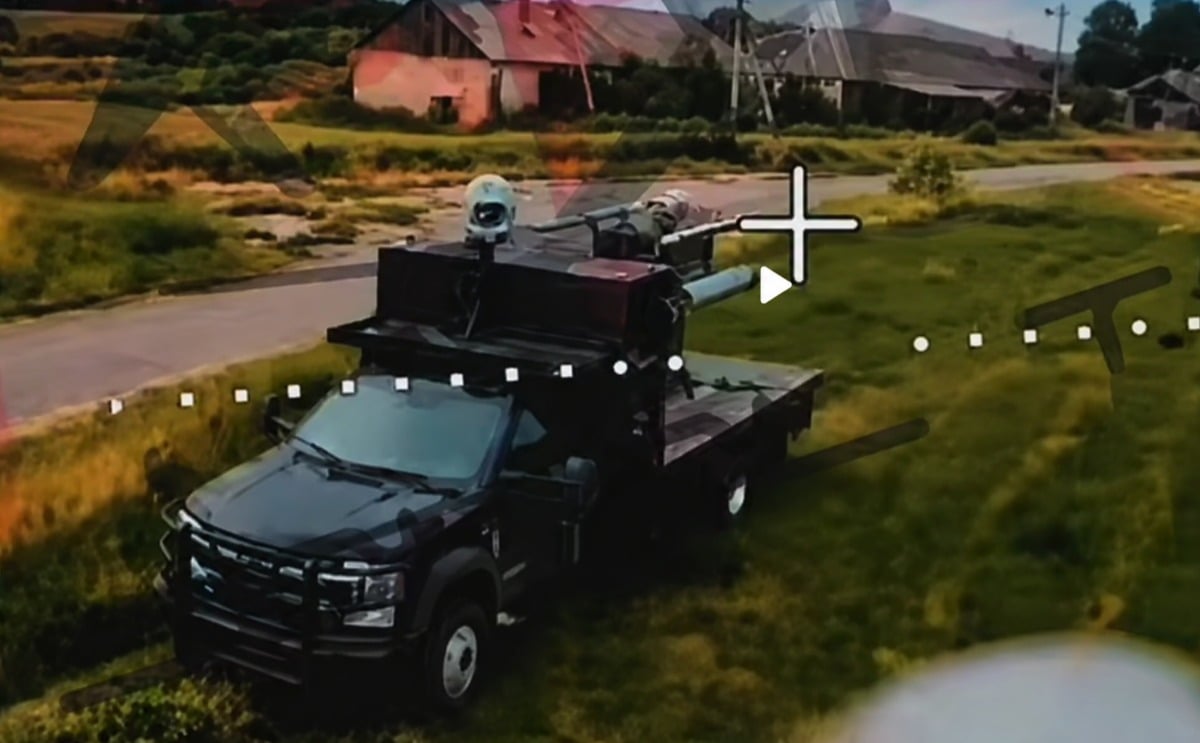
- A Ukrainian MAAWLR air defense launcher made by Sierra Nevada Corporation was destroyed by a Russian FPV drone in Kharkiv Oblast, Ukraine.
- The MAAWLR is a truck-mounted reconfigurable missile system capable of engaging aerial targets at ranges between 6 km and 15 km (3.7 to 9.3 miles).
A Ukrainian air defense system built by the U.S. defense company Sierra Nevada Corporation was destroyed in Kharkiv region by a Russian first-person-view (FPV) drone operated by the “Sever” (North) assault grouping, marking what appears to be the first confirmed combat loss of the MAAWLR anti-drone missile launcher in the war.
The MAAWLR, which stands for Mobile Anti-Air Weapons Launcher, Reconfigurable, is a truck-mounted air defense platform designed to hunt and destroy drones, cruise missiles, and low-flying aircraft. Unlike the large, expensive, and difficult-to-move systems that form the backbone of traditional air defense networks, the MAAWLR fits entirely onto a pickup truck chassis, measures 8.5 m long, 2.4 m wide, and 4.6 m tall (28 ft x 8 ft x 15 ft), and weighs approximately 9,072 kg (20,000 lb) fully loaded. A crew of just two soldiers can set it up in 20 minutes and break it down in the same time, making it the kind of system that can relocate before a counter-strike arrives, a survival requirement that has defined air defense tactics throughout the war in Ukraine.
Sierra Nevada Corporation, known in the defense industry as SNC and headquartered in Sparks, Nevada, developed the MAAWLR as part of its Rapidly Deployable Air Defense family, a suite of systems designed to give ground forces mobile, flexible protection against the full spectrum of airborne threats that now define the modern battlefield. The system’s central feature is its reconfigurability: rather than being locked into a single missile type, the MAAWLR can fire a broad range of weapons depending on the threat and the mission, including the AIM-9M Sidewinder, a heat-seeking missile originally designed for fighter jets but adapted for surface launch; the AIM-120 AMRAAM, an advanced radar-guided missile capable of engaging targets beyond visual range; the AIM-132 ASRAAM, a British-developed short-range air-to-air missile; the German IRIS-T; the Soviet-era R-27; and the APKWS II, a laser-guided rocket originally designed to transform unguided 70 mm (2.75 in) rockets into precision weapons. Depending on which munitions are loaded, SNC says the system can engage aerial targets at ranges between 6 km (3.7 miles) and 15 km (9.3 miles), covering the altitude bands and distances where most drone threats to Ukrainian ground forces operate.
The sensor package mounted on the truck gives the MAAWLR the ability to find and engage targets without depending on an external radar network, a critical independence that matters in contested environments where radar emissions can themselves attract attack. Two RPS-82 X-band radar dishes provide a 90-degree radar cone for target detection and tracking, while an MX-15 FLIR sensor, a stabilized electro-optical and infrared turret manufactured by L3Harris and widely used across American military aircraft and ground vehicles, provides the optical identification capability. A SISLIR target illuminator guides certain missile types to their targets. The system can also receive targeting data from external radar sources, extending its reach into an integrated air defense network when one is available. Data outputs in OMNI, Link 16, and Asterix formats allow the MAAWLR to communicate with NATO-standard command and control architecture, and its open software architecture supports integration with SNC’s own TRAX system as well as WinTAK and ATAK, the Android-based tactical awareness platforms widely used by Ukrainian forces.
The vehicle that carries all of this runs on diesel, carries enough fuel for between 24 and 72 hours of continuous operation depending on conditions, and has a road range exceeding 400 km (249 miles). It is transportable by C-17 Globemaster III strategic airlift aircraft, meaning a single large military cargo plane can deliver multiple systems directly to a forward airfield and have them operational within hours of landing. Training a crew to operate the system takes 14 days according to SNC’s documentation, a relatively short learning curve for a platform of this capability that reflects the design philosophy of keeping complexity off the operator and embedding it in the software.
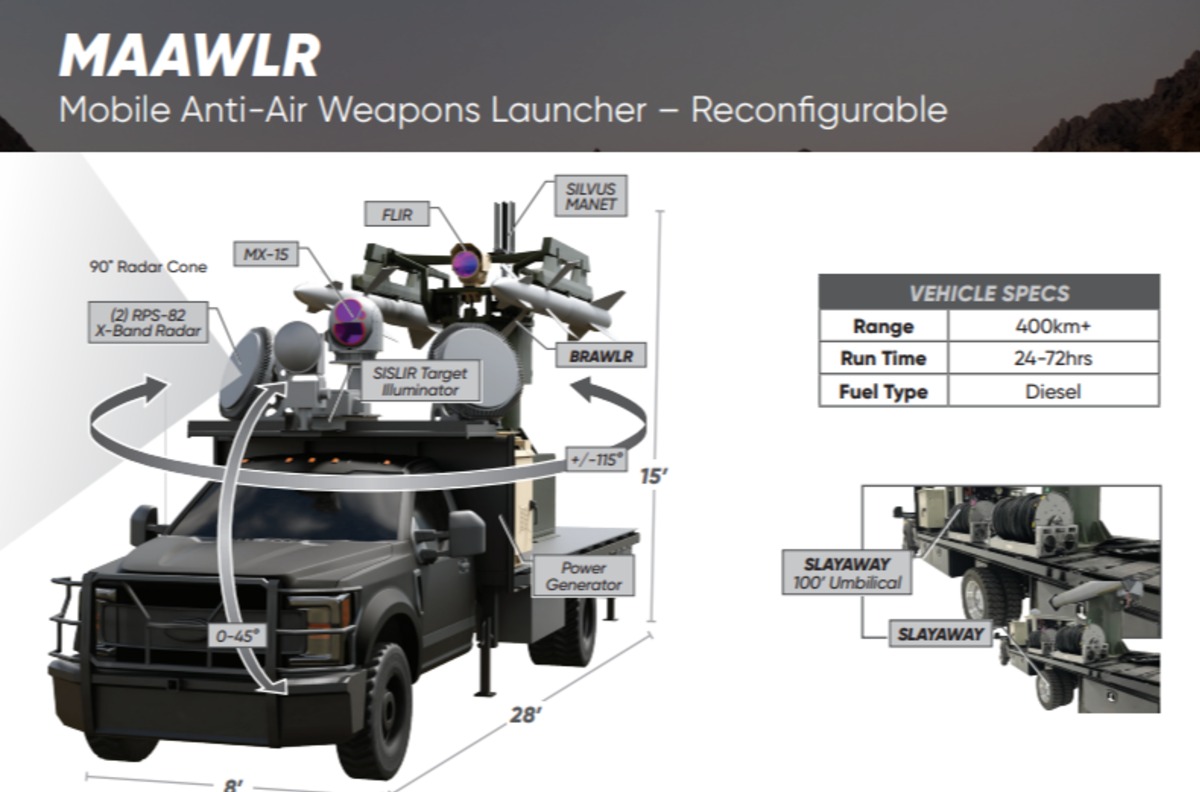
The brochure SNC published rates the MAAWLR at Technology Readiness Level 9, Manufacturing Readiness Level 9, and Integration Readiness Level 9, meaning the company considers the system fully mature across every dimension from engineering to production to fielding. Those ratings, combined with its confirmed operational presence in Ukraine, place the MAAWLR well beyond the prototype or pre-production stage that characterizes many Western systems rushed to the front.
A crew operating the MAAWLR had apparently engaged or was prepared to engage during a Russian attack drone strike when a Russian FPV drone, the small, camera-equipped one-way attack munitions that have emerged as one of the most cost-effective weapons of the conflict, located and destroyed the launcher. FPV drones have proven lethally effective against precisely this category of target: high-value, mobile, and expensive systems that are difficult to protect from a threat flying at ground level, below radar coverage, and costing a fraction of the value it destroys.