

- Chief of Naval Research Rachel Riley unveiled the "Feed S&T at Speed to the Fleet and Force" strategy at the Defense One Tech Summit on June 16, 2026.
- ONR manages a roughly $3 billion annual budget and a workforce of approximately 1,100 scientists, almost all in STEM fields.
The U.S. Navy is overhauling how it moves research from laboratory to warship, with its top science official announcing a new strategy that strips bureaucracy from the development pipeline and demands that the service’s $3 billion annual research budget stop competing with the private sector for work that commercial investors will fund on their own, Defense One reported Tuesday.
The announcement, made by Chief of Naval Research Rachel Riley at the Defense One Tech Summit in Arlington, Virginia, signals a sharper turn toward speed and focus at an office that has historically driven some of the Navy’s most consequential long-range technology investments.
The new strategy, titled “Feed S&T at Speed to the Fleet and Force,” where S&T stands for science and technology, was described by Riley as being in final production. She said ONR, which stands for the Office of Naval Research, the Navy’s primary science and research command founded in 1946 and responsible for funding both basic and applied research across academic, industry, and government laboratories, is working to “de-layer and simplify” its internal bureaucracy so that the limiting factor on technology development becomes “the physical science and not the processes and the policies around it.”
“Speed is, of course, the word of the year in our business,” Riley said during the summit panel.
The strategic logic Riley outlined is straightforward: stop duplicating what industry will build for profit, and concentrate federal research dollars on problems that only the military needs solved or that commercial investors will never touch because the market for them is too small, too distant, or too niche. Riley offered a deliberately blunt test for sorting the two categories.
“If there is profit to be made, then it is something where industry capital will flow. Perhaps not perfectly, but eventually,” she said.
ONR controls a workforce of roughly 1,100 scientists and researchers, almost all in science, technology, engineering, and mathematics. Riley acknowledged that identifying what industry would or would not pursue had historically frustrated her staff, but argued the framework is simpler than it appears. She gave submarines as her clearest example of what ONR must continue to fund without hesitation, describing the vessel type without naming it first.
“My favorite example, because it immediately resonates with everyone, is currently there’s really no commercial need for very quiet tubes that move through the water for a very long time,” she said.
ONR has funded submarine stealth research for decades, and Riley made clear the office intends to keep the submarine force “the most lethal in the world.” That commitment carries real weight in 2026, as the U.S. Navy pursues the AUKUS agreement with Australia and the United Kingdom, which centers on transferring nuclear-powered submarine technology to Canberra as part of a generational strategic alignment in the Indo-Pacific. No commercial entity will develop quieter submarine propulsion because no commercial entity builds submarines. That is precisely the kind of gap ONR exists to fill.
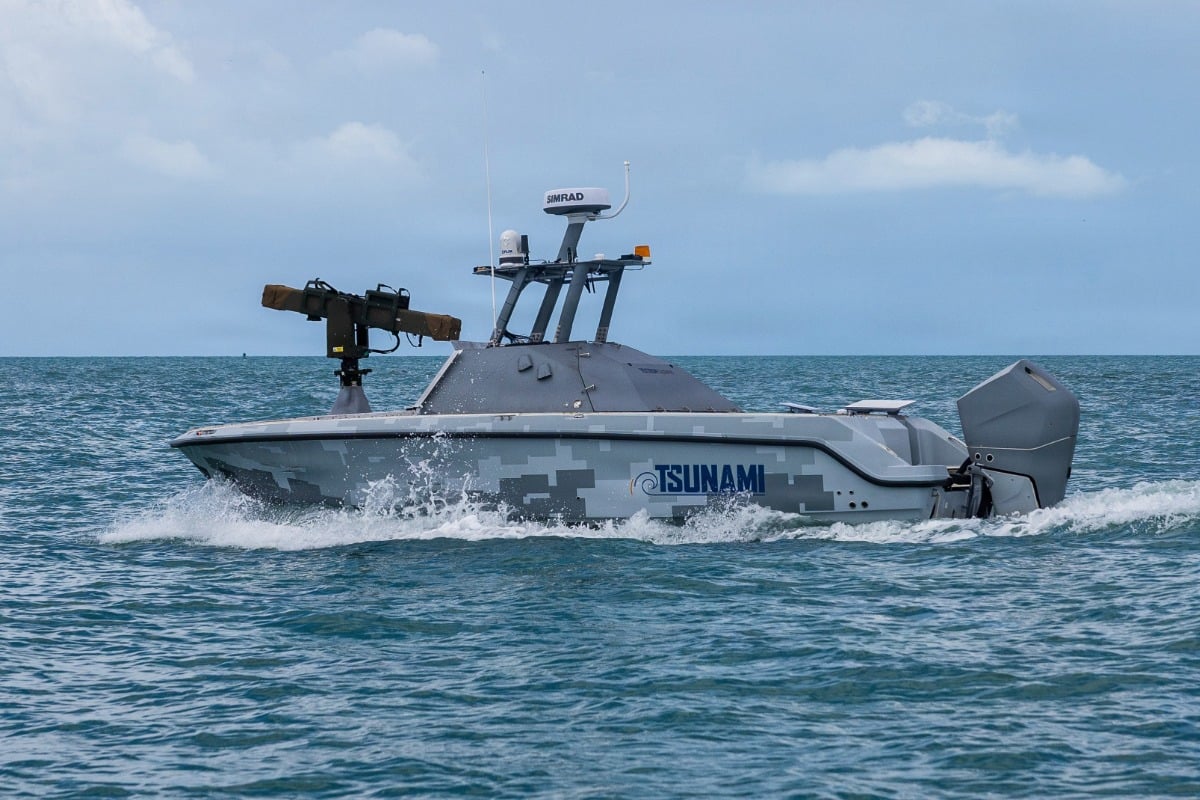
The strategy also aims to redefine ONR’s relationship with defense contractors, pushing the office’s program officers to act as what Riley described as a “thought partner” to industry rather than a parallel research track. She pointed to the Sea Hunter, a 40-meter (131-foot) autonomous drone ship that ONR began experimenting with in 2017 as a platform for tracking submarines and clearing mines without a crew, as a model for how that handoff should work. Sea Hunter, built by defense technology company Leidos, is no longer an experiment. According to Breaking Defense, the vessel and its sister ship Seahawk have transitioned from experimental status into fleet control in 2026, with Seahawk deploying operationally alongside a carrier strike group, marking a transition that has taken the better part of a decade to achieve.
The panel also featured Jarred Conley, principal director for maritime efforts at the Defense Innovation Unit, a Department of War agency established to accelerate the adoption of commercially developed technology into military service. Conley described a recent landmark that he said made the preceding days “a great week at the Defense Innovation Unit”: the first-ever rescue of downed military aircrew by an unmanned boat.
Two U.S. Army pilots flying an AH-64 Apache attack helicopter, a twin-engine gunship primarily used for close air support and anti-armor missions, went down near the coast of Oman on June 8, 2026, in circumstances that remain under investigation. A Saronic Corsair autonomous surface vessel, a 7.3-meter (24-foot) crewless boat built by Austin-based startup Saronic Technologies and operated by the Navy’s Task Force 59, the service’s dedicated unmanned maritime integration unit, located the pilots in the water and transported them to a position where a crewed helicopter could recover them. According to U.S. Central Command, both pilots were rescued within approximately two hours and were in stable condition. Conley described the Corsair system as having gone “from first splash to success in four months.”
Saronic received a production contract worth more than $392 million from the Navy for the Corsair platform, and in April 2026 the company announced a Series D funding round of $1.75 billion at a valuation of $9.25 billion, one of the largest fundraising rounds in maritime technology history. The rescue mission was not a capability the Corsair was originally fielded to perform: the vessel had been deployed in the region for maritime surveillance, and the pilots, both conscious, pulled themselves aboard the low-freeboard hull. Nevertheless, the outcome illustrated the potential for autonomous surface vessels to reduce risk to human rescue crews in contested or hazardous environments.
Conley said DIU’s maritime team is now working on contested logistics, including autonomous resupply vessels, and on the problem of clearing naval mines, a weapon class he described as one of the Navy’s most underfunded challenges despite posing “a huge problem for the global economy.” Iran has used, or at minimum threatened to use, mines to restrict passage through the Strait of Hormuz, the narrow waterway through which roughly 20 percent of global oil supply transits. Neutralizing mines currently requires humans, either flying aboard MH-60 Seahawk helicopters or working as explosive ordnance disposal divers. Last month, DIU launched what Conley called an MCM Modernization Prize Challenge, a competition to find autonomous or machine-assisted approaches to the problem, with candidate systems expected to deploy by September 2026.
Both Riley and Conley identified the same overarching challenge for the next phase of unmanned systems development: moving from one human controlling one drone to one human controlling many drones simultaneously. Riley described too many current approaches as resembling “little kids playing soccer,” a formation of vehicles that cluster around the same objective rather than distributing intelligently across a problem. To address that, ONR is funding academic research into the mathematics of how insects and birds coordinate in swarms, with the goal of modeling that behavior computationally and applying it to unmanned platforms at scale.
“Mass matters,” Conley said at the summit, noting that the jump from zero to one operational autonomous system is achievable, but the jump from one to one hundred presents fundamentally different challenges in coordination, logistics, and command authority. He added that commanders’ tolerance for accepting an imperfect but functional solution, iterating quickly, and providing feedback to developers is growing across the force, a cultural shift that may prove as important as any technical breakthrough.
The forum also touched on a congressional proposal to create a dedicated combatant command for robotics and autonomous systems, an idea Conley expressed support for. Such a command would give unmanned systems a permanent institutional home at the highest level of military organizational authority, rather than distributing responsibility for drones and autonomous boats across individual services. Whether Congress advances that proposal remains to be seen, but the conversation reflects how far autonomous warfare has traveled since Sea Hunter first left the dock nine years ago. The Navy’s research office is betting that the next nine years will move considerably faster.