

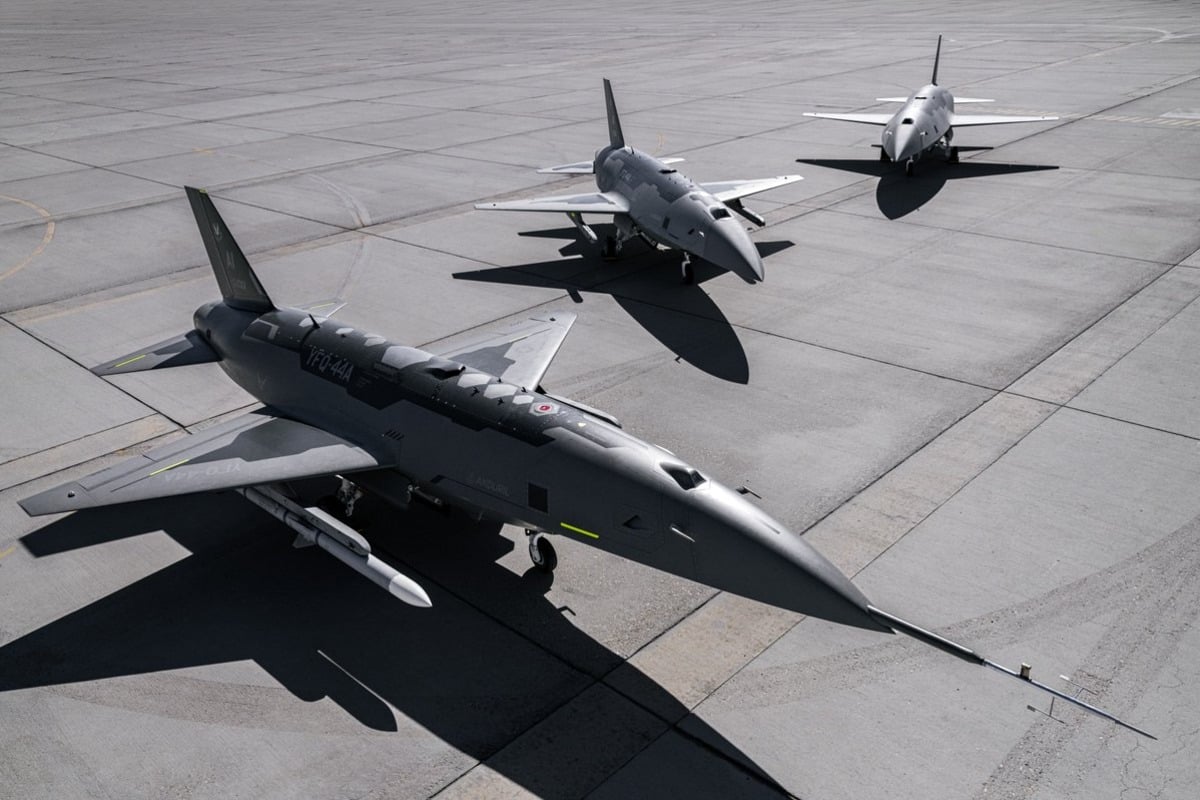
- The U.S. Air Force awarded Anduril and General Atomics production contracts for the FQ-44 and FQ-42 Collaborative Combat Aircraft on June 17, 2026.
- The Air Force said it aims to procure more than 150 combat-capable CCAs by the end of the decade, with contract size and order quantities undisclosed.
Anduril Industries announced that the U.S. Air Force selected Anduril’s FQ-44, developed as the YFQ-44A prototype, for production under the Collaborative Combat Aircraft program, a Pentagon effort to field large numbers of semi-autonomous fighter-type drones designed to fly alongside crewed jets like the F-35.
The Air Force’s decision arrived months ahead of the program’s original schedule, and Anduril described the award as the first time in more than 50 years that a new entrant has won a U.S. fighter aircraft production program, rather than an established defense giant like Lockheed Martin or Boeing.
Anduril wasn’t the only winner that day. The Air Force simultaneously awarded a production contract to General Atomics’ FQ-42, developed as the YFQ-42A Dark Merlin prototype, meaning the service will field a split fleet built around two genuinely different aircraft rather than betting everything on a single design. The Air Force did not disclose contract size or order quantity, but said it aims to procure more than 150 combat-capable CCAs by the end of the decade, with the option to order additional production lots from either company depending on performance, cost, and how fast each manufacturer can actually deliver hardware.
Understanding why this milestone matters requires understanding what a Collaborative Combat Aircraft actually is, since the category didn’t exist in any meaningful operational sense just three years ago. These are uncrewed aircraft built to the same general size and performance class as a crewed fighter jet, capable of carrying weapons, flying combat missions, and operating either alongside a human-piloted aircraft or independently using onboard autonomy software. Often described as “loyal wingmen,” CCAs are intended to operate with crewed fighters, built on the idea that a single human pilot in an F-35 or similar jet could eventually direct several of these uncrewed aircraft at once, multiplying the number of weapons and sensors in the sky without multiplying the number of pilots at risk. Anduril’s FQ-44 is a jet-powered uncrewed fighter-type aircraft developed from the Fury design, while GA-ASI says the YFQ-42A is based on the genus-species concept pioneered with the XQ-67A OBSS program, giving the Air Force two different design philosophies rather than two versions of the same one.
Anduril’s own account of the program’s timeline reads almost implausibly fast by the standards of military aircraft development, and the broader reporting on the program confirms the pace. The company received its prototype award in April 2024, started ground testing in April 2025, and announced the start of YFQ-44A flight testing in October 2025, before securing a production contract in June 2026, a span of roughly two years from a standing start to a manufacturing line. By comparison, traditional fighter programs have historically taken a decade or longer to move from initial design to production aircraft, a timeline shaped by the complexity of integrating new airframes, engines, avionics, and weapons systems through extensive testing cycles. Anduril credits that compression to designing for mass production from day one rather than treating manufacturing as an afterthought once the aircraft itself was finalized, building and refining its production tooling in parallel with the aircraft’s development rather than waiting until the design was locked.
Anduril has begun building Fury aircraft at its Arsenal-1 facility near Columbus, Ohio, and the company says the site is designed for high-rate production, with equipment mounted on wheels specifically so the line can be reconfigured as the aircraft design evolves or as demand requires scaling further. That flexibility matters because the FQ-44’s central selling point isn’t just that it can fly. It’s that the Air Force could theoretically order dozens or hundreds of them on a timeline that would have been unthinkable for a traditional crewed fighter program, addressing what defense planners have increasingly described as a critical shortfall in the number of combat aircraft the U.S. could field quickly in a prolonged, high-intensity conflict against a major power.
Anduril has disclosed extensive flight testing beyond the basic first-flight milestone, reporting that it has flown multiple FQ-44 aircraft regularly across dozens of sorties from different airfields, switched between two different autonomy software suites mid-flight, and integrated the aircraft with inert air-to-air munitions during test flights. In one exercise with the Air Force’s Experimental Operations Unit, the company says a small crew with only a few days of training successfully launched, recovered, and turned around multiple FQ-44 sorties without the kind of large, established base infrastructure a traditional fighter squadron would typically require, a result the company frames as proof the aircraft can deploy and operate from austere locations rather than depending on major air bases.
The current contracts cover production of the first fleet of initial aircraft to support continued testing and validation, while broader fielding and any move toward larger-scale manufacturing remain ahead. Anduril and the Air Force have set a goal of having an operational capability ready by the end of the decade, and the company has acknowledged that scaling production while continuing to test, validate, and refine the aircraft remains the harder phase of the program, one that a single contract announcement does not resolve no matter how fast the road to get here moved. The Air Force is betting that two different companies building two different uncrewed fighters can deliver the affordable combat mass that decades of shrinking fighter fleets and rising aircraft costs have steadily eroded.