

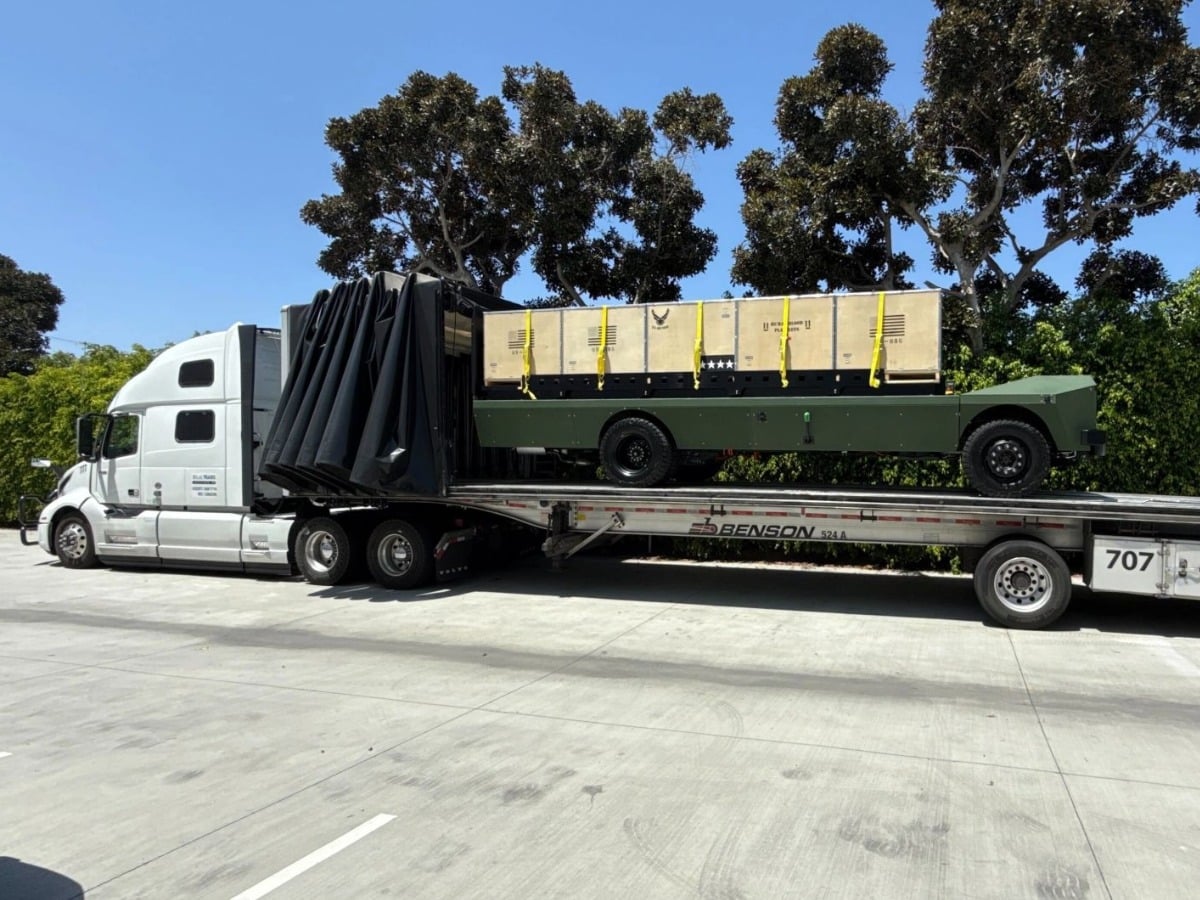
- Harbinger launched its Harbinger Praesidia defense division with an unmanned hybrid-electric vehicle platform for military logistics, communications, security, and counter-drone missions.
- In-Q-Tel made a strategic investment in Harbinger to support the company's expansion into government and defense markets; no contract values or customer names were disclosed.
An American electric truck manufacturer has launched a new defense business vertical and unveiled autonomy-ready hybrid-electric vehicles for national-security missions, backed by In-Q-Tel, the not-for-profit strategic investor serving the U.S. national security community.
Harbinger, a medium-duty commercial vehicle manufacturer, announced Harbinger Praesidia, a new defense business vertical, alongside a strategic investment from In-Q-Tel, which identifies and funds emerging commercial technologies for the U.S. national security community and its allies. In-Q-Tel has previously invested in companies including Palantir and dozens of other technology firms that went on to serve government customers, and its involvement brings institutional validation to Harbinger’s military push that a commercial automotive company would struggle to obtain through normal channels.
Harbinger Praesidia vehicles are built on the same clean-sheet medium-duty plug-in hybrid chassis the company uses for its commercial trucks, adapted for missions including resupply, troop transport, patrol, communications, and counter-drone support through autonomous and teleoperation capabilities. The platform uses a series hybrid drivetrain, meaning the gasoline engine does not drive the wheels directly but instead charges batteries and powers an electric motor that provides propulsion, generating up to 350 kilowatts (470 horsepower) of exportable electrical power to external systems. That exported power figure is significant for military users: 350 kW is enough to run sophisticated sensor arrays, communications systems, directed energy weapons, or electronic warfare equipment without requiring a separate generator vehicle. The platform also delivers approximately 48 kW of continuous power from the gasoline engine and a 15 kW onboard inverter for split-phase AC output, the kind of standard electrical supply that powers field equipment worldwide.
The vehicle’s hybrid range specification is equally notable for military logistics applications. Harbinger claims over 800 km (500 miles) of hybrid driving range in standard configuration and approximately 169 km (105 miles) of fully electric range, with the electric-only mode enabling a Stealth Mode that disables exterior lights, acoustic alerts, and the onboard generator to minimize acoustic and thermal signature during sensitive operations. The ability to approach a position quietly, run mission equipment from stored battery power without generator noise, and then depart under electric power before switching to the range-extending hybrid system addresses a combination of requirements that has historically required purpose-built military vehicles with no commercial equivalent.
The gross vehicle weight ratings range from 16,000 pounds (7,257 kg) to 26,000 pounds (11,793 kg) across three available wheelbases of 158 inches (4.0 m), 178 inches (4.5 m), and 208 inches (5.3 m), supporting customer payloads of up to 18,000 pounds (8,165 kg). That payload capacity puts the platform in the weight class of the U.S. Army’s Family of Medium Tactical Vehicles, the workhorse logistics trucks that have supported American operations for decades, though the Harbinger platform is purpose-built around electric drive architecture rather than adapted from a conventional diesel powertrain. The vehicle operates in temperatures from minus 30 degrees Celsius to 55 degrees Celsius and at altitudes up to 3,658 meters (12,000 feet), covering the environmental range from Arctic operations through high-altitude mountain warfare.
The teleoperation architecture is built around advanced mesh radios supporting unmanned control up to 5 km (3.1 miles) line-of-sight and satellite communications for beyond-line-of-sight operations. A six-camera system provides a 360-degree bird’s-eye view for operators controlling the vehicle remotely, and the drive-by-wire system, in which steering, braking, and acceleration are all controlled electronically rather than through mechanical linkages, makes the transition from crewed to remote operation seamless. That drive-by-wire architecture is the enabling technology for true autonomous readiness, since mechanical controls that require human physical input cannot be automated without complete system redesign.
Harbinger’s CEO John Harris brings a credential that will resonate with defense technology buyers who have been tracking the hardware renaissance in American defense startups. Before founding Harbinger, Harris led hardware engineering and manufacturing for Anduril’s first product, the Sentry Tower autonomous surveillance system. Anduril has become one of the most consequential new entrants in American defense technology, winning contracts across autonomous systems, counter-drone, and electronic warfare. Harris’s direct experience building the physical hardware and manufacturing infrastructure for Anduril’s first commercial product gives him credibility in defense circles that a purely commercial automotive background would not.
“The government needs robust vehicles that can support a wide range of use cases without forcing operators to compromise on payload, range, exportable power or durability,” Harris said. “Our American designed, engineered and assembled vehicles fulfill this need while supporting domestic manufacturing capacity, which is itself a national security asset. At the same time, these unmanned vehicles are engineered to help keep soldiers out of harm’s way without compromising on performance.”
Sara Jones, Principal at In-Q-Tel, framed the investment in terms of the U.S. government’s broader push to leverage commercial innovation for military use. “Harbinger’s vertically integrated vehicle platform brings together power generation, energy storage, mobility, and flexible configuration in a way that is highly extensible to emerging government and national security needs,” Jones said. “Harbinger’s combination of proven commercial vehicle technology and U.S.-based manufacturing aligns with the U.S. government’s effort to leverage cost-effective commercial innovation for military use and makes it a strong fit for IQT’s investment focus.”