

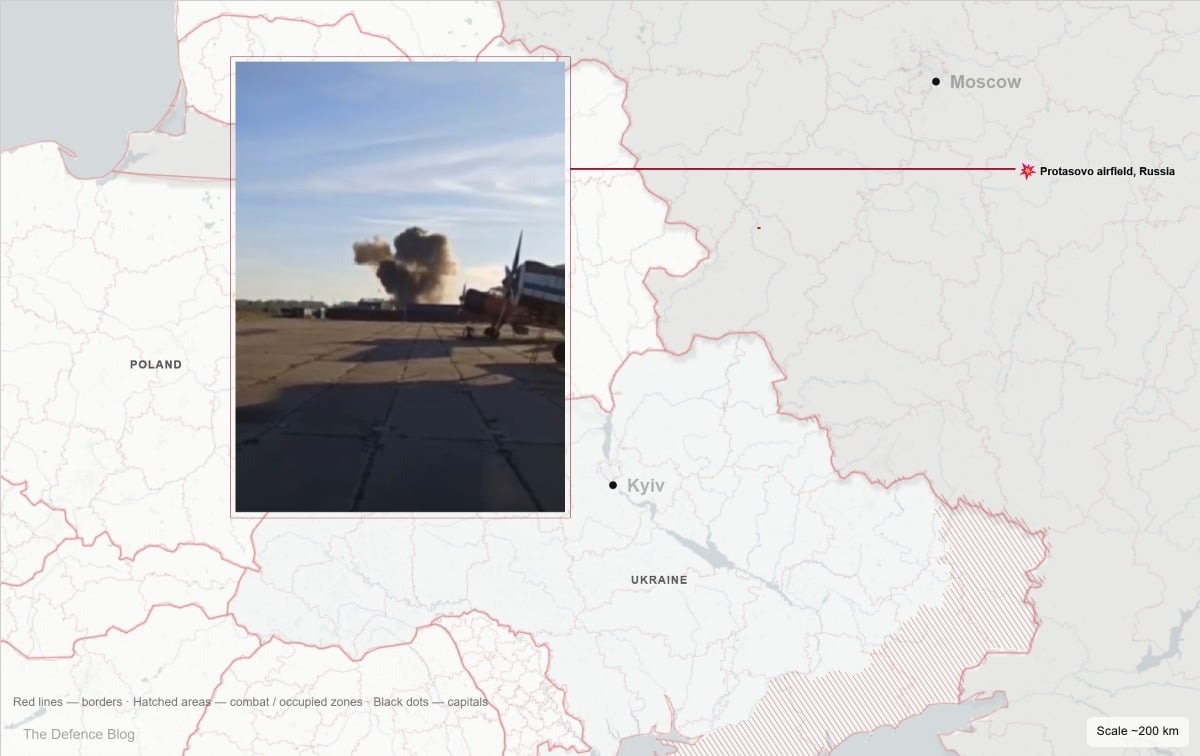
- CyberBoroshno reported that a Ukrainian FP-1 drone built by Fire Point struck hangars of a drone research and production center at Protasovo airfield in Russia's Ryazan region.
- The Protasovo facility was established in August 2023 as part of Russia's national drone production expansion strategy, confirmed by Ryazan region Deputy Governor Yulia Shvakova.
A Ukrainian strike drone flew hundreds of kilometers into Russian territory and hit the hangars of a research and production center that Russia uses to develop and manufacture its own unmanned aircraft systems, targeting the kind of facility that feeds the very drone campaign Russia has been waging against Ukrainian cities every night for years.
The strike on Protasovo airfield in Russia’s Ryazan region, approximately 180 km (112 miles) southeast of Moscow, was reported by the Ukrainian open-source intelligence community CyberBoroshno, which identified the weapon used as an FP-1 drone produced by the Ukrainian company Fire Point.
CyberBoroshno reported that the FP-1 strike drone struck the hangars of the scientific and production center for drone development and manufacture located on the grounds of Protasovo airfield. The extent of the damage caused by the strike was not confirmed from independent sources at the time of reporting, and neither Ukrainian military authorities nor the Russian regional government had issued official statements on the incident. The FP-1, developed by the Ukrainian company Fire Point, is a fixed-wing strike drone designed for medium-range precision attacks on ground targets, part of a growing family of domestically produced Ukrainian long-range strike systems that have expanded Ukraine’s ability to reach deep into Russian territory without relying on Western-supplied weapons.
The target’s significance extends well beyond a single airfield or set of hangars. Russia established the Protasovo research and production center in August 2023, with Ryazan region Deputy Governor Yulia Shvakova announcing its creation as part of Russia’s national strategy to develop drone manufacturing capacity across multiple regions. The facility represents exactly the kind of target Ukraine has been systematically pursuing since it developed the capability to strike deep inside Russia: not just the drones themselves, but the industrial and engineering infrastructure that produces them, trains the engineers who design them, and develops the next generation of systems Russia will use in future attacks.
The Ryazan region has featured in Ukraine’s long-range strike campaign multiple times. The Ryazan oil refinery, one of Russia’s significant petroleum processing facilities, caught fire during a large-scale Ukrainian drone attack in May 2026 that targeted military and energy infrastructure across multiple Russian regions simultaneously. Protasovo airfield sits in the same general geographic area, approximately 450 km (280 miles) from Ukraine’s northeastern border with Russia along Sumy Oblast, a distance that the FP-1’s long-range strike profile puts within operational reach under the right conditions and mission planning.
Ukraine’s campaign against Russian drone production facilities has been deliberate and systematic throughout 2025 and into 2026, reflecting a clear strategic logic: every Russian drone destroyed in the factory is one that never reaches Ukrainian airspace. Ukraine’s Defense Intelligence directorate struck a concealed drone assembly facility in Kaluga Oblast in March 2026, hitting production lines for Russian unmanned systems that had been hidden inside the workshops of an industrial plant. Ukraine’s General Staff confirmed a separate strike in July 2025 on the Scientific Research Institute of Applied Chemistry in Sergiev Posad in Moscow Oblast, a facility manufacturing thermobaric warheads for Shahed-type drones and described as an important link in Russia’s aerial attack infrastructure against Ukraine.
Russia’s drone industrial base has been one of the primary targets of Ukraine’s deep strike campaign because Russia’s air offensive depends on volume. Russia fired approximately 5,700 Shahed-type drones in just the first nine months of 2024, with production continuing to scale throughout 2025, and Ukraine’s Commander-in-Chief Oleksandr Syrskyi said Russia planned to produce 7.3 million FPV drones in 2026. Meeting those production targets requires a functioning network of manufacturing facilities, component suppliers, research centers, and engineering talent that Ukraine has been working to disrupt since it developed the range to reach them. A research and production center at an airfield in Ryazan that develops the next generation of Russian unmanned systems is not a peripheral target in that campaign.