

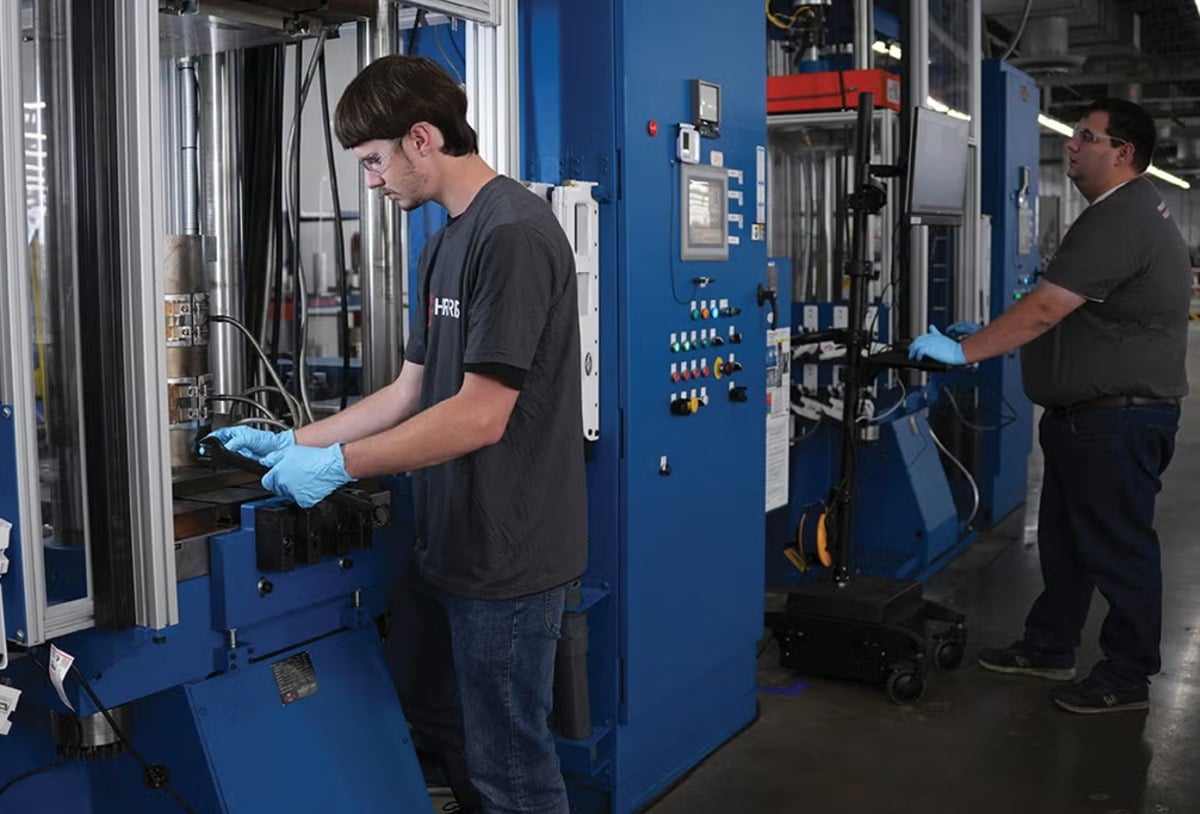
- L3Harris invested $25 million to add 130,000 square feet of manufacturing space at its AMF-South facility in Huntsville, Alabama, announced June 1, 2026.
- The expansion brings L3Harris's total Huntsville footprint to approximately 670,000 square feet across three sites, supporting more than half of its solid rocket motor programs.
L3Harris Technologies has spent $25 million adding 130,000 square feet (12,077 square meters) of manufacturing space to its solid rocket motor facility in Huntsville, Alabama, as the U.S. defense industry races to close the gap between munitions demand and production capacity.
The expansion at L3Harris’s Advanced Manufacturing Facility-South, announced June 1, 2026, pushes the company’s total footprint in Huntsville to approximately 670,000 square feet (62,243 square meters) across three sites in the city. The company tripled its capital spending in Huntsville from 2024 to 2025, and the AMF-South site now supports more than half of L3Harris’s solid rocket motor programs through inert component production, with output increasing year over year.
Solid rocket motors are the propulsion systems that power a wide range of guided munitions, from short-range air defense interceptors to long-range surface-to-surface missiles. They are among the most constrained components in the U.S. defense supply chain. Unlike electronics or even precision guidance systems, solid rocket motors require specialized facilities, tightly controlled manufacturing environments, and skilled workers with highly specific credentials to produce safely. Expanding that capacity is not a matter of ordering more parts from a supplier — it requires purpose-built infrastructure, years of investment, and a workforce trained to handle energetic materials. The bottleneck became acutely visible after 2022, when the pace of munitions consumption in Ukraine, combined with accelerating U.S. procurement commitments across multiple missile programs, exposed how thin the industrial margin actually was.
“The additional space allows us to lean forward and surge capacity in a way that directly aligns with the Department of War’s demand for critical munition acceleration,” said Ken Bedingfield, President of Missile Solutions at L3Harris. “Huntsville’s expansion at AMF-South gives us the flexibility we need to grow quickly and continue delivering for our customers.”
The Department of War has been pressing prime contractors and their supply chains to compress production timelines across multiple guided weapons programs, driven partly by lessons from Ukraine and partly by planning scenarios that envision a high-intensity conflict consuming munitions at rates that current stockpiles and production lines cannot sustain. Solid rocket motors sit near the top of that constraint list because they underpin so many different weapons simultaneously. The same Aerojet Rocketdyne and Northrop Grumman facilities that produce motors for Patriot interceptors also supply components feeding into HIMARS rockets, Javelin missiles, and a range of air-launched weapons. L3Harris, which entered the solid rocket motor business through its acquisition of Aerojet Rocketdyne’s L3Harris Propulsion Systems operations, has been positioning itself as a significant player in that constrained supply chain.
The AMF-South expansion takes advantage of existing infrastructure at the site, allowing L3Harris to add floor space without the lead time that building a greenfield facility would require. That approach, using space that already carries the necessary utilities, safety systems, and regulatory certifications for handling propulsion components, is how the company says it can scale rapidly rather than on the multi-year timelines that new construction typically demands. The 130,000 square feet added in this expansion is roughly equivalent to three American football fields of production floor, providing room to add assembly lines, testing stations, and storage for materials and finished components that the existing footprint could not accommodate.
Huntsville’s role as a hub for this expansion is not coincidental. The city has been the center of U.S. missile and rocket development since the Army brought Wernher von Braun and his team there in 1950, establishing Redstone Arsenal as the birthplace of American ballistic missile and space rocket programs. Today the Huntsville area hosts Redstone Arsenal, the Army’s Aviation and Missile Command, NASA’s Marshall Space Flight Center, and the manufacturing operations of virtually every major U.S. missile prime contractor, creating a concentration of specialized workforce, regulatory familiarity, and supply chain infrastructure that makes it the natural location for this kind of expansion. L3Harris is actively hiring at AMF-South to fill the positions the new space requires, including mechanical and manufacturing engineers, project engineers, quality specialists, machinists, and composite technicians, the last of which are particularly critical given that modern rocket motor casings and nozzle components rely heavily on advanced composite materials.
The scale of L3Harris’s Huntsville investment reflects a broader shift in how the U.S. defense industrial base is approaching capacity. For most of the post-Cold War period, defense manufacturers optimized for efficiency over surge capacity, running lean inventories and just-in-time production models that worked well in a low-threat, steady-state procurement environment. The wars in Ukraine and the shifting strategic calculus in the Indo-Pacific have made clear that model carries significant risk when demand spikes suddenly. The current push to expand solid rocket motor production, across L3Harris, Northrop Grumman, and others, represents a deliberate effort to rebuild the industrial buffer that decades of efficiency-focused contracting eroded.