


Russian defense enterprise Koncern Granit has introduced a new twin-engine reconnaissance unmanned aerial vehicle (UAV) designated Os-25-R, designed for optical-electronic intelligence missions at tactical depth.
The company says the drone’s structure is produced using domestic materials and technologies that allow rapid manufacturing and high durability.
According to Granit, the Os-25-R belongs to the same class as the Orlan-30 and features a takeoff weight of 29 kilograms with a payload capacity of up to 8 kilograms. The system is intended for “operational-tactical optical-electronic reconnaissance at a depth of 80 to 130 kilometers,” the company said.
The aircraft’s fuselage spans 3.6 meters, extendable to 4.12 meters with additional wing inserts. It has a cruise speed of 70–90 km/h, a maximum flight speed of 160 km/h, and can remain airborne for up to 4.5 hours. The stated operational ceiling is 5,500 meters, with a range of up to 300 kilometers. Granit’s data also lists wind resistance of up to 18 meters per second, and operation supported by electric engines.
Granit says the Os-25-R can be launched by hand or with a catapult and recovered conventionally by landing on its fuselage.
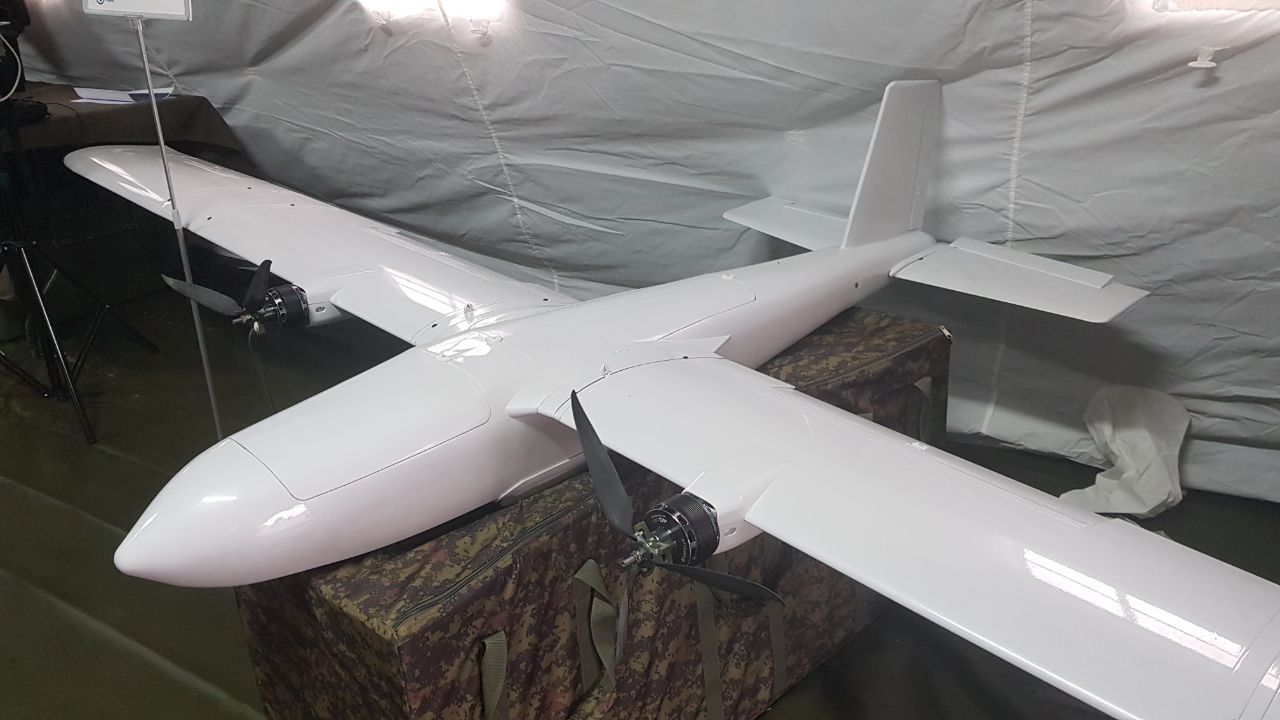
The drone is equipped with satellite navigation and an autonomous inertial system to maintain orientation even in the presence of electronic interference. The manufacturer notes that “the UAV is produced using unique technology that allows manufacturing of the airframe entirely from domestic materials.”
The main mission of the Os-25-R, as stated by Granit, is tactical reconnaissance and target designation. The drone can carry a turreted multispectral television and thermal imaging module with long-focus optics and a laser targeting system compatible with tactical missiles such as the Kh-38ML. This configuration allows the platform to detect, track, and designate ground targets for precision strikes.
The company also reports that the UAV can be fitted with communication relay terminals to ensure secure tactical data exchange between units operating in dispersed formations. To counter electronic warfare threats, the system uses GLONASS navigation modules based on CRPA antennas, which protect satellite signals from jamming and interference.
According to Granit’s documentation, the Os-25-R can be customized to customer requirements, equipped with high-resolution cameras, LIDARs, thermal imagers, or infrared sensors. The drone’s modular design allows field assembly in as little as five minutes and disassembly within fifteen minutes, depending on the configuration.
The drone’s lightweight airframe and moderate payload capacity position it as a flexible system for front-line intelligence and battlefield support. The combination of long-endurance flight, multispectral reconnaissance equipment, and laser designation capability suggests that Granit designed the Os-25-R to operate both as a surveillance platform and a target-acquisition asset within Russia’s expanding UAV fleet.