

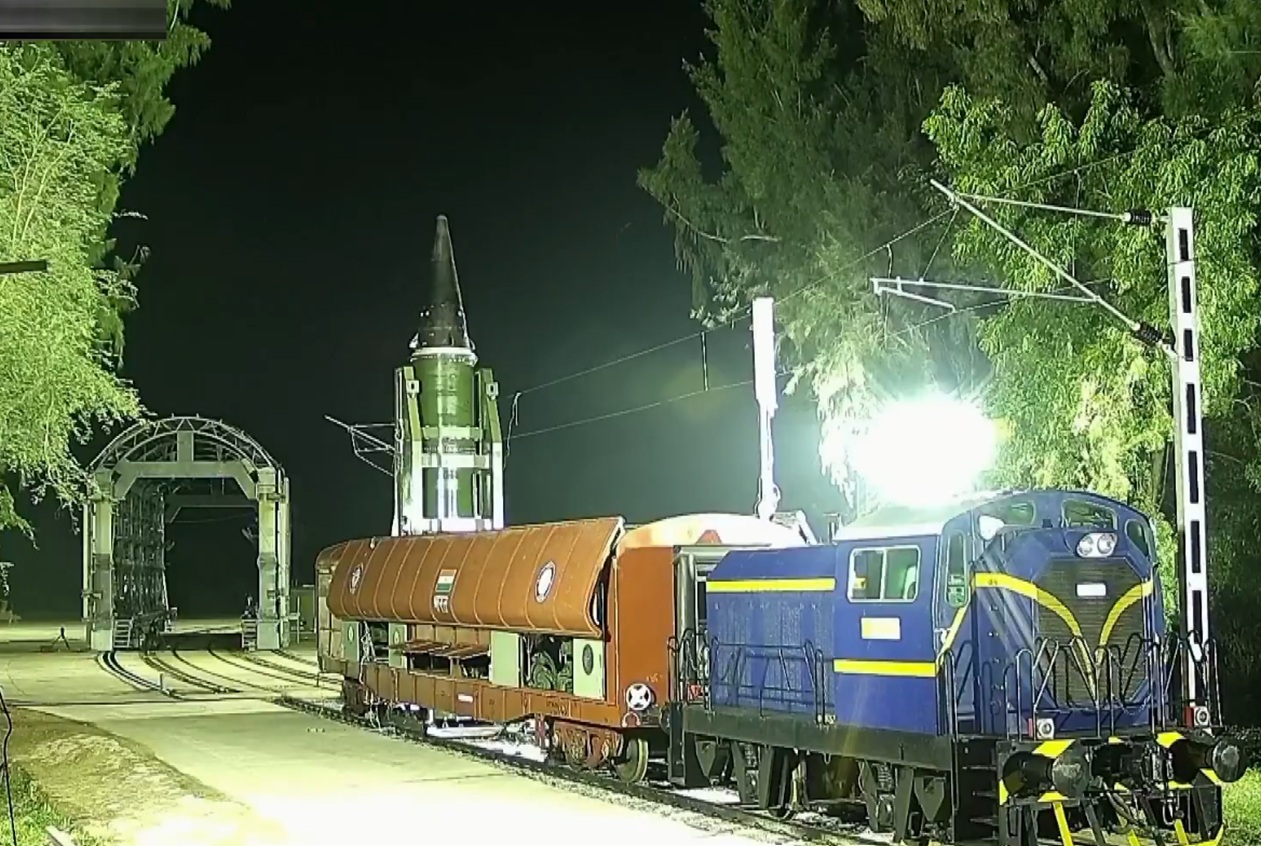
India has successfully test-fired a rail-launched ballistic missile for the first time, placing it among a small group of nations capable of deploying nuclear-capable weapons from mobile train-based platforms.
Defence Minister Rajnath Singh announced the breakthrough early Thursday on X, sharing footage of the dramatic launch and calling the test a milestone for India’s strategic capabilities.
The missile tested was the Agni Prime — an intermediate-range, nuclear-capable ballistic missile with a range of 2,000 kilometers — fired from a launch bed mounted on an Indian Railways locomotive.
While a weapons test is routine for a country with a broad missile arsenal like India, the Ministry of Defence emphasized that this was no ordinary trial. The launch demonstrated India’s ability to integrate advanced missile systems with rail mobility, a capability previously demonstrated only by Russia, the United States, and China.
“… the first-of-its-kind launch was carried out from a specially-designed, rail-based mobile launcher,” Singh said. He added that the system “has the capability to move on the rail network without pre-conditions (and) that allows shorter reaction time and cross-country mobility.”
The mobile platform expands India’s strategic options by enabling rapid, concealed deployment of ballistic missiles over long distances via its vast rail network. Such mobility greatly enhances survivability in the event of a preemptive strike, complicating adversary targeting and strengthening second-strike capability — a key pillar of nuclear deterrence strategy.
In a statement, the Ministry of Defence said the test “put India in a group of select nations that have developed canisterised-launch systems from on-the-move rail networks.” The successful trial also demonstrates progress in India’s efforts to diversify its strategic delivery platforms beyond traditional road- and silo-based launchers.
Rail-based launch systems were first developed during the Cold War by the Soviet Union and later by the United States, which sought to increase the survivability of their nuclear arsenals by deploying them on highly mobile, difficult-to-detect platforms. China has since developed similar capabilities, and North Korea claimed in 2021 to have launched a missile from a railway-borne system, though those claims remain unverified.
The Agni Prime represents the latest evolution in India’s ballistic missile family. Designed to be lighter and more accurate than previous versions, the missile can carry nuclear or conventional payloads and is part of New Delhi’s broader strategy to modernize its deterrent capabilities.
Analysts say the successful rail-based launch demonstrates India’s ability to adapt its strategic forces to the realities of 21st-century conflict, where mobility, flexibility, and concealment are increasingly vital. It also reflects a growing emphasis on survivable deterrent systems amid evolving regional security dynamics, particularly with China’s expanding missile forces and Pakistan’s continued modernization of its strategic arsenal.
The integration of rail mobility into India’s missile program could also enable the rapid repositioning of launch systems during crises, extending their reach and complicating enemy defense planning. By leveraging its extensive rail infrastructure, India can deploy missile launchers deep into its interior or closer to operational theaters, maintaining strategic ambiguity about launch locations.