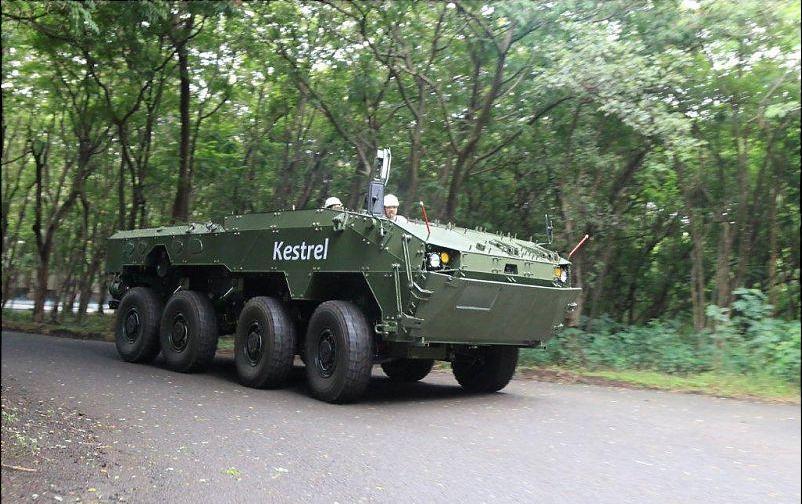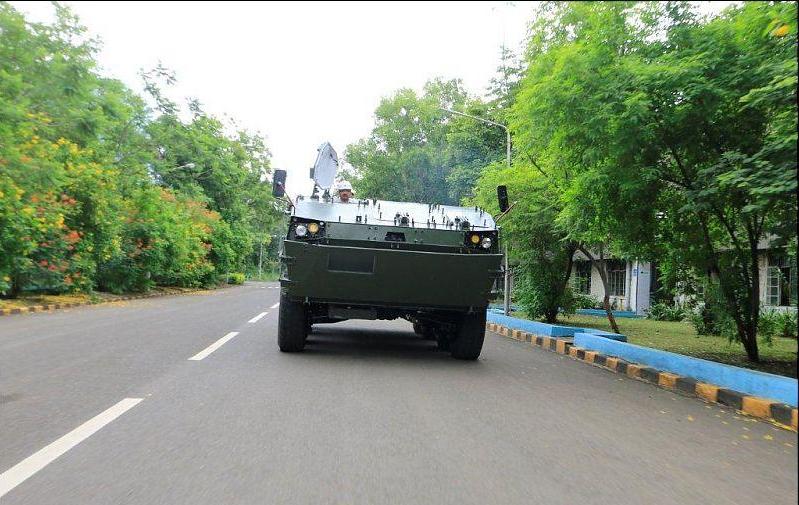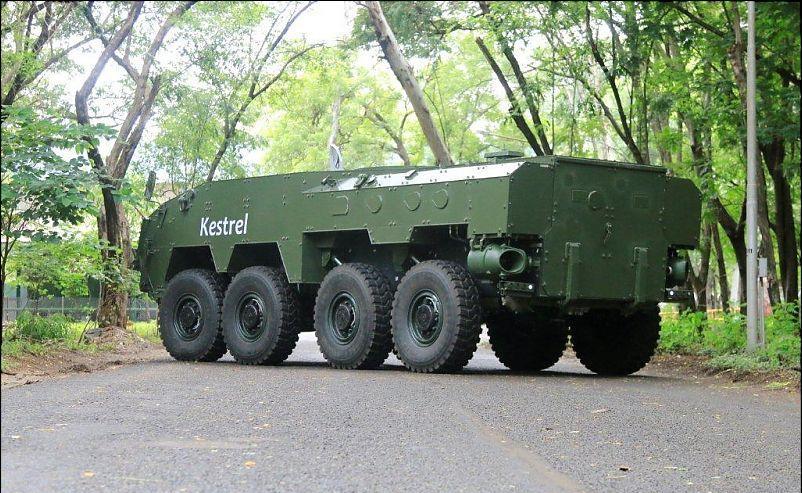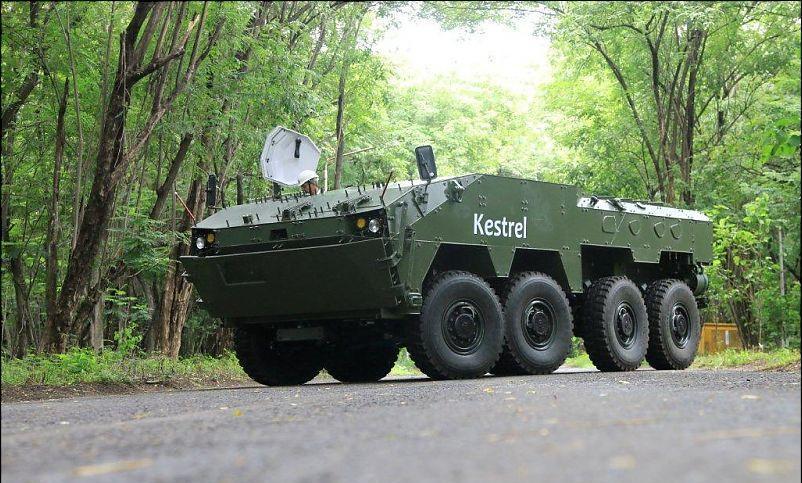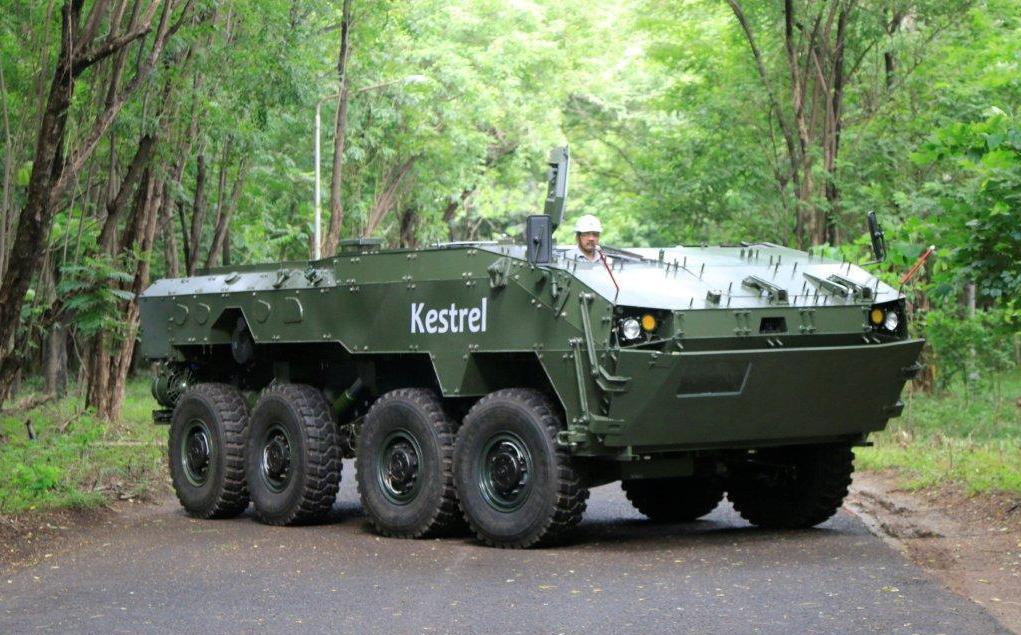
The «Kestrel» wheeled armoured amphibious platform designed Tata Motors.
The Kestrel has a scalable 22.5 ton to 26 ton gross vehicle weight and can carry 10+2 people inside. The design includes a front left engine placement that enables better space utilization.
The vehicle has an 8×8 under chassis driveline with a double wishbone type independent hydro pneumatic suspension, with the front two axles being steerable.
The Kestrel has a turning radius of 19 metres and the tyres have the run flat capability, with the central tyre inflation system (CTIS) coming as standard.
The Kestrel’s ballistic protection has been designed to protect the occupants from threat levels ranging from Stanag I to Stanag IV, depending on the application. The monocoque comprises of a welded armour steel hull with applique and inner composite spall liner. The protection modules can be replaced in a short time frame to increase or decrease the protection level. The bottom of the hull is guarded by blast protection up to Stanag III. The seats are designed to reduce the impact of any external force, providing additional protection.
A complete NBC (nuclear, biological, chemical) protection system ensures safety for the crew from any kind of NBC threats, ensuring the ability to operate even in contaminated areas. The driver & commander have their own roof hatches for ingress / egress. The rear personnel compartment is accessible through the rear door and roof hatches.
The Kestrel is capable of carrying a 30 mm remote weapon station with 2 fire and forget missiles or with the turret-mounted cannon and missiles. In addition, the vehicle will house one 7.62 mm co-axial MMG and an automatic grenade launcher.
The Kestrel measure 7.8 metres in length, 2.95 metres in width, and 2.28 metres in height, with a ground clearance of 0.45 metres. The engine produces 600 horsepower, enabling the vehicle to hit a top speed of 100 km/h on land and 10 km/h in amphibious conditions.